



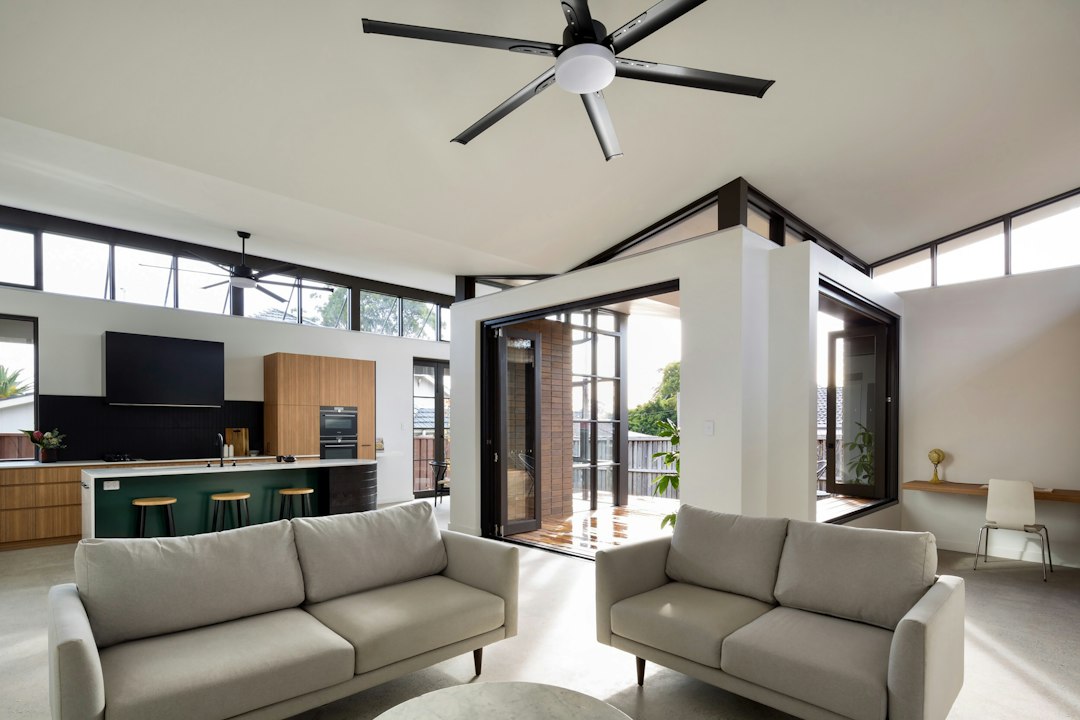
To set your ceiling fan for winter, turn it off, wait for the blades to stop, flip the reversing switch so the fan spins clockwise when viewed from below, and run it on low speed. The change takes about two minutes and, according to fan makers, helps push warm air trapped near the ceiling back down into the room.
With furnaces about to run for months across most of the country, it is a small step worth doing now. Warm air rises, so in rooms with high or vaulted ceilings the heat tends to collect overhead while the floor stays cooler. Hunter Fan says a fan running clockwise on low speed creates a gentle updraft that moves that warm air back into the living space, which can help your thermostat sense the warmth and let your furnace run less. Another fan maker, Kua, claims running ceiling fans in winter can cut heating costs by as much as 10 per cent. That figure comes from the company, not an independent study, so treat it as a best case rather than a promise.
The job involves no wiring. If your fan has no reversing switch, or you would need to climb or stretch to reach it, read the safety notes at the end before going further.
- Check which way the fan is spinning now. Turn the fan on low and stand under it. Look up at the blades. For winter, they should travel clockwise. In summer they should travel counterclockwise at a higher speed to create a breeze. If the blades already turn clockwise, you are done.
- Turn the fan off and let it stop completely. Both Hunter Fan and Kua stress this step. Never flip the direction while the blades are still spinning.
- Find the reversing switch. On a pull-chain fan it is usually a small slide switch on the fan body, near the motor housing or the light fixture, close to the pull cords. Some fans have the switch on a handheld remote or a wall control instead.
- Move the switch to the opposite position. If it was in one position, slide it to the other. On a remote-controlled fan, Hunter Fan says to press and hold the fan button on the handheld remote until the light on the remote blinks. Smart fans can usually be reversed through their app or a voice assistant.
- Restart the fan on low speed. Winter operation should be low. A fast fan in a cold season creates a draught and defeats the purpose.
- Confirm the airflow. Stand directly under the fan. Hunter Fan says you should feel little direct airflow when the setting is right for winter. If you feel a strong breeze, the fan is likely still in its summer setting or running too fast.
- Check again in spring. Reverse the switch to counterclockwise when the weather warms up so the fan cools the room as intended.
A few safety notes. If the switch is out of easy reach, use a sturdy step stool placed on a flat, dry floor, and ask someone to steady it. Do not use a chair or stand on furniture. Make sure the fan has fully stopped and keep your hands clear of the blades. If you cannot reach the switch safely, a remote or a helper is a better option than stretching.
Some fans, particularly older or budget models, have no reverse function. Do not try to rewire a fan or open its housing to add one. Electrical work on fixtures should be done by a licensed electrician, who can also tell you whether your fan can be replaced with a reversible model. If the fan wobbles, hums loudly or the switch does not seem to do anything, check the manufacturer’s manual or contact the maker rather than forcing it.
This habit works best in rooms where people spend time, such as living rooms and bedrooms, and in homes with higher ceilings, where warm air has further to rise. In a room with a standard eight-foot ceiling the effect is smaller. As always, keep the fan on low and turn it off when the room is empty.
For more control over home heating, our guide to the best smart thermostats on Amazon.ca for winter compares models that can schedule temperature changes.
If you find reporting like this useful, consider supporting Canada News Media, an independent Canadian newsroom with no corporate parent.
Sources: Hunter Fan, ceiling fan direction for summer and winter; Kua, switch your ceiling fan’s spin direction to warm your home in the winter. No Canadian government source was found for this topic; heating savings figures are manufacturer claims.
Follow Canada News Media
Get the day's top Canadian stories and our two daily 60-second news videos wherever you scroll.
X Threads Facebook Instagram LinkedIn TikTok YouTube Pinterest Reddit Substack Flipboard Newsletter RSS