

Maurice Duplessis, the premier who dominated Quebec politics for the better part of two decades, died on Sept. 7, 1959, in Schefferville, a remote iron-mining town in the province’s north that he had named himself only a few years earlier.
He was 69, and he died in office. According to the Dictionary of Canadian Biography, Duplessis had travelled to the region to tour the iron operations of the Iron Ore Company of Canada, the consortium whose railway and company town had opened the Quebec-Labrador ore field to industrial extraction. He suffered a cerebral hemorrhage there on Sept. 2 that left him paralysed on his right side, according to accounts of the trip, and further strokes followed over the next several days. He never recovered.
The setting was, in retrospect, almost too neat. Schefferville existed because of the policy Duplessis was best known for and most criticized for, opening Quebec’s resource frontier to private and largely foreign capital on terms his opponents considered far too generous to the companies. The Canadian Encyclopedia notes the town was named by Duplessis himself in honour of Monseigneur Lionel Scheffer, the first bishop of Labrador, and that the first ore shipment reached Sept-Iles by rail in 1954. He died in the place his own economic program had built.
Duplessis led Quebec from 1936 to 1939 and again from 1944 until his death, a run of roughly 18 years in office at the head of the Union Nationale, the party he founded. His government married a defensive provincial nationalism to the institutional authority of the Roman Catholic Church and to industrial development financed from outside the province. It also earned a reputation for patronage, for hostility to organized labour and for the blunt use of state power against dissenters, a record that produced the label later attached to the period, la Grande Noirceur, the Great Darkness.
That label has not gone unchallenged. The Canadian Encyclopedia notes that later historians have substantially complicated the picture, pointing out that Quebec continued to industrialize, urbanize and build infrastructure through the Duplessis years, and that significant social, intellectual and cultural currents were already running well before 1960. The tidy contrast between a dark Duplessis era and an enlightened Quiet Revolution, on this reading, is partly a story Quebec told about itself afterward.
What is not in dispute is how quickly things moved once he was gone. Paul Sauvé, his longtime lieutenant, was sworn in as premier within days and adopted a one-word watchword, “Désormais,” meaning “from now on.” In the stretch since remembered as the Hundred Days, Sauvé opened a broad review of files the Duplessis government had left untouched, and some historians credit him rather than his Liberal successors with beginning the Quiet Revolution. He died on Jan. 2, 1960, after roughly 100 days in the job. Jean Lesage’s Liberals took the province that June, and the reforms that followed reshaped Quebec’s schools, hospitals, hydroelectric sector and civil service inside a decade.
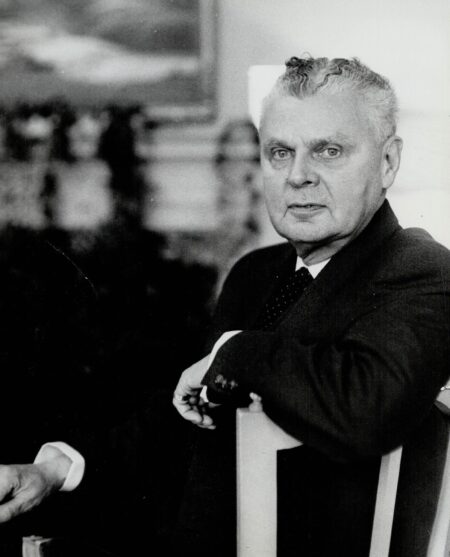
Duplessis’s state funeral drew, among others, Prime Minister John Diefenbaker, a longtime political rival.
Sources differ on the precise hour of the death, with some accounts placing it just after midnight and others simply in the early hours of that morning. The date itself is consistent across the Dictionary of Canadian Biography, the Canadian Encyclopedia and contemporary accounts.
Schefferville outlived him by little more than two decades as a company town. The Iron Ore Company of Canada shut the mine in 1982 and the settlement largely emptied, though the Naskapi and Innu communities nearby remain. The premier who named it is buried far to the south, in his native Trois-Rivières, and the province he governed for 18 years was, within a year of his death, already becoming a place he would not have recognized.
Sources: Dictionary of Canadian Biography, “DUPLESSIS, MAURICE LE NOBLET” (biographi.ca/en/bio/8426); The Canadian Encyclopedia, “Schefferville,” “La Grande Noirceur” and “Iron Ore Company of Canada”; Alloprof, Maurice Duplessis biography. A commonly repeated “one cent a ton” iron-ore royalty criticism could not be verified and has been left out.
Follow Canada News Media
Get the day's top Canadian stories and our two daily 60-second news videos wherever you scroll.
X Threads Facebook Instagram LinkedIn TikTok YouTube Pinterest Reddit Substack Flipboard Newsletter RSS