

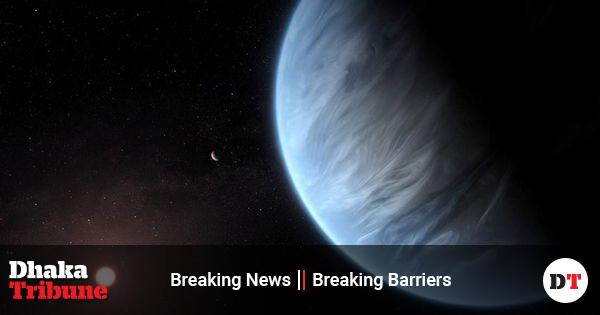

An artist’s impression released by NASA on September 11, 2019 shows the planet K2-18b, its host star and an accompanying planet Reuters
The exoplanet K2-18b might have liquid water underneath the hydrogen-rich atmosphere on its surface
A planet twice the size of Earth may be habitable, say scientists, opening up new possibilities in the search for alien life, reports The Independent.
The exoplanet K2-18b might have liquid water underneath the hydrogen-rich atmosphere on its surface.
Researchers looked at the mass, radius and atmospheric data of the distant exoplanet and used models to find the water.
K2-18b is 124 lightyears away, relatively close by in terms of exoplanets. It is also quite similar to Earth, with a radius 2.6 times as big as our planet’s and a mass 8.6 times as big.
The research suggests that life could flourish on worlds bigger than Earth but smaller than Neptune, just like K2-18b.
The exoplanet is also already somewhat famous. It was discovered in 2017, prompting frenzied speculation about what conditions might be like there.
It was the subject of even more excitement towards the end of last year, when it became the first other planet discovered to have water vapour in its atmosphere.
The latest study gives a look at what conditions could be like underneath that atmosphere. And it suggests life could be supported in just the way scientists had hoped.
Dr Nikku Madhusudhan from Cambridge’s Institute of Astronomy, who led the study, said: “Water vapour has been detected in the atmospheres of a number of exoplanets but, even if the planet is in the habitable zone, that doesn’t necessarily mean there are habitable conditions on the surface.
“To establish the prospects for habitability, it is important to obtain a unified understanding of the interior and atmospheric conditions on the planet – in particular, whether liquid water can exist beneath the atmosphere.”
Because of the size of K2-18b, some suggest it would be more like a smaller version of Neptune than a larger version of Earth.
It is thought a mini-Neptune would have a significant hydrogen envelope surrounding a layer of high-pressure water, with an inner core of rock and iron.
If this envelope is too thick, it would be too hot, and pressure at the surface of the water layer beneath would be far too great to support life.
According to the study published in The Astrophysical Journal Letters, despite the size of K2-18b, its hydrogen envelope is not necessarily too thick and the water layer could support life.