


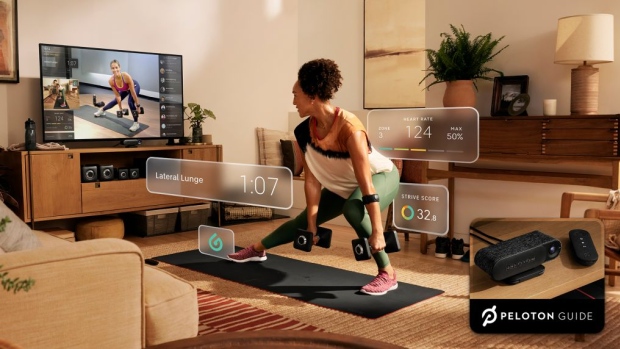

(Bloomberg) — Peloton Interactive Inc., known for its stationary bikes, launched its first strength training device to expand beyond cardio: a $495 TV set-top-box with a camera that guides users through exercises.
The Peloton Guide device allows users to access a video library of strength training classes from their TV and uses a two-dimensional, wide-angle camera and artificial intelligence technology to analyze and provide feedback on the workout. Users can exercise with their own equipment and weights.
Peloton is bringing out the product just days after lowering its fiscal 2022 revenue forecast by as much as $1 billion, hurt by people returning to offices and gyms following pandemic-induced lockdowns. That threw the company’s stock into a tizzy, leading to a decline of about 40% since it gave the forecast on Thursday. During its earnings call that day, Peloton hinted at new products that could help lift the company in future quarters.
The device offers three main features driven by the on-board camera: the movement tracker, self-mode, and body activity mode.
The movement tracker feature uses the camera to determine if the user is doing an exercise such as a dumbbell curl or plank correctly. Self-mode analyzes a user’s form during a workout and compares that to the on-screen instructor. The body activity mode will analyze which muscles a user worked out and recommend further exercises.
The Guide works with a new arm-worn heart rate monitor to measure intensity and how long a user remains in various heart rate zones. The new monitor differs from the company’s chest-worn strap and includes an improved sensor.
The Peloton Heart Rate band will also be sold as a standalone accessory next year for use with Peloton’s bikes, treadmills, and the digital app for the iPhone and Android devices. The company didn’t say how much the band, which Bloomberg News reported on previously, would cost on its own.
The Guide can be controlled both via voice and an included hardware remote. The voice assistant was developed through a combination of in-house technology, the acqui-hire of voice tech company Aiqudo, and some technology from a third-party vendor, Peloton co-founder Tom Cortese said in an interview. He hinted that the voice control feature would eventually expand to bikes and treadmills.
As some users question the privacy of in-home devices, Peloton said the Guide has physical switches to disable both the camera and microphones, as is now standard in many of the latest smart speakers from other technology companies.
Cortese said more people train for strength at home than for cardio. Strength training also is Peloton’s fastest growing content sector, which led to the development of a dedicated hardware product, Cortese said. The Guide “will be the start for us as we enter a very big opportunity,” he said.
Falling hardware sales — down 17% to $501 million last quarter — has been a drag on Peloton’s revenue growth, but it’s betting on the Guide to reverse the trend. Cortese said strength training and cardio make up the two halves of the company’s overall fitness opportunity and some consumers will want devices from both categories.
The Guide is Peloton’s most “accessible” product in terms of price, Cortese said. The device is a third of the cost of its cheapest bike and goes on sale in early 2022 in the U.S. and Canada. It will arrive later next year in the U.K., Australia, and Germany.
In addition to hardware sales, the product could boost subscription revenue. To access the device’s key features and content library users will need to pay a $12.99 monthly fee. That is waived for existing users who subscribe to Peloton workouts on its bikes and treadmills.
The Guide will rival the Tonal, a far pricier training device with a large display and built-in strength equipment. The Peloton device also joins a growing array of set-top boxes, but is one of the few focused entirely on strength training.
Amazon.com Inc. and Apple Inc. offer more traditional set-top-boxes, with the iPhone maker’s now including access to its own Fitness+ service. Meta Platforms Inc. offers a device for video conferencing. Peloton’s new product doesn’t have additional features beyond those for fitness.
©2021 Bloomberg L.P.