


Statistics Canada has published the final edition of the quarterly survey that has served since 2020 as Ottawa’s clearest window into how Canadian businesses are using artificial intelligence, and the agency has not said what, if anything, will replace it.
The Canadian Survey on Business Conditions, released Aug. 31, found that 25.2 per cent of Canadian businesses now plan to use AI over the next 12 months, up from 14.5 per cent a year earlier and more than double the 10.6 per cent recorded two years ago, Statistics Canada reported. The share of businesses with no plans to adopt AI fell to 52.7 per cent from 66.7 per cent last year and 71.8 per cent in 2024, a drop of more than 19 percentage points in two years, according to the release, first reported by Digital Journal on Sept. 1.
Among businesses still holding out, 79.1 per cent told Statistics Canada that AI simply is not relevant to what they make or sell. Privacy or security concerns accounted for 10.8 per cent, and 9.9 per cent cited a lack of knowledge about the technology’s capabilities. Separately, 2.7 per cent of businesses reported the theft of sensitive business data over the preceding year, with manufacturers hit hardest at 5.7 per cent. About half of the businesses that experienced a breach said it cost them money, disrupted operations or drove up their security spending.
Statistics Canada described the release as the last in a series that has run since 2020, without saying why the survey is ending or what will take its place.
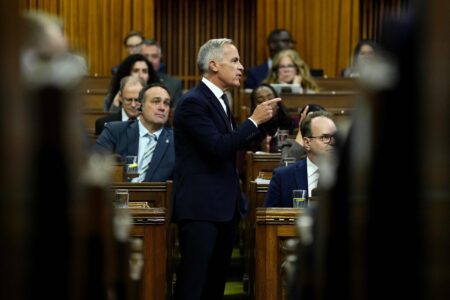
The timing is awkward for Ottawa. On June 4, Prime Minister Mark Carney launched AI for All, a national strategy built around more than $3.5 billion in committed and new spending, with a stated goal of pushing business AI adoption from roughly 12 per cent to 60 per cent by 2034, according to the Prime Minister’s Office. Two of its central tools are aimed squarely at the barriers Statistics Canada has spent two years documenting: the Business Development Bank of Canada’s $500-million LIFT program offers loans at rates as low as 2.25 per cent to help smaller firms buy AI tools, addressing the cost concerns that showed up repeatedly in the agency’s surveys, while a separate $500-million regional initiative and funding through the National Research Council’s Industrial Research Assistance Program target the same adoption gap sector by sector.
Those programs have been running for barely three months. The survey that would have shown, quarter after quarter, whether they were actually moving the needle no longer exists. The stakes are not small: CBC News reported in June that even the headline size of the AI for All package is contested, with government figures blending new spending and existing federal programs in a way that puts the strategy’s real value anywhere from about $2 billion to roughly $8 billion, a range BetaKit separately pegged at closer to $2.3 billion in genuinely new money.
The gap will be felt almost immediately. Canada’s largest AI event, ALL IN, returns to Montreal’s Palais des congrès Sept. 16-17, drawing more than 6,500 founders, investors and executives to a conference organizers and attendees say has shifted from broad pitches toward deployment and budget decisions. Without the quarterly survey, officials heading into that room will have to rely on private polling, such as a BDO Canada survey of 520 business leaders conducted in June, or on the government’s own program data, rather than a consistent, economy-wide measure of whether the roughly half of Canadian businesses still on the sidelines are actually moving.
Statistics Canada thanked the businesses that took part in the survey since 2020 for helping the agency understand the environment they operate in. It offered no timeline for a replacement.
via Digital Journal and Statistics Canada. Original reporting: digitaljournal.com/article/half-of-canadian-businesses-arent-buying-the-ai-story and Statistics Canada, The Daily
Follow Canada News Media
Get the day's top Canadian stories and our two daily 60-second news videos wherever you scroll.
X Threads Facebook Instagram LinkedIn TikTok YouTube Pinterest Reddit Substack Flipboard Newsletter RSS