

The “Freedom Convoy,” which has paralyzed the nation’s capital for more than a week, could eventually be a political gift for Prime Minister Justin Trudeau, say some political insiders, but others warn the rise in “disruption politics” could turn into an “Occupy Parliament Hill movement” and become a major headache for the prime minister and the government.
“Trudeau knows that these guys aren’t going to stay there forever,” said Darrell Bricker, CEO of Ipsos Public Affairs, in a Feb. 1 interview. “There’s a time limit on this: I mean, the two things that they did that were silly, was they did it on a weekend when none of the Ottawa press gallery is there, and Ottawa’s downtown is shut down pretty much anyway. And the second thing they did was they picked one of the coldest periods that we’re going to get this winter to do it, with another big snowstorm on the way. So, I’d say time and the weather are on Trudeau’s side.”
 For more than a week, hundreds of protesters, including some truckers, dubbing themselves the “Freedom Convoy 2022” have been protesting in downtown Ottawa against vaccines mandates. Some of them are anti-vaxxers, others are protesting against what they interpret as government infringing on their liberties by making vaccines mandatory to cross the Canada-U.S. border. Many of them are protesting the Liberal government in general, expressing particular disdain for the prime minister himself. On the weekend, there were an estimated 5,000 protesters in Ottawa.
These protests started in reaction to an existing vaccine mandate for all who wanted to cross the border from the United States into Canada. Previously, truckers had been given an exemption from this requirement. On Jan. 15, that exemption was no more, and all truckers entering into Canada from the United States now need to be vaccinated in order to avoid a 14-day quarantine. The announcement that this was happening was made in November.
Trucking is the No. 1 occupation amongst Canadian men, and according to Statistics Canada, employs 303,000 men in the country. Most Canadian truckers are vaccinated and many have denounced the demonstration.
The protests started in Ottawa on the last weekend of January when the temperatures were hitting below 20 degrees Celsius before the windchill factor. Considering the frigid cold weather and that many of these protesters must be missing work, it remains to be seen how long this can continue.

Thousands of protesters have blocked downtown Ottawa against the government’s COVID-19 mandate. The Hill Times photograph by Andrew Meade
According to a recent poll, the demonstration is not supported by Canadians. An Abacus Data poll released on Feb. 3 suggested that 68 per cent said that they have “very little in common with how the protesters in Ottawa see things,” and 32 per cent said they “have a lot in common.”
The same poll also suggested that 57 per cent of the respondents said that the protest came off as “offensive and inappropriate,” compared to 43 per cent who described it as “respectful and appropriate.”
According to Health Canada, about 80 per cent of Canadians are fully vaccinated and an overwhelming majority of the population is in support of vaccination against COVID-19.
The federal Liberals used this wedge successfully against the Conservatives in the last federal election which paved the way for them to win another minority government. Even still, a number of Conservative MPs are supporting the demonstration and some Saskatchewan MPs, including caucus chair Kevin Waugh (Saskatoon Grasswood, Sask.) and former party leader Andrew Scheer (Regina-Qu’Appelle, Sask.), took pictures with the trucks last week.
Soon after the demonstration started on Saturday, Jan. 29, complaints emerged about some protesters desecrating national monuments, stealing food from a homeless shelter and some also hurling death threats at Trudeau.
Some also used Nazi symbols on protest signs and waved Nazi flags, in addition to the more common signs bearing divisive and inflammatory rhetoric against the prime minister and the Liberal government.
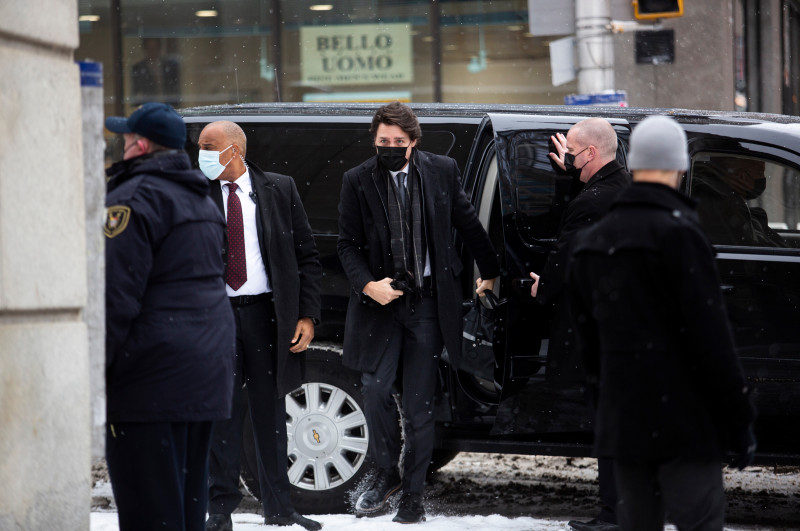
In a press conference last week, Trudeau (Papineau, Que.) doubled down and vowed not to back down from his vaccine policy.
“I want to be very clear: we are not intimidated by those who hurl abuse at small business workers and steal food from the homeless,” Trudeau said about the protesters on Jan. 31. “We won’t give in to those who fly racist flags. We won’t cave to those who engage in vandalism, or dishonour the memory of our veterans.”
Trudeau encouraged those protesters who disagreed with the divisive tactics of the protesters to distance themselves or speak up against those who had infiltrated their movement.
“To anyone who joined the convoy but is rightly uncomfortable with the symbols of hatred and division on display: join with your fellow Canadians, be courageous, and speak out,” Trudeau said. “Do not stand for, or with, intolerance and hate.”
In the House of Commons, Trudeau said on Feb. 2, that the government was working with law enforcement agencies to put an end to the protest which was becoming “illegal.”
Ottawa Police Chief Peter Sloly did not rule out the possibility of seeking support from the military to deal with this situation.
Meanwhile, Bricker said the situation is especially tricky for the Conservatives. Erin O’Toole (Durham, Ont.), who was dumped by his caucus last week as leader, was trying to balance between his base, which is largely located in Western Canada, and the suburban swing voters, a key demographic which the party needs to win elections. So far, the party has been unsuccessful, he said. This delicate balance requires Conservatives to not let their base move to the populist People’s Party of Canada or some other right-of-centre party like the Maverick Party, Bricker added.
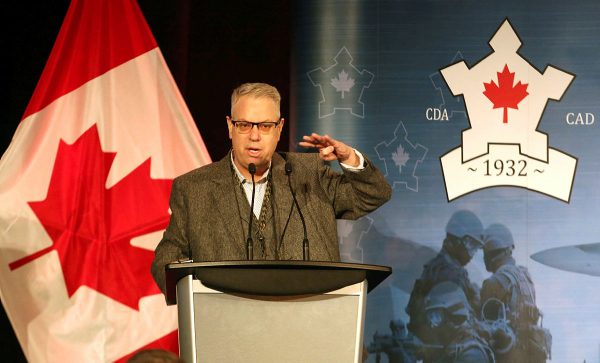
Ipsos Public Affairs CEO Darrell Bricker says that the ongoing protest in Ottawa is helpful for the Liberals but has created a tricky situation for the Conservatives. The Hill Times photograph by Andrew Meade
The People’s Party was not able to win any seats, but won about 850,000 votes nationally in the last federal election. In contrast, the left-leaning Green Party, which has been around for years, won two seats with 397,000 votes. According to some estimates, the vote split between the Conservatives and Peoples’ Party caused the Conservatives to lose 20 seats across the country.
Bricker said that the trucking protest issue will not be top of mind in a few weeks as Ontario business establishments like restaurants and gyms have already opened up at 50 per cent capacity and things are expected to get better in the coming days.
Nik Nanos, chief data scientist for Nanos Research, described the Ottawa protests as a new escalation of the disruption politics that Canadians first saw in the last federal election. In a number of the Liberal Party’s campaign events, some protesters showed up to demonstrate against the vaccine mandates. In some incidents, they threw gravel at the prime minister and made particularly nasty comments about Trudeau and his family. Nanos said that Trudeau is a “polarizing figure” and the current situation could become challenging for him as it puts a spotlight on him. Nanos said it could make him look weak for not intervening or doing anything. He said that whether Canadians are for or against the COVID vaccines, they are tired of the pandemic and this is just another frustration point for them.
“This is a new, popular, anti-establishment front that has been formed, that is very diverse, in terms of what the drivers are [demanding]; everything from being concerned about vaccinations, to being concerned about big government imposing its will on individuals, through to concern about Ottawa … being out of touch with Canadians and not serving Canada,” said Nanos. “This is a new anti-establishment popular front [that] should not be dismissed, and it’s not going away.”
Nanos said that this situation could be a political windfall for NDP Leader Jagmeet Singh (Burnaby South, B.C.) whose popularity numbers have already gone up. Nanos said Canadians disappointed with the Liberals and Conservatives could park their support with the NDP.
According to a Nanos poll released Jan. 28, the Conservatives and the Liberals were tied in a statistical dead heat at 30.4 per cent and 29.9 per cent, respectively. The NDP had the support of 20.7 per cent, the People’s Party of Canada at 6.7 per cent and the Greens at 5.8 per cent.
“It’s not a slam dunk for Justin Trudeau,” said Nanos. “It does mobilize progressive voters, but I don’t think we should equate progressive voters being mobilized with them voting for Justin Trudeau. And this is why Jagmeet Singh is well positioned at this time.”
He warned that the Liberals should be worried as this could turn into an “Occupy Ottawa movement” where truckers take turns and occupy as much of the Parliamentary Precinct as possible. He noted that the truckers don’t need thousands of trucks for this, and even a hundred trucks could bring the city to a standstill. Meanwhile, Nanos said Canadians want the government to come up with a long-term solution to the COVID-19 pandemic.
“I would hazard to say that average Canadians are still frustrated with a pandemic, want proactive action from the federal party leaders to have a path forward,” said Nanos. “And what this does is this makes voters even grumpier, because basically, it looks like a capital that’s gripped in indecision and inaction that is hostage to truckers.”
The Hill Times