

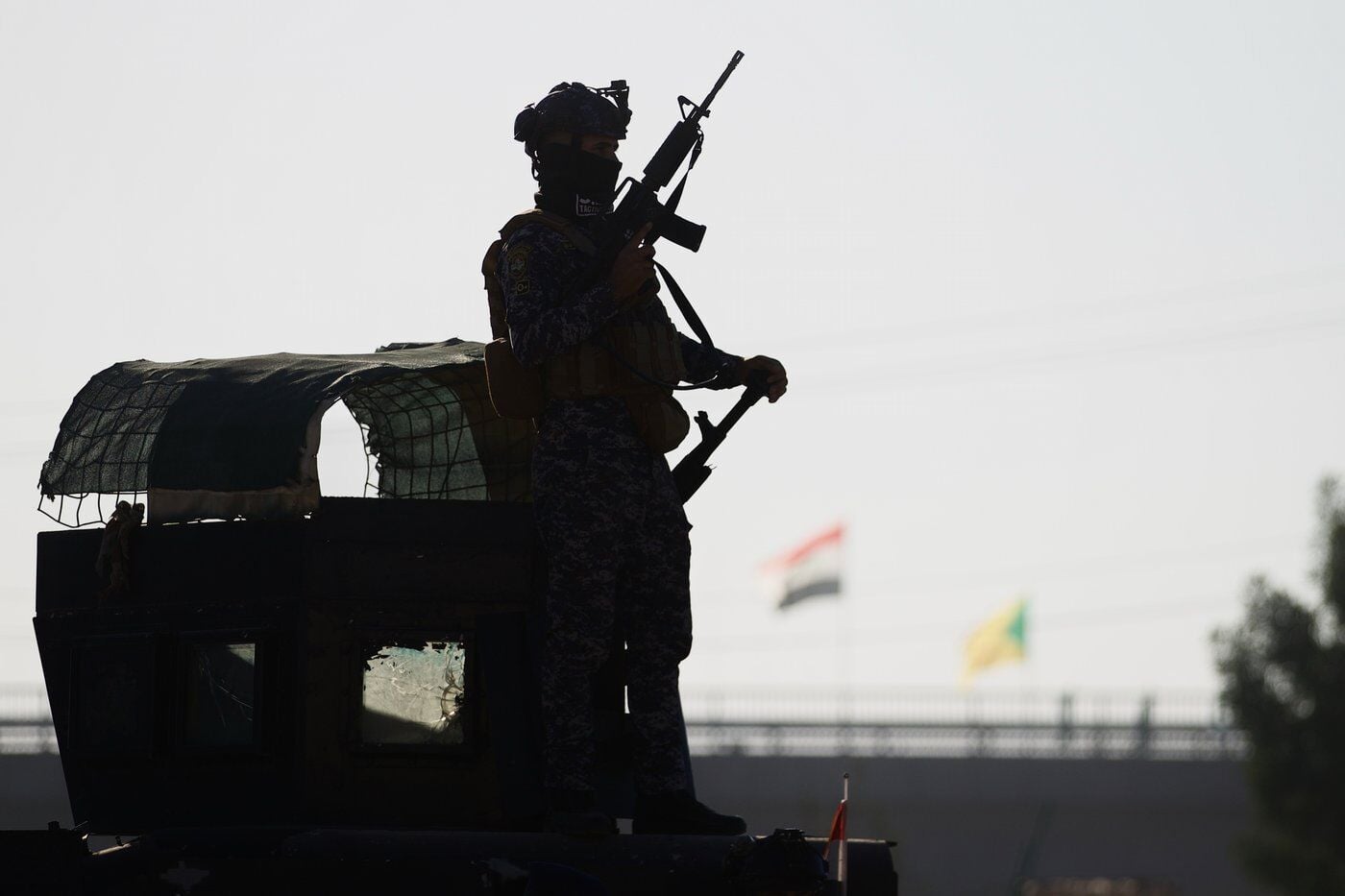
Iraqi security forces set up a command headquarters on Friday on the outskirts of Jurf al-Sakhar, a longtime stronghold of the Iran-backed Kataib Hezbollah militia south of Baghdad, under a reported deal that lets the group’s fighters stay for now and withdraw within a month.
The deployment ends days of tension in which the government of Prime Minister Ali al-Zaidi ordered troops into the area and set a deadline, reported to fall on Friday, for the militia to leave, while Kataib Hezbollah threatened to fight any incursion, The Associated Press reported.
Two Iraqi officials, speaking on condition of anonymity because they were not authorized to comment publicly, told the AP that the government and Kataib Hezbollah reached an agreement under which security forces could enter but the militia would not immediately withdraw. The officials said the deal followed negotiations facilitated by Esmail Qaani, commander of the Quds Force, the branch of Iran’s Revolutionary Guard responsible for operations outside Iran. Neither the Iraqi government nor Kataib Hezbollah had confirmed the terms on the record, and they could not be independently verified.
Under the arrangement described to the AP, the Iraqi army, federal police and police tied to the energy sector will deploy in the area. As a compromise, the deployment will also include fighters from the Popular Mobilization Forces, a collection of mostly Shiite armed groups close to Iran that are officially part of Iraq’s security forces. Kataib Hezbollah would pull its fighters out within a month, the officials said.
Jurf al-Sakhar, about 60 kilometres southwest of Baghdad, spans roughly 345 square kilometres on the Shia pilgrimage route between the capital and Karbala, Al Jazeera reported. Kataib Hezbollah, one of the largest groups in the Popular Mobilization Forces, has held it since 2014, renamed it Jurf al-Nasr and barred state institutions from entering, Al Jazeera said. The militia sealed the town, citing security concerns, which has kept about 140,000 displaced residents from returning.
The confrontation grew out of an oil-smuggling investigation. A leaked Interior Ministry intelligence report said millions of dollars’ worth of crude had been siphoned from two state pipelines running through the closed area since 2021, and that makeshift underground refineries were used to process it, Al Jazeera reported. Sources told Reuters the smuggling, carried out with accomplices among some security and oil officials, has cost the government hundreds of millions of dollars since 2021.
An investigative committee entered the area with military backing on Nov. 13, and government spokesman Haidar al-Aboudi said it had detected “clear tampering with pipelines passing through the area, as well as attempts to bury and conceal traces of that tampering.” Nine senior security and administrative officials in Babil province, including the provincial police chief and the director of the Oil Pipelines Company, have been dismissed.
Kataib Hezbollah has denied the smuggling allegations. In a statement on Nov. 15 it said an inspection had found no interference with pipelines and accused the government of “the greatest campaign of blackmail” aimed at forcing it to give up its weapons, Al Jazeera reported. The group also moved what Al Jazeera described as about 8,000 fighters toward Jurf al-Sakhar ahead of the committee’s visit.
The standoff comes amid U.S. and Gulf pressure on Baghdad to curb Iran’s influence over Iraqi armed groups, and amid wider regional strain. Saudi Arabia said on Friday that Iran-backed Houthi rebels had fired more missiles and drones at the kingdom, as we reported in our earlier coverage of the Yemen war. Iraq’s economy has also been under strain, with the government letting the dinar weaken to 1,520 per dollar in October as oil income fell, we reported.
For Canadians, the Government of Canada advises Canadians to avoid all travel to Iraq because of the volatile security situation, according to its travel advice page on travel.gc.ca, last updated July 23, 2026. Canadians in the country can register through the Registration of Canadians Abroad service.
What happens next depends on whether Kataib Hezbollah keeps to the one-month withdrawal window described by the officials. The group has not publicly said it will leave.
Sources: The Associated Press via The Canadian Press, Al Jazeera, Nov. 18 and Al Jazeera, Nov. 16, Government of Canada travel advice for Iraq.
If you find reporting like this useful, consider supporting Canada News Media, an independently owned Canadian newsroom.
Follow Canada News Media
Get the day's top Canadian stories and our two daily 60-second news videos wherever you scroll.
X Threads Facebook Instagram LinkedIn TikTok YouTube Pinterest Reddit Substack Flipboard Newsletter RSS