



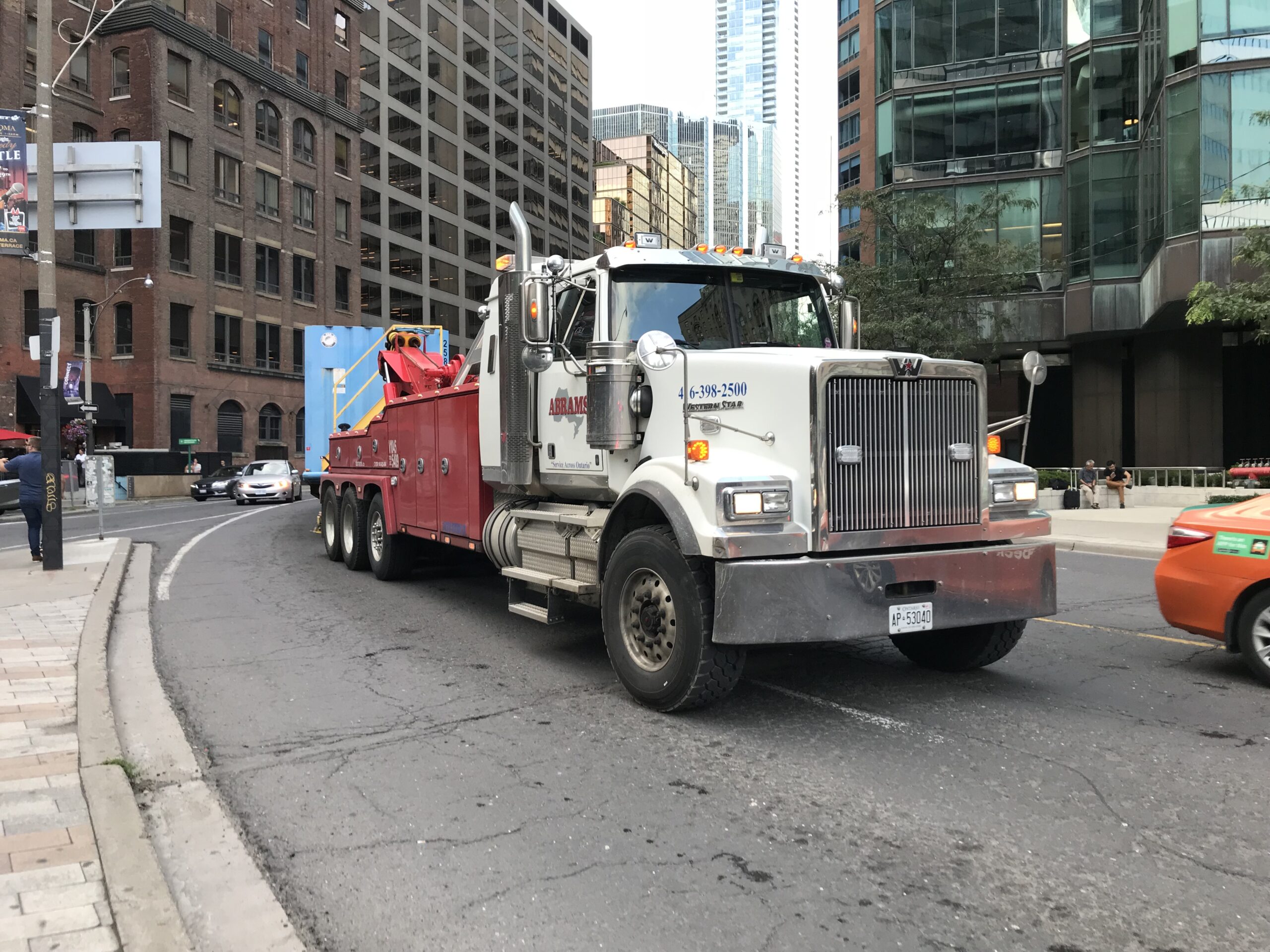
Tow-truck operators in Ontario with old drug convictions cannot be shut out of the industry for life simply because those convictions came with an automatic weapons prohibition, the Court of Appeal for Ontario has ruled, in a decision that opens the door for some refused operators to apply again.
The ruling, Thibault v. Ontario (Attorney General), 2026 ONCA 797, was released Nov. 9, 2026, by Justices P. Lauwers, M. Rahman and L. Brownstone, less than two weeks after the Oct. 27 hearing. It concerns the certification system Ontario created for tow operators under the Towing and Storage Safety and Enforcement Act, 2021.
Under the rules in Ontario Regulation 167/23, a person cannot be certified if they have a “disqualifying record.” One clause, section 2(1)(c), disqualifies anyone convicted in the previous 10 years of trafficking, importing, exporting or production offences under sections 5, 6, 7 or 7.1 of the Controlled Drugs and Substances Act. Another clause, section 2(1)(d)(i), disqualifies anyone under a court order prohibiting them from possessing a weapon.
The two men who brought the case have worked in towing for decades, according to the decision. They were refused certification because each is subject to a lifetime weapons prohibition under section 109 of the Criminal Code, imposed as a result of dated drug convictions. They challenged the weapons clause as outside the province’s authority and as a breach of the Charter. The Divisional Court dismissed their application in February 2025 (2025 ONSC 647).
Before the appeal was heard, the Court of Appeal asked both sides to address a narrower question: how the weapons clause fits with the 10-year drug clause. The answer decided the case. As the judges explained, anyone convicted of the main drug offences listed in the 10-year clause automatically receives a lifetime section 109 order. If that order alone were enough to disqualify them, the 10-year limit would almost never matter, because nearly everyone it covers would be barred for life anyway.
“It is trite that the legislature does not pointlessly repeat itself or speak in vain,” the panel wrote. Applying the principle that a specific rule overrides a general one, the court held that a weapons order flowing from one of the listed drug offences cannot be used as a separate ground for refusal. Once 10 years have passed since the conviction, and if nothing else disqualifies them, such operators should be eligible.
The weapons clause still applies to other people, the court said: those under weapons orders that do not come from the listed drug offences, and those barred from having weapons by bail conditions, parole conditions or an undertaking to police.
The outcome is unusual. Formally, the appeal was dismissed. The court said the two men had not asked for judicial review of the decisions of Ontario’s Director of Towing who refused them, so it would not quash those refusals, and because its reading of the regulation removed the basis of their challenge, they had no standing to pursue the arguments that the rule was invalid or unconstitutional. But the court said they may reapply, and the Director must consider their applications in line with its reasons. Because of “the unusual nature of this case,” it awarded costs to the operators even though their appeal was dismissed.
The decision does not say how many tow operators have been refused certification because of section 109 orders, and Ontario has not published that figure in the records we reviewed. It also does not decide whether the regulation is constitutional; that question was left unanswered. Operators refused on this ground whose drug convictions are more than 10 years old can use the ruling when they reapply.
The Court of Appeal has been busy with challenges to provincial rules this month. On Nov. 20 we reported on its ruling in the Norfolk County soil-dumping case.
How we checked: We read the Court of Appeal’s full reasons, paragraphs 1 to 11 and both footnotes, on CanLII on Nov. 21, 2026, and confirmed the Divisional Court citation through CanLII’s case database. We compared the court’s description of the regulation with the text of O. Reg. 167/23 and the 2021 act on Ontario’s e-Laws site. We did not name the operators beyond the case title, because they are private individuals whose criminal records are dated. We searched our archive for earlier coverage and found none. We did not contact the parties; the findings are the court’s.
If you find reporting like this useful, consider supporting Canada News Media, an independently owned Canadian newsroom.
Follow Canada News Media
Get the day's top Canadian stories and our two daily 60-second news videos wherever you scroll.
X Threads Facebook Instagram LinkedIn TikTok YouTube Pinterest Reddit Substack Flipboard Newsletter RSS