

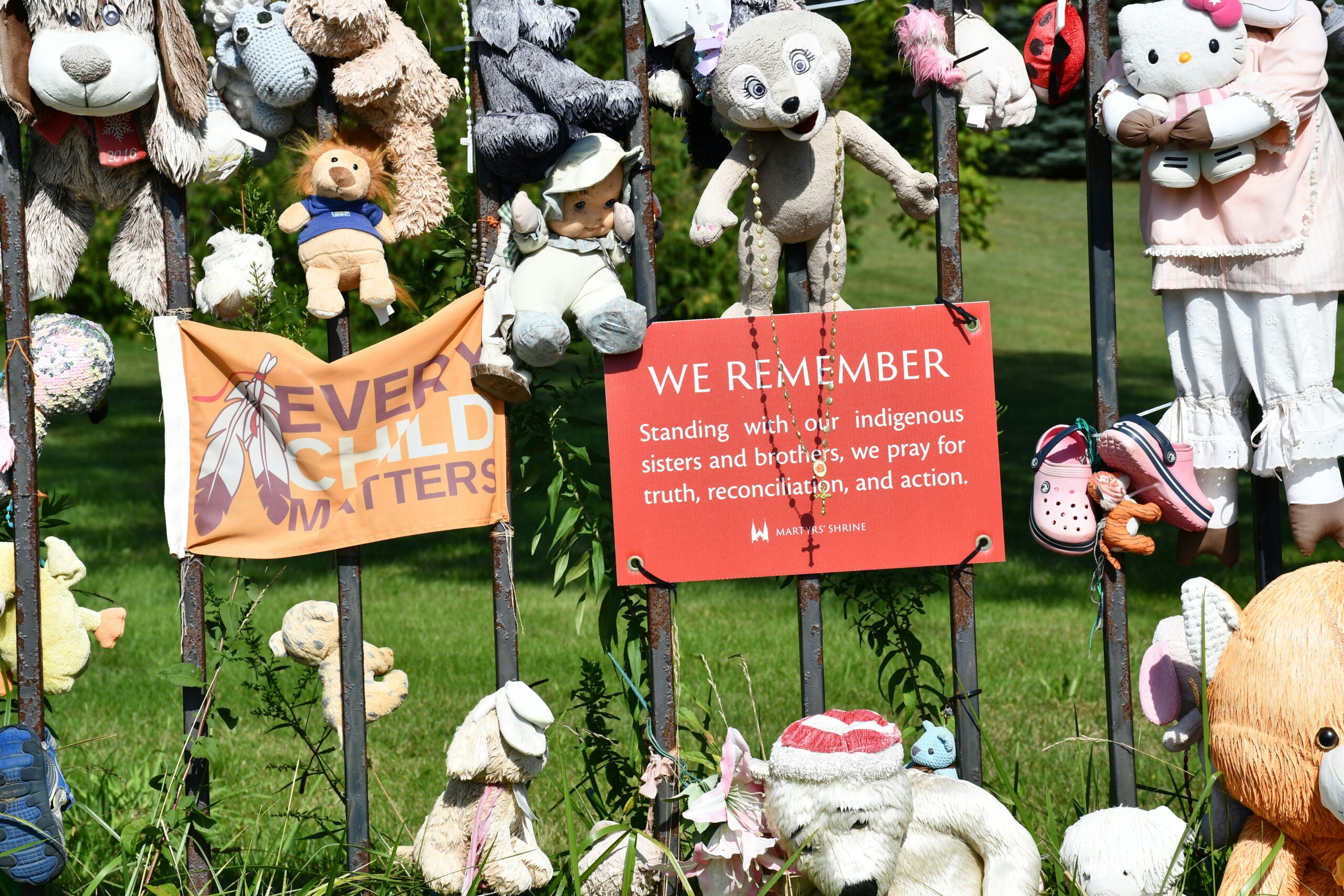
Indigenous members of Parliament from both the Conservative and Liberal benches are condemning a merchandise campaign that promotes residential school denialism, three months after Parliament closed the only legislative door that would have brought such a campaign within reach of the Criminal Code.
Conservative MP Billy Morin, who represents Edmonton Northwest, told APTN News he considers the campaign racist. “I find it absolutely disgusting that they’re attempting to make a profit off the pain and suffering of residential schools,” Morin said. The Liberal Indigenous Caucus, whose members include Indigenous Services Minister Mandy Gull-Masty and Northern and Arctic Affairs Minister Rebecca Chartrand, issued a written statement this week urging Canadians to reject what it called a campaign of hate, and said it would advocate within the government caucus “about how we can ensure that this type of hatred is never promoted or tolerated in our country.”
The campaign was launched Aug. 27 by the commentary outlet Rebel News and sells shirts carrying slogans that dispute unmarked burial findings at former residential school sites. It is timed to Orange Shirt Day and the National Day for Truth and Reconciliation on Sept. 30. APTN reported that Rebel News did not respond to a request for comment. The Truth and Reconciliation Commission found that one in 25 children who attended residential schools never came home, and documented roughly 4,000 deaths.
What the coverage of the condemnations has largely left out is that the question of whether Canadian law should reach this conduct was put to Parliament earlier this year, and answered.
On June 3, the Senate defeated an amendment to Bill C-9, the Combatting Hate Act, that would have made it an offence to wilfully promote hatred against Indigenous Peoples by condoning, denying or downplaying the residential school system, punishable by up to two years in prison. The amendment was brought by Nunavut Sen. Nancy Karetak-Lindell, herself a residential school survivor. It had cleared the Senate’s human rights committee two days earlier on a vote of seven to one. In the chamber it failed 41 to 32, according to Nunatsiaq News.
The objection from the government’s own side was procedural rather than substantive. Sen. Pierre Moreau, the government representative in the Senate, told the chamber that no consultations had been undertaken and no legal analysis completed before the amendment was introduced, and said the issue must be addressed through what he described as a comprehensive and respectful consultation process. Bill C-9 went on to receive royal assent June 18 and came into force July 18 with no residential school provision in it. The shirt campaign launched about six weeks after the law took effect.
That sequence leaves the Liberal Indigenous Caucus asking its own government to revisit a position that government took in June. It is not clear from the public record whether the consultation Moreau described has since begun, and no minister has set out a timeline for one. Nor is there another live vehicle before Parliament. NDP MP Leah Gazan tabled Bill C-413 in September 2024 to criminalize residential school denialism. It received first reading and has not advanced since.
The comparison Morin reaches for is the same one that historians raised during the June debate. “When people deny the Holocaust, I understand it to be hate speech that is illegal in Canada,” Morin told APTN, adding that he would put the question of a double standard directly to Rebel News founder Ezra Levant. Sean Carleton, an associate professor of history and Indigenous studies at the University of Manitoba, made a near identical argument to Nunatsiaq News in June, saying the amendment’s defeat risks teaching Canadians “that anti-Indigenous racism is fine.” Carleton also argued the measure was aimed at people who are “materially benefiting” from bad-faith arguments, not at historical inquiry or at survivors describing their own experience. Karetak-Lindell made the same point in committee, saying her amendment “does not restrict historical discussions, academic inquiries or personal testimonies.”
Critics of the amendment, including several senators who voted against it, argued that criminalizing speech about a contested historical record is the wrong instrument regardless of the intent behind it, and that existing hate propaganda provisions already cover the most serious conduct. That disagreement is unresolved and was never settled on the merits, because the vote turned on process.
The condemnations this week were unanimous across party lines, from a Conservative backbencher and from Liberal cabinet ministers. The law that would have matched them is not on the books, and nobody in government has yet said when, or whether, it will be brought back.
via APTN News (Emma Honeybun, Sept. 4, 2026). Senate vote details and quotes from Nunatsiaq News (Nehaa Bimal, June 5, 2026). Bill C-9 legislative status from the Parliament of Canada and the Department of Justice.
Follow Canada News Media
Get the day's top Canadian stories and our two daily 60-second news videos wherever you scroll.
X Threads Facebook Instagram LinkedIn TikTok YouTube Pinterest Reddit Substack Flipboard Newsletter RSS