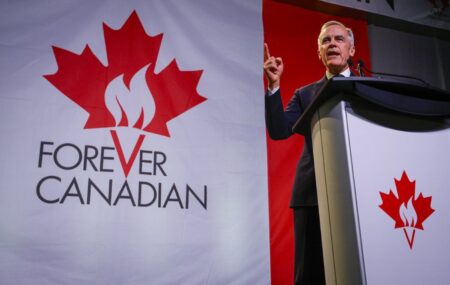



Jann Arden will headline a free pro-Canada concert in Calgary on Sept. 20, six weeks before Albertans vote in a referendum whose ballot includes a question on whether the province should begin the legal process toward a binding vote on leaving Canada.
The Forever Canadian campaign said the “Calgary Concert for Unity” will be held at The Confluence Historic Site, formerly Fort Calgary, and that folk musicians Celeigh Cardinal, Reuben Bullock and John Wort Hannam and jazz singer Caity Gyorgy will also perform. A campaign news release urged people to gather as “loud and proud Canadians,” according to a report by The Canadian Press carried by Global News on Sept. 4.
That report noted, in a single line, that people opposed to separation argue leaving could threaten Indigenous treaty rights. What the wire copy did not say is that the argument has already been tested twice in Alberta courtrooms in the past year, and it won both times.
In Chief Electoral Officer of Alberta v. Sylvestre, issued Dec. 5, 2025, the court found that a proposed referendum asking whether Alberta should become a sovereign, independent country would contravene the Charter and historic treaties between Canada and certain Alberta First Nations. According to an analysis published by the law firm Fasken in May, the court found that secession would fundamentally contravene Treaty 7 and Treaty 8 by unilaterally removing Canada as the treaty partner, and that the Crown’s obligations under those treaties could not be assumed by an independent foreign state. The court also found that secession would convert provincial boundaries into international borders, splitting treaty territory and disrupting the ability of First Nations members to move across treaty lands to exercise harvesting rights.
Alberta then amended its Citizen Initiative Act to remove the constitutional screening test that had allowed that challenge, and the chief electoral officer approved a question on substantially the same subject. Several Treaty First Nations challenged the approval. In Athabasca Chipewyan First Nation v. Alberta (Chief Electoral Officer), issued May 13, 2026, the court set it aside, finding the province owed a duty to consult First Nations first. Justice Shaina Leonard found that the government, as a representative of the Crown, had failed in that duty, Fasken said, and that Alberta could not legislate its way out of a constitutional obligation to consult before making decisions affecting treaty rights.
The province is appealing. Until that appeal succeeds, the rulings remain binding law in Alberta.
That history matters for how the Oct. 19 ballot should be read. Premier Danielle Smith’s government responded to the May decision by folding the sovereignty question into the referendum it had already called, and the question as finalized does not ask Albertans to leave Canada. It asks whether the government should commence the legal process required under the Constitution to hold a binding provincial referendum on separation. A Yes vote is an instruction to start a process, not an exit, and the process it points to is the one the courts have twice said cannot proceed without consultation first.
Separation is also not the main event by volume. Smith announced nine questions on Feb. 19, and separation was added later. Four of the original nine deal with reducing immigration and restricting newcomers’ access to provincially funded services, including limiting health care and education to citizens, permanent residents and people with an Alberta-approved status, imposing a 12-month residency wait for social supports, and charging fees to residents with non-permanent status. A fifth asks whether voters should show proof of citizenship to cast a provincial ballot. The last four ask whether Alberta should work with other provinces to amend the Constitution to move judicial appointments to the provinces, abolish the Senate, let provinces opt out of federal programs while keeping the funding, and give provincial laws priority over conflicting federal laws.
Each question appears on its own numbered, colour-coded ballot, and Elections Alberta has already opened special ballot requests.
One detail from the concert bill is worth holding alongside all of this. Celeigh Cardinal, one of the announced performers, is a Métis artist from Alberta. The treaty question that the wire brief reduced to a clause is, for a considerable number of Albertans, the whole question.
Via Global News (The Canadian Press). Court rulings summarized from a Fasken Indigenous Legal Matters bulletin published May 28, 2026; referendum questions from Elections Alberta and CBC News reporting.
Follow Canada News Media
Get the day's top Canadian stories and our two daily 60-second news videos wherever you scroll.
X Threads Facebook Instagram LinkedIn TikTok YouTube Pinterest Reddit Substack Flipboard Newsletter RSS