
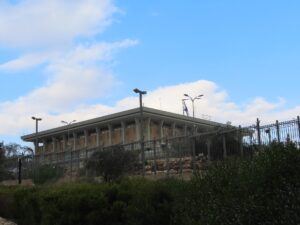

Israel’s election count showed Prime Minister Benjamin Netanyahu’s right-wing and religious bloc with 53 seats and former military chief Gadi Eisenkot’s bloc with 48, both well short of the 61 needed to govern the 120-seat Knesset, with 85.6 per cent of votes counted on Oct. 28.
The Arab parties won 19 seats, which the Times of Israel called a historic high. That leaves them holding the arithmetic that could decide whether either man can form a government, and it points to weeks of coalition talks after Tuesday’s vote.
The count is not final. Ynet reported that 93 per cent of polling stations had been counted, and the Central Elections Committee said the remaining ordinary ballots need extra oversight, the Times of Israel reported. About 600,000 double-envelope ballots, cast by soldiers and others voting outside their home polling stations, are still to be counted. Ynet said that count starts around midnight Wednesday and finishes Thursday evening.
Ynet’s tally put Netanyahu’s Likud at 26 seats, Eisenkot’s Yashar! list at 21 and former prime minister Naftali Bennett’s Beyachad at 12. The Joint List had 13 seats and Ra’am six, ynet said, while Yair Golan’s Democrats had eight. Earlier tallies differed: at 84.5 per cent counted the blocs stood at 54, 51 and 17, the Times of Israel reported. Our report on election-night exit polls showed how far the broadcasters’ projections diverged.
Each leader claimed the mandate. “The public chose change,” Eisenkot said, according to ynet, and he called on Netanyahu to step down. Netanyahu said “the Zionist majority must come to its senses and unite,” ynet reported, and told supporters he wants “a right-wing, national, strong government,” the Times of Israel said. He also said it was a “shame” that some parties were willing to cooperate with Arab parties.
Golan said “Netanyahu lost” and urged an opposition government with Arab party support. Yousef Jabareen of the Joint List said his party was ready to “pave the way for removing the Netanyahu, Ben-Gvir and Smotrich government,” ynet reported. The Times of Israel said President Isaac Herzog called for an “open mind” in coalition talks. Whether the parties would agree to govern together is a separate question from the numbers.
Ynet reported that sources said U.S. President Donald Trump does not want Netanyahu to bring Itamar Ben-Gvir, and likely Bezalel Smotrich, into his next government. No unity deal has been agreed, and ynet noted that Israel could stay under a caretaker government during negotiations. A caretaker government keeps its formal powers but is expected to show restraint on major decisions, and any decision to go to war needs government or security cabinet approval.
That matters because of Iran. Netanyahu said Israel faces a “historic, one-time opportunity” to remove the Iranian threat, the Times of Israel reported. The Wall Street Journal reported that the U.S. told Gulf Arab states to prepare for a short but intense offensive after the Nov. 3 midterm elections, according to the Times of Israel. The White House declined to comment on “sensitive military plans that may or may not exist” but said “President Trump keeps all options on the table.” Our report on Trump ruling out Iran strikes before the midterms has the earlier public position.
For Canadians, the clearest link is energy. Brent crude settled at US$116.72 in the most recent close we reported, a six-month high driven by the Iran war, and any change in Israel’s posture toward Iran would feed straight into fuel prices. The shekel weakened as the results came in, ynet reported.
What happens next: the double-envelope count is due to finish Thursday evening, Oct. 29, and further verification checks are set for next week, ynet said. The Times of Israel said the Central Elections Committee does not expect the headline figures to change soon. No deadline for forming a government has been reported in the sources we reviewed.
If you find reporting like this useful, consider supporting Canada News Media, an independent Canadian newsroom with no corporate parent.
Via the Times of Israel and ynet. Seat counts are partial and may change as the remaining ballots are counted.
Follow Canada News Media
Get the day's top Canadian stories and our two daily 60-second news videos wherever you scroll.
X Threads Facebook Instagram LinkedIn TikTok YouTube Pinterest Reddit Substack Flipboard Newsletter RSS