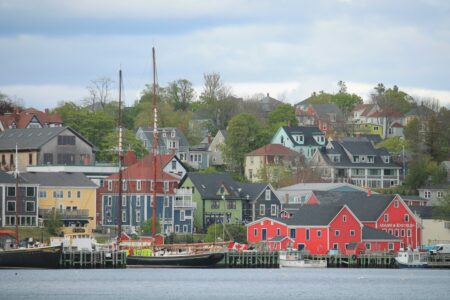


On the night of August 24 into August 25, 1927, a hurricane tore into Nova Scotia’s fishing fleet and sank four Lunenburg County schooners with their entire crews, killing close to 100 fishermen in a single night. The storm, remembered ever since as the Great August Gale of 1927, is considered the deadliest tropical cyclone to strike Canada in the 20th century, according to a Wikipedia summary of meteorological records for the storm, and it remains one of the darkest chapters in the history of Canada’s East Coast fishery.
According to the Fisheries Museum of the Atlantic in Lunenburg, Nova Scotia, the storm made landfall late on August 24, 1927, catching the schooner fleet far offshore near Sable Island, the notorious “Graveyard of the Atlantic” off Nova Scotia’s coast. Four Lunenburg schooners — the Mahala, the Uda R. Corkum, the Clayton W. Walters, and the Joyce M. Smith — went down with every man aboard. The American schooner Columbia, crewed mainly by Nova Scotians, was also lost; its owners did not confirm its fate until October, two months later.
The human toll fell hardest on a handful of small communities. Aboard the Mahala, Captain Warren Knickle was lost alongside his two brothers, Owen and Grenville, and their brother-in-law, Scott Miller — one family absorbing four deaths in a single sinking. Most of the crew of the Joyce M. Smith came from Newfoundland, which was then a separate British dominion and would not join Confederation until 1949; the rest of the fleet’s losses were drawn largely from Nova Scotia’s South Shore fishing villages.
This was not an isolated tragedy. A year earlier, in August 1926, an earlier storm had already claimed two Lunenburg schooners, the Sylvia Mosher and the Sadie A. Knickle. Together, the two storms became known collectively as “the August Gales,” and the Fisheries Museum of the Atlantic states that 138 Lunenburg-area men and boys died across the two disasters combined — a staggering loss for a county whose entire economy ran on schooner fishing.
Sources differ on some of the finer details. Wikipedia’s entry on the 1927 Nova Scotia hurricane cites a broader storm-wide death toll of 173 to 192 people and notes the hurricane came ashore near Yarmouth as a Category 2 storm before turning extratropical, figures that reflect the storm’s full track rather than Nova Scotia’s fishing losses alone. Separately, promotional material from the Maritime Museum of the Atlantic in Halifax, previewing a 2026 talk on the disaster, lists the Mahala’s date of loss as August 29, 1927, five days later than the landfall date given by the Fisheries Museum and Wikipedia — a discrepancy likely rooted in how long it took, in an era before ship-to-shore radio, for anyone onshore to learn a vessel was overdue and presumed lost.
That absence of radio communication is central to why the disaster unfolded the way it did. Plans to equip the Lunenburg fleet with radios and engines after the 1926 Gale had not been completed in time for the 1927 storm, the Fisheries Museum notes, leaving schooners with no way to call for help or report their position once the weather turned. Families on shore then faced weeks of uncertainty, waiting for wreckage, survivors, or news that never came for many of them. Nova Scotian families of the lost eventually received modest monthly compensation; Newfoundland families received no formal assistance until an Anglican minister arranged annual payments of $100 per family.
The August Gales reshaped Lunenburg’s relationship with the sea. The Fisheries Museum of the Atlantic still maintains a permanent exhibit on the disaster, built from photographs, biographies of the lost fishermen, contemporary newspaper accounts, and artifacts recovered from the wrecks. Marking the 100th anniversary of the twin 1926-27 disasters, the Maritime Museum of the Atlantic in Halifax hosted a public talk this year with the Fisheries Museum’s longtime curator, a reminder that the losses of that August are still actively commemorated in Nova Scotia nearly a century later — a sober counterpoint to the romanticized image of the Grand Banks schooner fisherman that Lunenburg’s own tourism industry has long promoted.
Sources: Fisheries Museum of the Atlantic (fisheriesmuseum.novascotia.ca); Maritime Museum of the Atlantic (maritimemuseum.novascotia.ca); Wikipedia, “1927 Nova Scotia hurricane.”
Follow Canada News Media
Get the day's top Canadian stories and our two daily 60-second news videos wherever you scroll.