


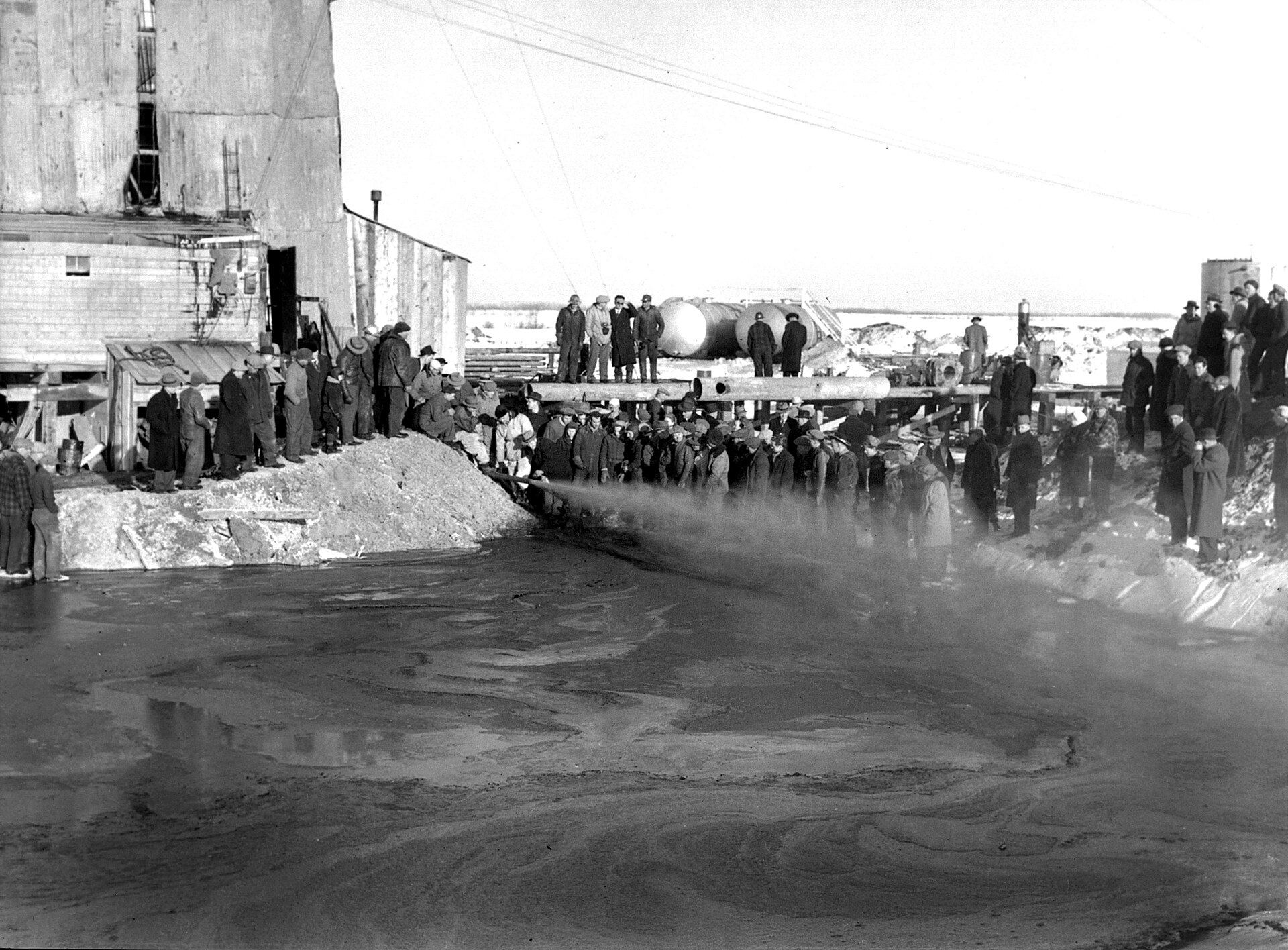
Imperial Oil began drilling a wildcat well on Mike Turta’s farm southwest of Edmonton on Nov. 20, 1946, the start of a project that would become Leduc No. 1 and open Alberta’s modern oil age.
The date comes from Wikipedia’s account of the well and from The Canadian Press “Today in History” feature, which marks Nov. 20 as the day crew boss Vern Hunter started drilling. The Canadian Encyclopedia gives a slightly different timeline, saying Hunter set up the rig on Nov. 26, 1946. Sources agree on the month and the farm, but not on the exact day the bit first turned.
The stakes were high. Alberta’s main oil field at Turner Valley was depleting at about 10 per cent a year, the Canadian Encyclopedia said, and Canada was producing roughly 21,000 barrels a day in 1946 while consuming about 10 times that amount, according to Wikipedia. Most of the country’s oil was imported.
Imperial had spent heavily on the search. The company had drilled 133 dry holes before Leduc, the Canadian Encyclopedia and Global News reported, and Hunter was known as “Dry Hole” Hunter. Imperial’s chief geologist, Ted Link, had picked the site, according to Wikipedia and APEGA, the engineers and geoscientists regulator.
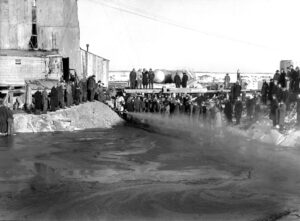
The crew drilled through the winter. Oil finally came in on Feb. 13, 1947, around 4 p.m., after a planned morning ceremony was delayed by equipment trouble, the Canadian Encyclopedia said. The well reached about 1,536 metres by APEGA’s and Wikipedia’s count and 1,544 metres by the Canadian Encyclopedia’s, a difference the sources do not explain.
Leduc No. 1 was not a gusher by later standards. Global News said it produced up to 1,000 barrels a day from the start. Its importance was what it proved: that large reserves lay in the Devonian rock beneath central Alberta.
The effect on the province was fast. APEGA reported that Alberta had about 7,400 producing wells and had pumped 144 million barrels by 1956, up from just over 500 wells a decade earlier. Wikipedia said Edmonton’s population reached 226,000 in 1956, double the figure from the census 10 years before. The Canadian Encyclopedia described the strike as the event that made Edmonton the oil capital of Canada.
The well itself had a modest working life. Wikipedia and Global News said it produced about 317,000 barrels of oil and 323 million cubic feet of natural gas before it was decommissioned in 1974. The Canadian Encyclopedia and the Canadian Museum of History said it was capped in 1984 and attributed more than 240 million barrels to it, a figure that appears to describe the wider field rather than one well. The accounts conflict, and this article does not settle it.
Leduc No. 1 was designated a National Historic Site in 1990, according to Wikipedia and Global News. The wells have also left a legacy of cleanup. The Alberta Energy Regulator has put the province’s oil and gas liability at $38 billion, as Canada News Media reported, and an insolvent firm now holds one in five wells in the orphan well queue.
That is the other side of the boom that began in a farm field 80 years ago today. The first well was meant to end a long run of dry holes. It started an industry whose profits and costs Albertans are still counting.
Sources: The Canadian Encyclopedia; Wikipedia; The Canadian Press, Today in History; APEGA; Global News; Canadian Museum of History.
If you find reporting like this useful, consider supporting Canada News Media, an independently owned Canadian newsroom.
Follow Canada News Media
Get the day's top Canadian stories and our two daily 60-second news videos wherever you scroll.
X Threads Facebook Instagram LinkedIn TikTok YouTube Pinterest Reddit Substack Flipboard Newsletter RSS