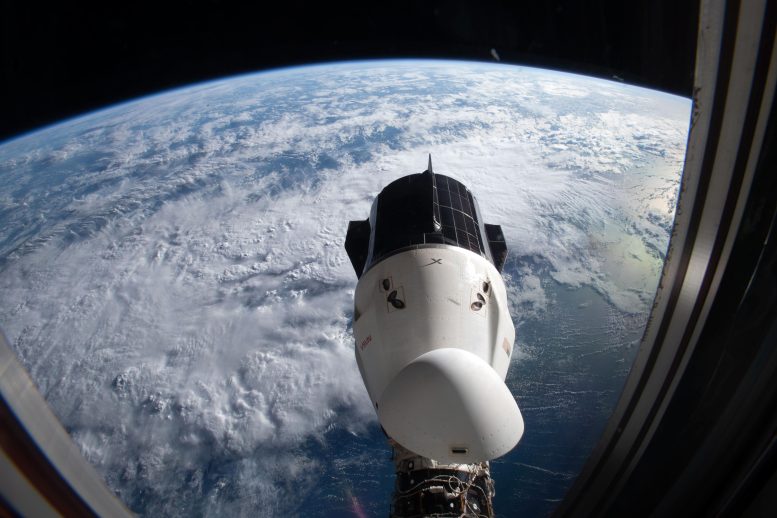
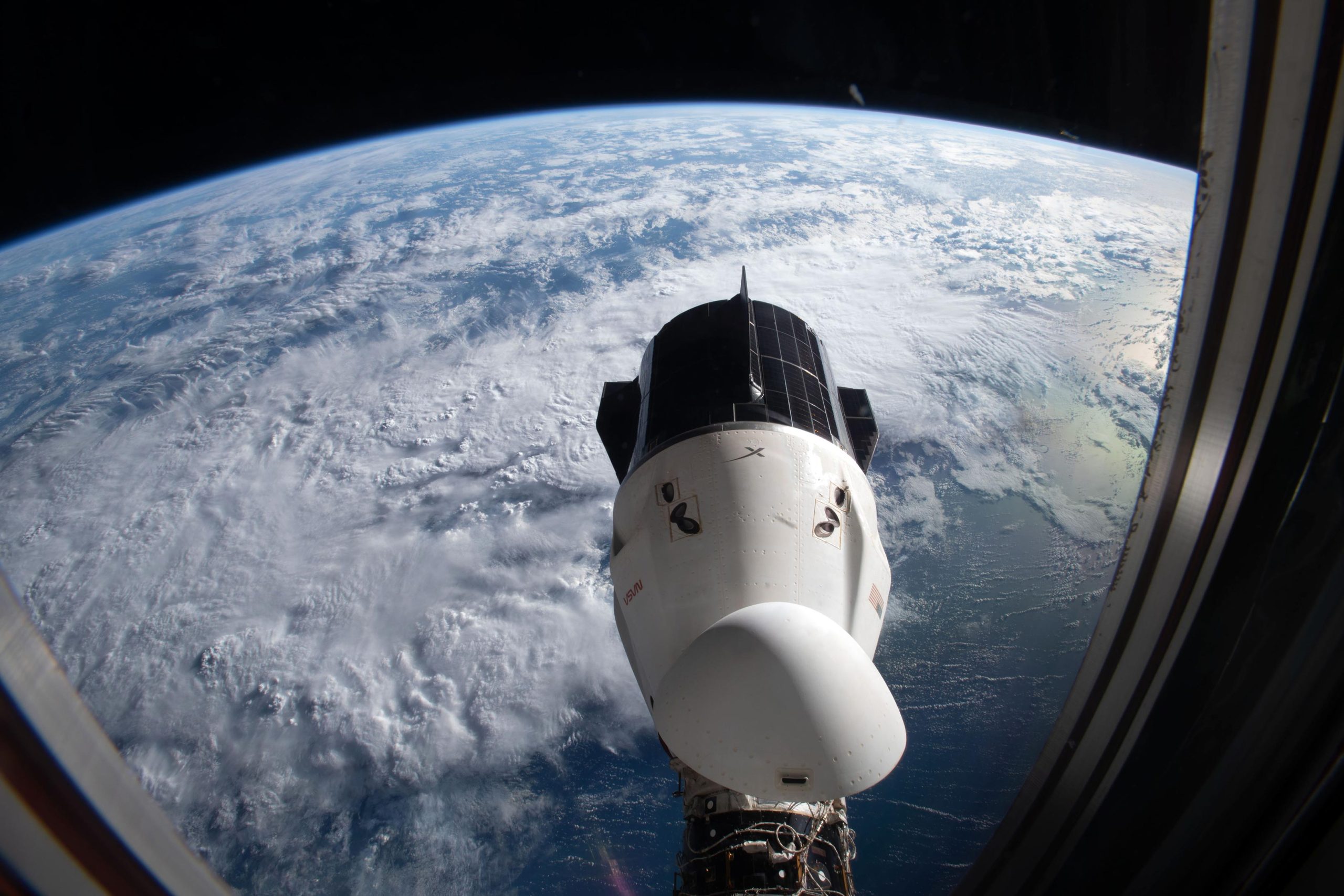
The SpaceX Dragon Endurance crew ship is pictured from a window aboard the SpaceX Dragon Endeavour crew ship. Endurance is docked to the Harmony module’s forward-facing port while Endeavour is docked to Harmony’s space-facing port on the International Space Station. (Photo taken on April 12, 2022.) Credit: NASA
Established in 1958, the National Aeronautics and Space Administration (NASA) is an independent agency of the United States Federal Government that succeeded the National Advisory Committee for Aeronautics (NACA). It is responsible for the civilian space program, as well as aeronautics and aerospace research. Its vision is "To discover and expand knowledge for the benefit of humanity." Its core values are "safety, integrity, teamwork, excellence, and inclusion." NASA conducts research, develops technology and launches missions to explore and study Earth, the solar system, and the universe beyond. It also works to advance the state of knowledge in a wide range of scientific fields, including Earth and space science, planetary science, astrophysics, and heliophysics, and it collaborates with private companies and international partners to achieve its goals.
The European Space Agency (ESA) is an intergovernmental organization dedicated to the exploration and study of space. ESA was established in 1975 and has 22 member states, with its headquarters located in Paris, France. ESA is responsible for the development and coordination of Europe's space activities, including the design, construction, and launch of spacecraft and satellites for scientific research and Earth observation. Some of ESA's flagship missions have included the Rosetta mission to study a comet, the Gaia mission to create a 3D map of the Milky Way, and the ExoMars mission to search for evidence of past or present life on Mars.
” data-gt-translate-attributes=”["attribute":"data-cmtooltip", "format":"html"]”>European Space Agency) astronaut Andreas Mogensen, <span class="glossaryLink" aria-describedby="tt" data-cmtooltip="
JAXA
Formed in 2003, the Japan Aerospace Exploration Agency (JAXA) was born through the merger of three institutions, namely the Institute of Space and Astronautical Science (ISAS), the National Aerospace Laboratory of Japan (NAL) and the National Space Development Agency of Japan (NASDA). JAXA performs various activities related to aerospace, from basic research in the aerospace field to development and utilization and is responsible for research, technology development, and launch of satellites into orbit, and is involved in advanced missions such as asteroid exploration and possible human exploration of the Moon.
Roscosmos, also known as the Roscosmos State Corporation for Space Activities, is the Russian government agency responsible for space activities, including the development and operation of spacecraft, launch vehicles, and space stations. It was formed in 2015 through the merger of the Federal Space Agency (Roscosmos) and the United Rocket and Space Corporation. Roscosmos is responsible for Russia's space program and works closely with other international space agencies on joint projects, such as the International Space Station. The agency is also involved in a wide range of space-related activities, including scientific research, earth observation, telecommunications, and manned spaceflight.
” data-gt-translate-attributes=”["attribute":"data-cmtooltip", "format":"html"]”>Roscosmos cosmonaut Konstantin Borisov arrived at the <span class="glossaryLink" aria-describedby="tt" data-cmtooltip="
International Space Station
The International Space Station (ISS) is a large spacecraft in orbit around the Earth that serves as a research laboratory and spaceport for international collaboration in space exploration. It was launched in 1998 and has been continuously occupied by rotating crews of astronauts and cosmonauts from around the world since 2000. The ISS is a joint project of five space agencies: NASA (USA), Roscosmos (Russia), JAXA (Japan), ESA (Europe), and CSA (Canada). It orbits the Earth at an altitude of approximately 400 kilometers (250 miles), and provides a unique platform for scientific research, technological development, and human space exploration.
” data-gt-translate-attributes=”["attribute":"data-cmtooltip", "format":"html"]”>International Space Station as the <span class="glossaryLink" aria-describedby="tt" data-cmtooltip="
SpaceX
Commonly known as SpaceX, Space Exploration Technologies Corp. is a private American aerospace manufacturer and space transport services company that was founded by Elon Musk in 2002. Headquartered in Hawthorne, California, the company designs, manufactures, and launches advanced rockets and spacecraft. SpaceX's ultimate goal is to reduce space transportation costs and enable the colonization of Mars.
” data-gt-translate-attributes=”["attribute":"data-cmtooltip", "format":"html"]”>SpaceX Dragon, named Endurance, docked to the complex at 9:16 a.m. <span class="glossaryLink" aria-describedby="tt" data-cmtooltip="
EDT
EDT is an abbreviation for Eastern Daylight Time, the time zone for the eastern coast of the United States and Canada when observing daylight saving time (spring/summer). It is four hours behind Coordinated Universal Time. New York City, Washington, D.C., Boston, and the Kennedy Space Center are in the Eastern Time Zone (ET).
” data-gt-translate-attributes=”["attribute":"data-cmtooltip", "format":"html"]”>EDT on Sunday while the station was 261 statute miles over Queensland, Australia.
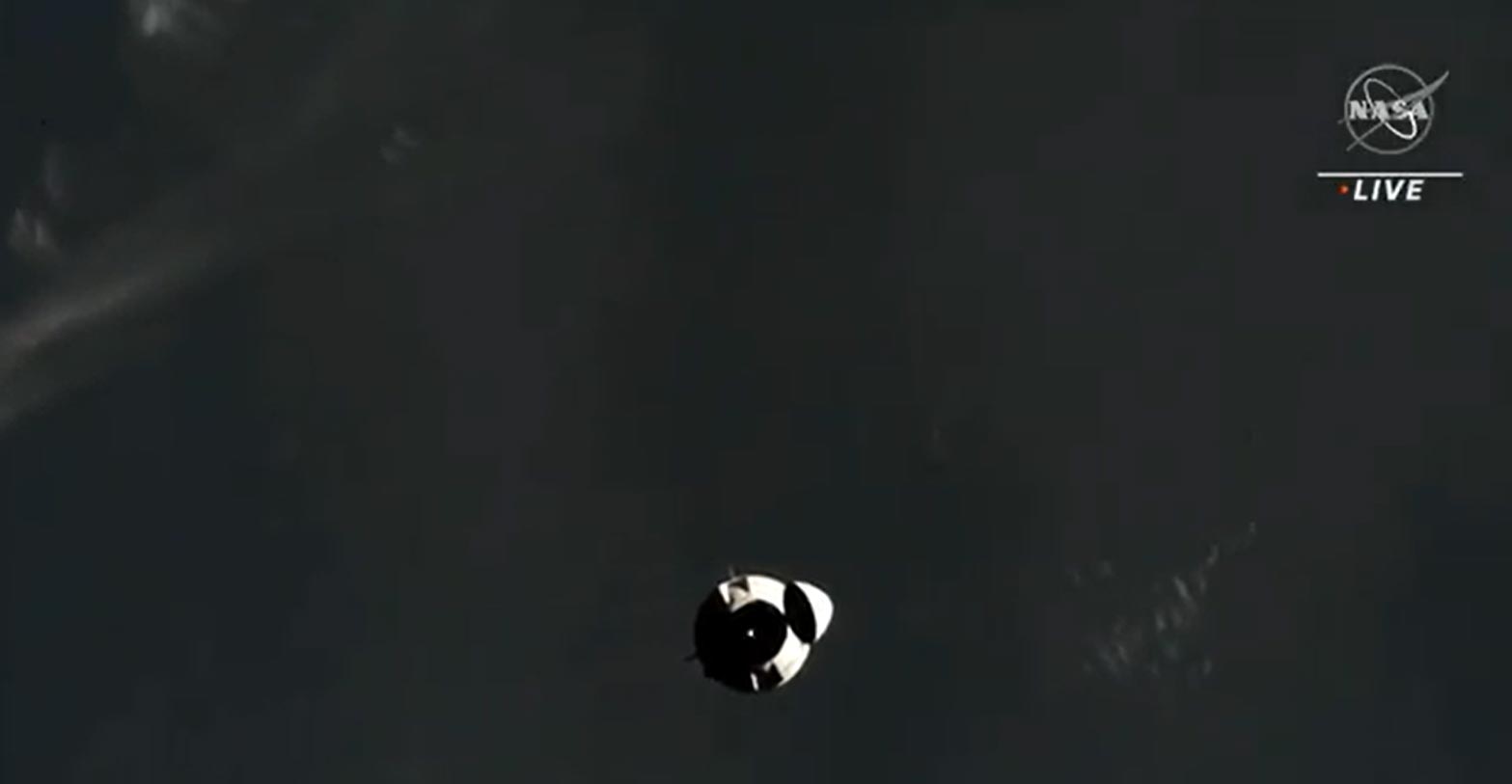
The SpaceX Dragon Endurance spacecraft approaches the space station as it soars over Ontario on August 27, 2023. Credit: NASA TV
Following Dragon’s link up to the Harmony module, the astronauts aboard the Dragon and the space station began conducting standard leak checks and pressurization between the spacecraft in preparation for hatch opening.
At 10:58 a.m. EDT, the Dragon spacecraft hatch was opened. This was shortly after the station crew opened the hatch between the space station and the pressurized mating adapter.
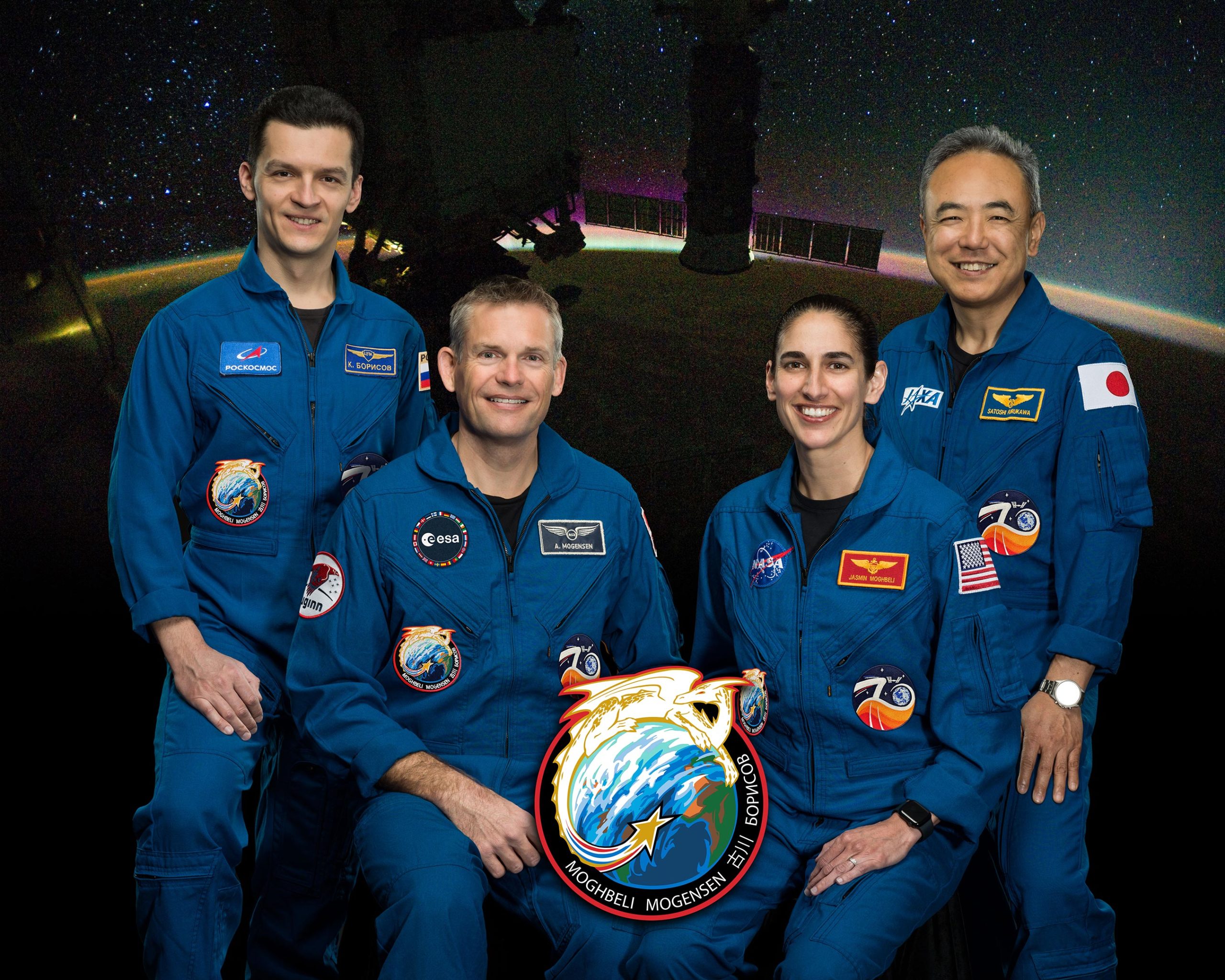
The official Crew-7 portrait. From left, Konstantin Borisov of Roscosmos, Andreas Mogensen of ESA, Jasmin Moghbeli of NASA, and Satoshi Furukawa of JAXA. Credit: Bill Stafford and Robert Markowitz, NASA
Crew-7 joins the Expedition 69 crew of NASA astronauts Stephen Bowen, Woody Hoburg, and Frank Rubio, as well as UAE astronaut (United Arab Emirates) astronaut Sultan Alneyadi, and Roscosmos cosmonauts Sergey Prokopyev, Dmitri Petelin, and Andrey Fedyaev.
This increases the number of crew aboard the space station to 11 people. This will only last for a short time until Crew-6 members Bowen, Hoburg, Alneyadi, and Fedyaev return to Earth in a few days.
NASA TV will continue live coverage through the welcoming ceremony at approximately 11:30 a.m.
Harry Miller is a writer and editor based in Toronto who has Ten years of experience in the journalism industry. Before coming to Canada News Media as a National Online Journalist, Miller worked as a senior writer and a reporter-editor with the Canadian Press and a breaking news reporter with the Toronto Star.
Miller currently holds two bachelor’s degrees, one in journalism from Ryerson University and another in communications and film studies from Carleton University.