
Upper Canada’s lieutenant-governor refused in 1833 to return Thornton and Lucie Blackburn to Michigan, where the couple faced a return to slavery after a courtroom ruling and a jailbreak that became known as the Blackburn Riots.
The decision shielded two people who went on to build one of Toronto’s early Black-owned businesses and to shelter other freedom seekers, according to the Canadian Encyclopedia and Parks Canada.
The Canadian Encyclopedia said the couple escaped slavery in Louisville, Ky., in 1831, travelling by steamboat with falsified papers that described them as free. They settled in Detroit, in Michigan Territory, where they became part of the small Black community.
In June 1833, a Kentucky traveller recognized Thornton on a Detroit street, the encyclopedia said. The couple were tried under U.S. fugitive slave law and sentenced to be returned to bondage.
On June 16, 1833, supporters swapped clothes with Lucie and smuggled her across the river to Amherstburg, in Upper Canada, the encyclopedia said. The next day, more than 200 armed people marched on the jail and freed Thornton. He fled to Sandwich, Upper Canada, with seven of the rescuers.
The University of Windsor’s Across the River collection describes the episode slightly differently, saying supporters freed both Blackburns at the jail. Both accounts agree that a law enforcement officer was badly injured and that Detroit’s mayor and the Blackburns’ enslavers pressed for their return.
The Canadian Encyclopedia said Michigan’s acting governor demanded the couple be handed over. Lt.-Gov. Sir John Colborne instead asked Attorney General Robert Simpson Jameson to find legal grounds to protect them. Colborne concluded the Blackburns could not be sent to a jurisdiction where the punishment would be harsher than anything Upper Canadian law allowed for a similar offence. The University of Windsor collection reports the same reasoning.
Parks Canada said the government “twice defended them against extradition.” The sources reviewed do not say what the second request involved.
A petition Thornton dictated during the dispute, transcribed by the Rev. William Johnson, said he was “convinced that the object of the Party is to have him and his wife carried back to Hopeless Slavery,” according to the University of Windsor collection.
The University of Windsor collection described the ruling as a precedent that protected later freedom seekers from similar extradition requests. It came nearly three decades before a Toronto court freed John Anderson, a fugitive from Missouri, in 1861. Canada News Media reported on the Anderson case earlier this month.
The Blackburns had settled in Toronto by 1834, Parks Canada said. In 1837, according to the Canadian Encyclopedia, they hired a mechanic, Paul Bishop, to build a hackney cab, painted yellow with red trim and named The City. Its stand was on Church Street, west of St. James Cathedral. Parks Canada describes the business as the city’s first cab company.
The couple used their earnings to buy property. The encyclopedia said they owned six houses in St. John’s Ward, which they rented at nominal rates to freedom seekers, and that Thornton brought his mother, Sibby, from Detroit to Toronto in the winter of 1837. Ann Maria Jackson and her seven children, who fled enslavement in Delaware in 1858, are believed to have stayed with them, the encyclopedia said.
Thornton also attended the Convention of Coloured Freemen in September 1851 as a delegate and later served as vice-president of the Canadian Mill and Mercantile Association, which backed businesses at the Elgin Settlement, according to the encyclopedia and the University of Windsor collection. For more on that community, see Canada News Media’s report on the Buxton Settlement.
Lucie died in Toronto in 1895, the sources agree. They differ on Thornton: the Canadian Encyclopedia gives 1890 and the University of Windsor collection gives 1895. The encyclopedia said both are buried in the Toronto Necropolis.
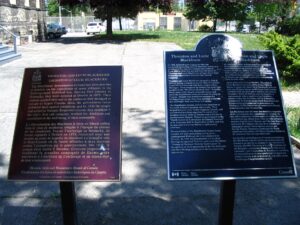
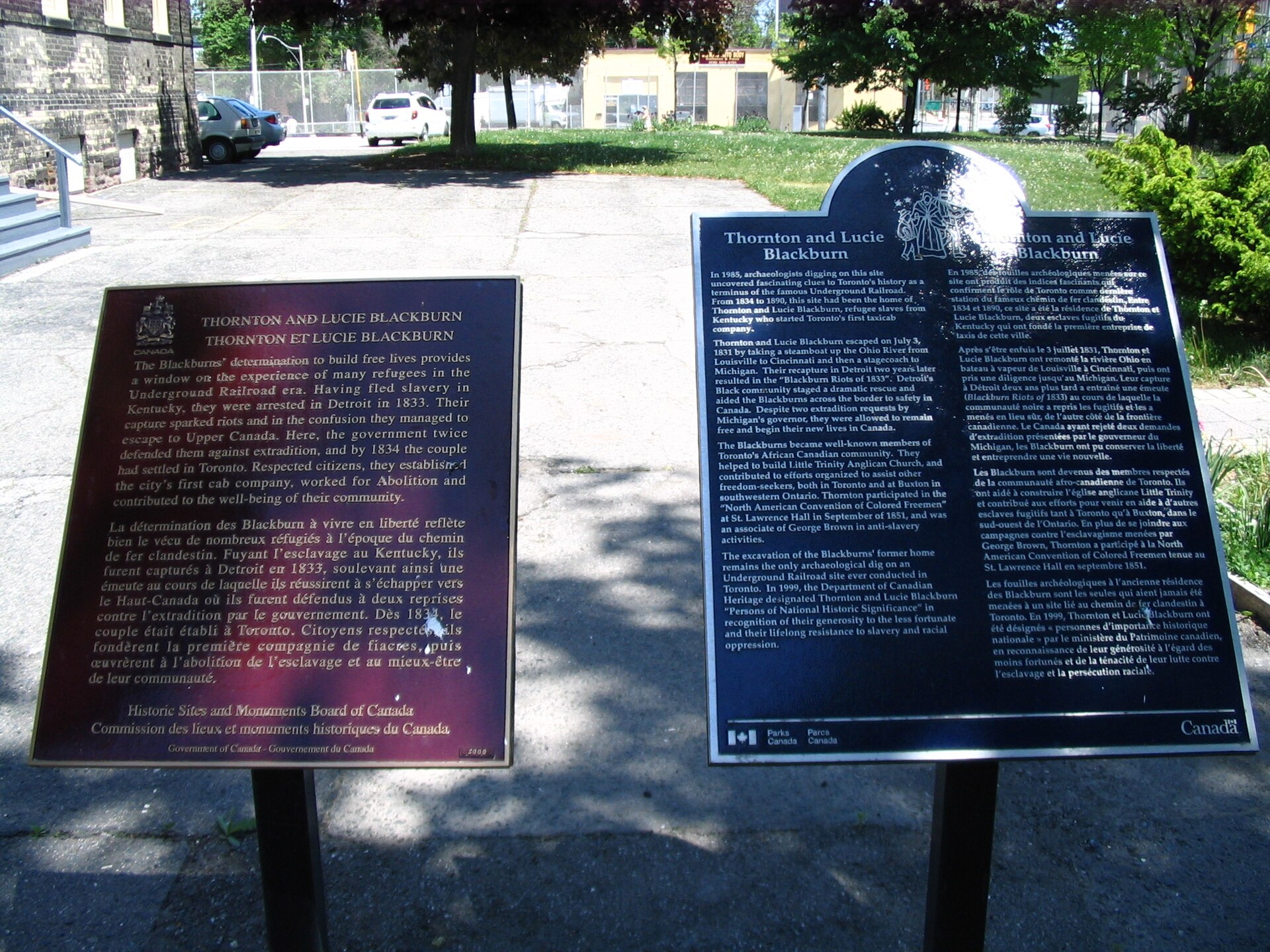
Their land has a footnote in the city’s public record. In 1887, the encyclopedia said, the Toronto school board built Sackville Street School on land expropriated from the back of the Blackburn property. Parks Canada designated Thornton and Lucie Blackburn national historic persons in 1999, with a plaque at 19 Sackville St.
The sources reviewed give differing details on the couple’s births, so those are omitted here. For an earlier chapter in the same legal story, see Canada News Media’s report on Chloe Cooley and the 1793 law.
If you find reporting like this useful, consider supporting Canada News Media, an independent Canadian newsroom with no corporate parent.
Follow Canada News Media
Get the day's top Canadian stories and our two daily 60-second news videos wherever you scroll.
X Threads Facebook Instagram LinkedIn TikTok YouTube Pinterest Reddit Substack Flipboard Newsletter RSS