

For Bruce Head, the underground concourse at Portage and Main was a career-defining development.
The late Winnipeg artist created the massive concrete artwork covering the inner wall of the circular walkway. Now, his widow is worried about the future of the renowned public art piece if the plaza is decommissioned.
“It meant the world to him; it meant a vindication and recognition of his talent, skills and experience as an artist,” says Judy Waytiuk, Head’s partner of 33 years.
“The biggest chunk of his legacy will be literally buried underground.”

RUTH BONNEVILLE / FREE PRESS
Judy Waytiuk, Bruce Head’s partner of 33 years, is worried about the future of his 127-metre-long sculpture, curved along the concourse below Portage and Main.
In the wake of Mayor Scott Gillingham’s proposal to reopen the city’s iconic intersection and close its underground concourse, Waytiuk has been seeking answers about the fate of the artwork.
The 127-metre-long geometric relief sculpture, entitled The Wall, is the longest in situ art piece in Canada. The installation was poured in place and is attached to the walls of the below-grade structure. Removing it would be a complicated endeavour. However, the closure of the concourse could leave it permanently hidden from public view.
“In an ideal situation, the concourse stays open and the artwork remains where it is; that’s where it was designed for. That’s where it was intended to be. But ideally the concourse stays open not just for that reason,” Waytiuk says.
During the city’s property and development committee meeting Thursday, possible options for salvaging the installation were discussed, including removal and relocation or recreating the piece elsewhere using 3D laser-imaging technology. Further consultation is needed before a decision is made.
Gillingham is open to looking into the issue.
“If (Bruce’s) work is going to be in peril, I would hope that there’s very clear and proper documentation of it, so the work itself and its heritage isn’t lost.”–Judy Waytiuk
“I want to have discussions with our staff, and with the Winnipeg Arts Council as well, and ask what could be done related to that piece of art,” he said during a media scrum.
“If there is a way to save it, I’d be very open to saving it.”
Head was a University of Manitoba art school graduate and longtime CBC graphic designer who rose to national acclaim for his colourful prints and paintings. He died in 2009.
In 1977, he won the commission to create a public art installation for the controversial, yet-to-be-constructed Portage and Main concourse. The project presented “design, engineering, architectural and public relations challenges,” owing to hostility surrounding the intersection’s closure, according to the catalogue for a major retrospective of Head’s career hosted at the Winnipeg Art Gallery.
The Wall is made of 52 poured and moulded concrete panels, many of which Head helped manufacture on-site over the course of two years. The work opened the door to new media and led the artist to a 30-year fascination with concrete sculpture work.
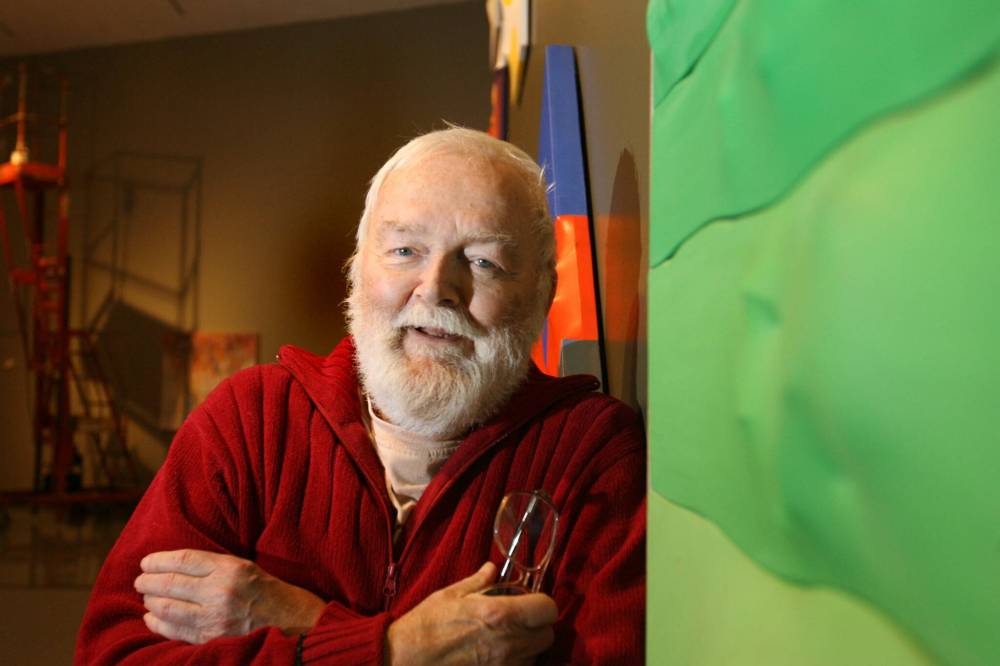
RUTH BONNEVILLE / FREE PRESS FILES
Local artist Bruce Head died in 2009.
“It’s an important piece. It helps define that space. And it was a big piece — big pieces assume an importance and so do works that artists do as part of these public art commissions,” art historian and former Canadian senator Patricia Bovey says of The Wall.
Head’s piece was created at a time when public art was included in the budgets for new public buildings in Winnipeg. The city’s preliminary 2024 budget has completely cut funding for the Winnipeg Arts Council’s public art program.
Bovey has seen other public art pieces covered up or dismantled during redevelopment projects in Winnipeg and elsewhere.
“It’s a loss of the fabric of a community,” she says. “If (Bruce’s) work is going to be in peril, I would hope that there’s very clear and proper documentation of it, so the work itself and its heritage isn’t lost.”
— With files from Joyanne Pursaga
X: @evawasney