
On Sept. 16, 1914, Canada created its first military air service, the Canadian Aviation Corps. It consisted of two officers, one mechanic and a single aircraft, and it never flew a combat mission.
The corps was authorized by Sam Hughes, the minister of militia and defence, roughly six weeks after Britain’s declaration of war drew Canada into the First World War. According to the Canadian Encyclopedia, Hughes acted without consulting either his cabinet colleagues or his own military officials, which was characteristic of a minister who ran the militia department largely on personal enthusiasm and personal grudges.
It was also a reversal. The Canadian Encyclopedia records that when aviation pioneer J.A.D. McCurdy, the first person to fly an aircraft in Canada, approached Hughes in August 1914 with a proposal for a Canadian air force, the minister replied that the aeroplane would “never play a part in such serious business as the defence of the nation.” Within weeks Hughes had changed his mind, though not because of McCurdy.
The man who persuaded him was Ernest Lloyd Janney, a motor mechanic from Galt, Ont. Janney talked his way into a commission as a captain and into command of the new corps, despite having no flying experience of his own, according to the Canadian Encyclopedia. Hughes authorized him to spend $5,000 on an aircraft, and Janney travelled to the Burgess Company factory at Marblehead, Mass., to buy one.
What he came back with was a Burgess-Dunne floatplane, a tailless swept-wing design licensed from the British designer J.W. Dunne and built in the United States. The Royal Canadian Air Force Association’s account of the purchase says the machine was shipped to Vermont and then flown north to Valcartier, Que., where the First Canadian Contingent was assembling. There it was dismantled, crated and loaded aboard a transport for England with the rest of the contingent.
The corps had three members in total. Besides Janney there was Lieut. William Frederick Nelson Sharpe of Prescott, Ont., and Staff Sgt. Harry A. Farr, the mechanic. Sources differ on Sharpe’s middle name, with some accounts rendering it Norman rather than Nelson; Veterans Affairs Canada’s Canadian Virtual War Memorial uses Nelson.
The aircraft did not survive the crossing in usable condition. Accounts agree that it was badly damaged in transit and never repaired, and that it was left on Salisbury Plain in southern England, where the Canadian troops were training through a notoriously wet winter. The RCAF Association describes it as having rotted into a heap of worthless junk. No part of the original machine survives. A replica is on display at the National Air Force Museum of Canada at CFB Trenton, Ont.
The corps outlasted its aeroplane, but not by much. Janney returned to Canada in January 1915 and resigned his commission. Sharpe, who had gone on to train with Britain’s Royal Flying Corps, was killed on Feb. 4, 1915, when his biplane crashed during a solo training flight at Shoreham, in Sussex. He was 22, and he is recognized as Canada’s first military aviation fatality. His body was returned home and he was buried at Prescott on March 22, 1915, with full military honours. By May 1915 the Canadian Aviation Corps had ceased to exist.
Canada would not establish a permanent air service for another decade and a half. Thousands of Canadians instead flew with British units during the war, among them some of its most decorated pilots. The Royal Canadian Air Force received its royal designation in 1924, ten years after Hughes signed off on the two officers, the mechanic and the floatplane that never flew for Canada at all.
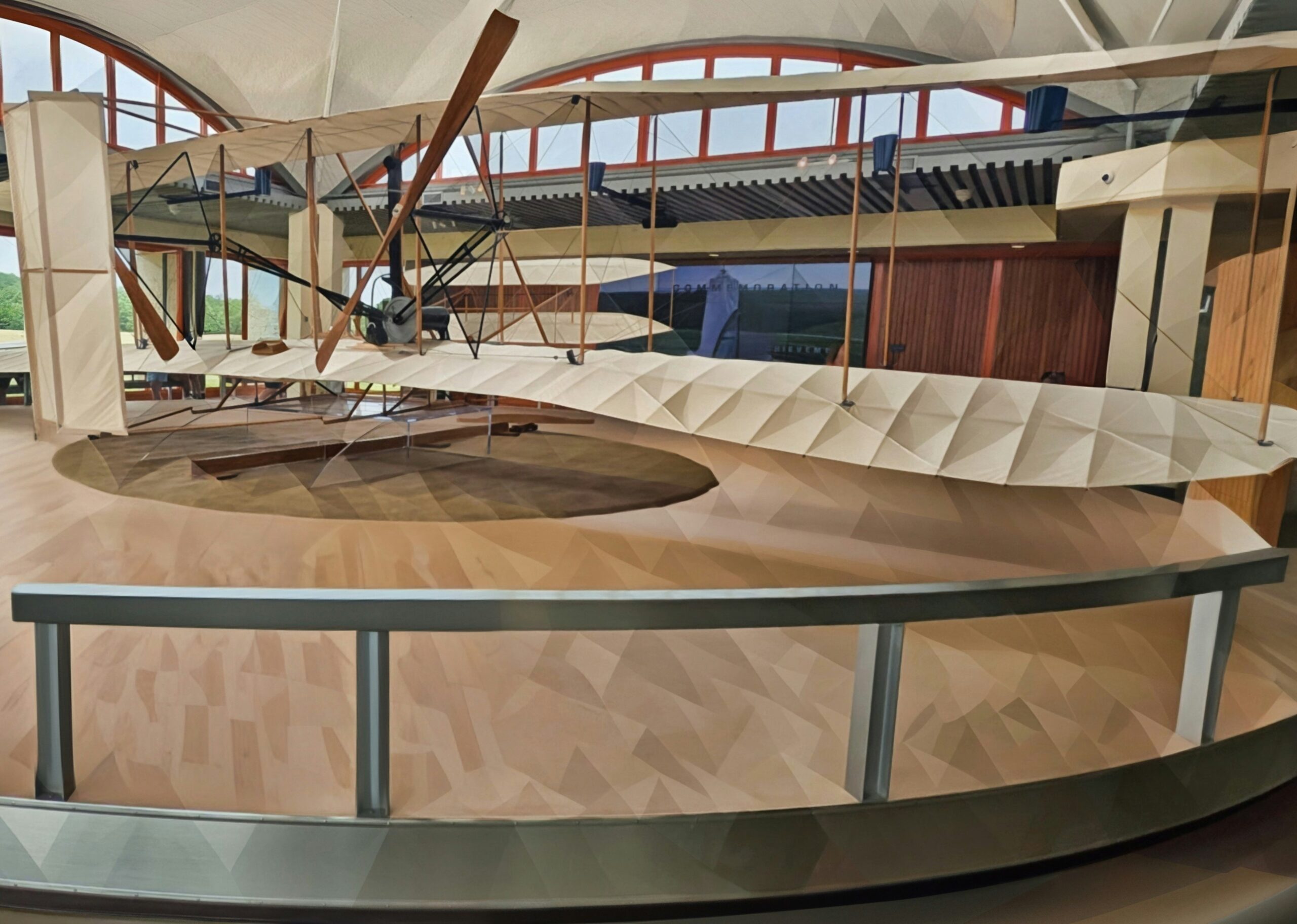
Featured image: a replica of an early biplane on museum display, shown as an illustration of pioneer-era aircraft. It is not the Burgess-Dunne or its replica. Photo by Deborah Downes via Unsplash.