
In the Mohawk community of Kahnawake, south of Montreal, just 20 of 2,313 registered voters cast a ballot in Quebec’s 2022 election, a turnout below one per cent that has barely moved in nearly two decades. Grand Chief Cody Diabo says it won’t change much when Quebecers vote again on Oct. 5, and for his community, that is by design.
“We’re staying in our lane, and we expect the federal and provincial governments to stay in their lane. So that’s why we don’t participate in their governing system,” Diabo said, describing a stance rooted in the Two Row Wampum, a centuries-old treaty principle under which Mohawk and settler nations agreed to govern themselves separately, without interference. In neighbouring Akwesasne, turnout was even lower: not a single ballot was cast among 1,423 registered voters in 2022, and only one vote has been recorded there in the past two decades, in 2018. Some community members go further than simply not voting, removing campaign signs on sight; a widely shared video this month showed someone taking a sledgehammer to a Parti Quebecois poster.
Not every Indigenous community in Quebec abstains on principle. In Wendake, near Quebec City, 1,012 of 1,691 registered voters cast ballots in 2022, close to the provincial norm. But averaged across Quebec since 2007, Indigenous turnout sits at roughly 19 per cent, versus 68 per cent provincewide, a gap Charles Milliard of the Quebec Liberals says the province needs to close by “passing on a passion for voting,” while Quebec solidaire’s Yssia Tormin argues parties themselves have shown too little sustained interest in Indigenous communities between elections.
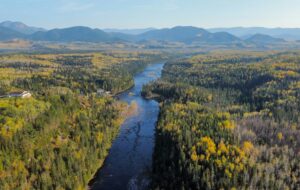
Sixteen hundred kilometres north, in the riding of Ungava, the problem looks different. Ungava is Quebec’s largest electoral district, bigger than Alberta, and home to Nunavik’s roughly 14,000 residents, an overwhelmingly young and largely Indigenous population growing three to four times faster than the provincial average. Three weeks before the vote, not a single campaign sign was reported up in several Nunavik villages, even with five major parties fielding candidates there, among them Sonia Caron for the Parti Quebecois, Sandrine Rioux for the Liberals and Antoine Cote for Quebec solidaire. Turnout in Ungava reached just over 30 per cent in 2022, well ahead of Mohawk territory but still less than half the provincial average of 66 per cent. Parties say they are compensating with radio ads, phone outreach and video conferences rather than door-knocking a region with no road access to most communities.
Elections Quebec is also adjusting. Spokesperson Julie St-Arnaud-Drolet says the agency is focused on “making sure that voting is accessible,” including trilingual voting materials, and a Canadian Press dispatch published Sept. 19 detailed fresh measures the agency is rolling out specifically to reach Nunavik voters, an unusually direct acknowledgment that the system has not been working for the region.
The exclusion has deep roots. Indigenous people in Quebec did not gain the provincial right to vote until 1969, nearly three decades after women’s suffrage in 1940. Parti Quebecois Leader Paul St-Pierre Plamondon has proposed nation-by-nation conversations to rebuild trust, though critics note such pledges have followed past campaigns with little structural change to show for it.
The gap looks even starker next to federal numbers: Indigenous turnout hit 40 per cent in the 2025 federal election, more than double the provincial average. Whoever forms Quebec’s next government on Oct. 5 will do so with a thin mandate from Indigenous voters, at the same time as Nunavik’s young, fast-growing population is set to make up a larger share of the province’s future. For communities like Kahnawake, that outcome is beside the point; for Ungava, advocates say it is a problem parties could still fix, if they showed up.
Via The Canadian Press, with reporting from CP24, Global News and CTV News.
Sourcing notes: Turnout figures, quotes and candidate names are drawn from three separate Canadian Press dispatches (Sept. 14, Sept. 18 and Sept. 19, 2026) syndicated across CP24, CBC News, Global News and CTV News. Federal Indigenous turnout figure and the 1969/1940 voting-rights comparison are drawn from the same CP24/CBC dispatch. This piece synthesizes those three separate reports, which each covered only one region or angle, into a single comparison of the very different reasons behind low Indigenous turnout in southern Mohawk communities versus northern Nunavik, a connection none of the original wire stories drew on their own.