

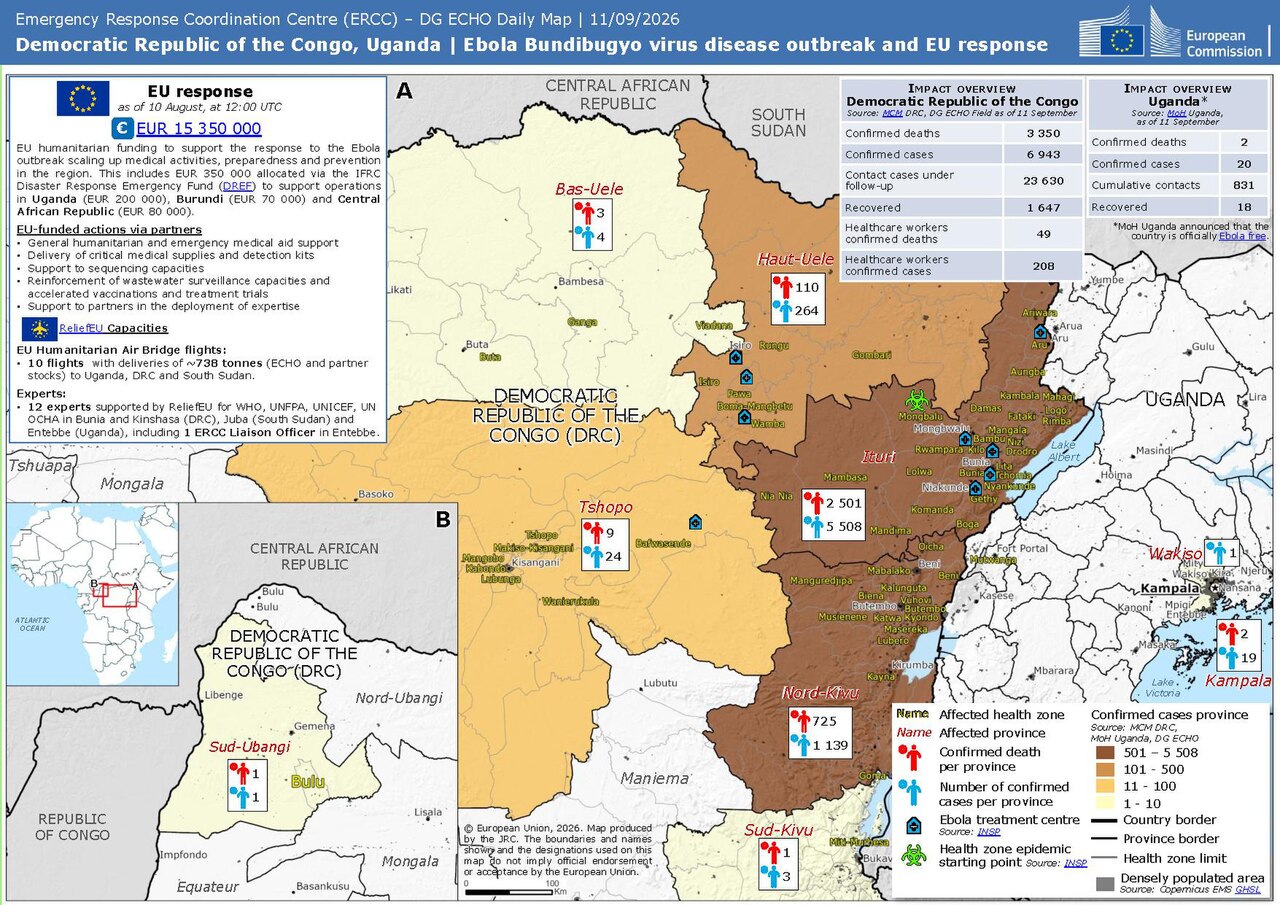
Congo’s Health Ministry reported 9,066 confirmed Ebola cases and 4,381 deaths on Oct. 13, 2026, making the Bundibugyo virus outbreak the country’s largest and deadliest and the second-largest Ebola outbreak ever recorded.
Updated Oct. 14, 2026, 2:45 p.m. ET. Developing.
The toll is now close to half the number of confirmed cases, a fatality rate of 48.3 per cent. Only the 2014-2016 West Africa epidemic was bigger, with more than 28,600 confirmed cases and more than 11,000 deaths in Guinea, Liberia and Sierra Leone, according to the World Health Organization, which also says in its Oct. 8 outbreak bulletin that no approved vaccine or specific treatment exists for the Bundibugyo strain.
The Associated Press, in a report carried by PBS NewsHour, said the latest ministry update added 88 cases and warned that “community transmission remains a concern.” The outbreak now covers 65 health zones in seven provinces, and a large share of deaths are happening outside treatment centres, the AP reported. Officials told the news agency that confirmed cases make up only about a third of all cases.
Xinhua, in a report republished by Kazinform, said the figures are from a task force situation report as of Oct. 11 and released Oct. 13. It reported 2,389 recoveries and said Ituri province, the epicentre, accounts for 73.8 per cent of confirmed cases, while North Kivu has the highest fatality rate at 57.1 per cent.
The WHO bulletin put the count at 8,728 confirmed cases and 4,205 deaths as of Oct. 6. Comparing the two datasets, which come from different sources and cut-off dates, suggests about 338 more confirmed cases and 176 more deaths in five days. The WHO named the seven provinces as Bas-Uélé, Haut-Uélé, Ituri, North Kivu, South Kivu, Sud-Ubangi and Tshopo.
The WHO said its risk assessment, last updated Aug. 14, rates the risk as very high in Congo, high in countries that share a land border with it, and low for the rest of the African region and globally. It also advises against restricting travel to, or trade with, the affected countries.
Signals on the trend are mixed. Xinhua reported that WHO Director-General Tedros Adhanom Ghebreyesus said on Oct. 7 the epidemic was slowing in some areas but still growing in others, and that Congo’s health minister, Roger Kamba, said earlier this month that several affected zones had reported no new cases for weeks.
Al Jazeera, in a report that also drew on the AP, described obstacles to the response, including local distrust of health workers and fighting between the M23 rebel group and government forces that complicates the delivery of supplies to remote areas. It said a local politician in eastern Congo was beaten to death in September after defending the Ebola response on the radio, according to his party. Bunia resident Samuel Buju told the AP: “I feel that the government is overwhelmed by events.”
On vaccines, Xinhua reported that 399 frontline workers in Haut-Uélé have received Ervebo, a vaccine approved for the Zaire strain whose effectiveness against Bundibugyo is unproven. The Coalition for Epidemic Preparedness Innovations said on Oct. 13 that preparations for the Tumaini Phase 2/3 trial were nearly complete, with a start expected in the coming weeks pending ethical and regulatory approval, Xinhua said. Dr. Chikwe Ihekweazu, head of the WHO health emergencies programme, said on Oct. 13 that a trial to evaluate vaccine efficacy is being prepared, Al Jazeera reported.
The outbreak has crossed borders. Uganda reported 20 cases and two deaths earlier this year and was declared Ebola-free in August, Al Jazeera reported. Kenya confirmed its first imported case on Oct. 6, as we reported, after a man who had lived in Congo travelled through Uganda to Nairobi and died there. Congo’s conflict has also deepened since former president Joseph Kabila joined the M23 in a new rebel front.
For Canadians, the measures introduced in May remain in force. Immigration, Refugees and Citizenship Canada extended its restrictions on residents of Congo, Uganda and South Sudan until 11:59 p.m. Eastern time on Nov. 27, 2026. A separate order bars foreign nationals who have been in Congo in the past 21 days from boarding flights to Canada. Canadian citizens and permanent residents can return, but those who have been in any of the three countries in the past 21 days face a health assessment and a 21-day quarantine, as we have reported.
The WHO’s advice against travel restrictions sits alongside Canada’s measures, which the federal government has said are meant to prevent the spread of Ebola in Canada. Whether Ottawa extends them past Nov. 27 has not been announced.
Congo’s health ministry is expected to keep releasing situation reports, and the Tumaini vaccine trial could begin in the coming weeks. Canada’s current border measures run to Nov. 27.
Via the Associated Press, Al Jazeera, Xinhua (through Kazinform) and the World Health Organization.
If you find reporting like this useful, consider supporting Canada News Media, an independent Canadian newsroom with no corporate parent.
Follow Canada News Media
Get the day's top Canadian stories and our two daily 60-second news videos wherever you scroll.
X Threads Facebook Instagram LinkedIn TikTok YouTube Pinterest Reddit Substack Flipboard Newsletter RSS