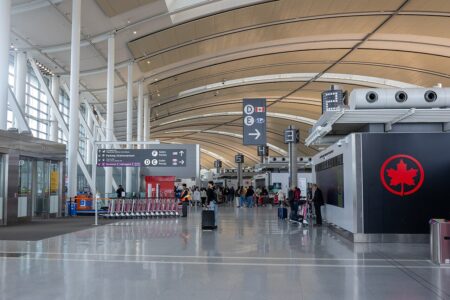




Major Canadian airlines flew 8.5 million passengers in August, up 3.7 per cent from a year earlier, even as total aircraft movements at Canada’s airports fell 3.6 per cent, Statistics Canada said Thursday.
The agency said the passenger count was essentially the same as in August 2024. It cautioned that the year-over-year comparison is flattered because August 2025 was disrupted by an Air Canada flight attendant strike that lasted almost four days and led to thousands of cancellations.
Passenger-kilometres rose 7.8 per cent to 24.4 billion, matching a 7.8 per cent rise in capacity to 27.7 billion available seat-kilometres. The load factor was 88.2 per cent, on par with 88.3 per cent a year earlier. Each passenger travelled an average of 2,889 kilometres, up 3.9 per cent. Level I carriers flew 214,000 hours, up 5.9 per cent, and took in $3.3 billion in operating revenue, up 15 per cent.
Aircraft movements at major and select small airports totalled 553,695. Local movements, which are often training flights, fell 8.1 per cent to 152,073, the sixth straight monthly year-over-year decline. Statistics Canada tied the slide to the steep rise in aviation fuel prices that began in March 2026.
Domestic itinerant movements dropped 2.6 per cent to 343,081, driven by smaller airports with flight-training activity. Movements of light aircraft weighing 2,000 kilograms or less fell 10.6 per cent, a loss of 15,135 movements. At the four largest airports, domestic itinerant movements rose, led by Toronto Pearson, up 780 movements or 5.3 per cent.
Transborder movements rose 1.3 per cent to 39,960, the second monthly increase after 15 months of declines. Other international movements rose 7.7 per cent to 18,581.
Wildfires that ramped up in July continued to affect regions in August. In British Columbia, where a province-wide state of emergency was declared, movements related to fire response rose at Castlegar (357 movements, up 94.2 per cent) and Cranbrook (515 movements, up 52.8 per cent).
Across the summer, total movements were 1.7 million, down 3.0 per cent from summer 2025, as fuel costs stayed elevated. By our calculation, August’s 3.6 per cent fall in movements was slightly steeper than the 3.0 per cent drop for the summer as a whole.
Statistics Canada said the Monthly Civil Aviation Survey’s last publication will be for September 2026. The figures are in the agency’s release.
Airline costs have been in the news. Air Canada added a $30 phone booking fee and dropped five U.S. routes, and the carrier and United are seeking a joint-venture renewal. Fuel prices have also been rising, as we reported when crude topped US$100.
If you find reporting like this useful, consider supporting Canada News Media, an independent Canadian newsroom with no corporate parent.
Follow Canada News Media
Get the day's top Canadian stories and our two daily 60-second news videos wherever you scroll.
X Threads Facebook Instagram LinkedIn TikTok YouTube Pinterest Reddit Substack Flipboard Newsletter RSS