


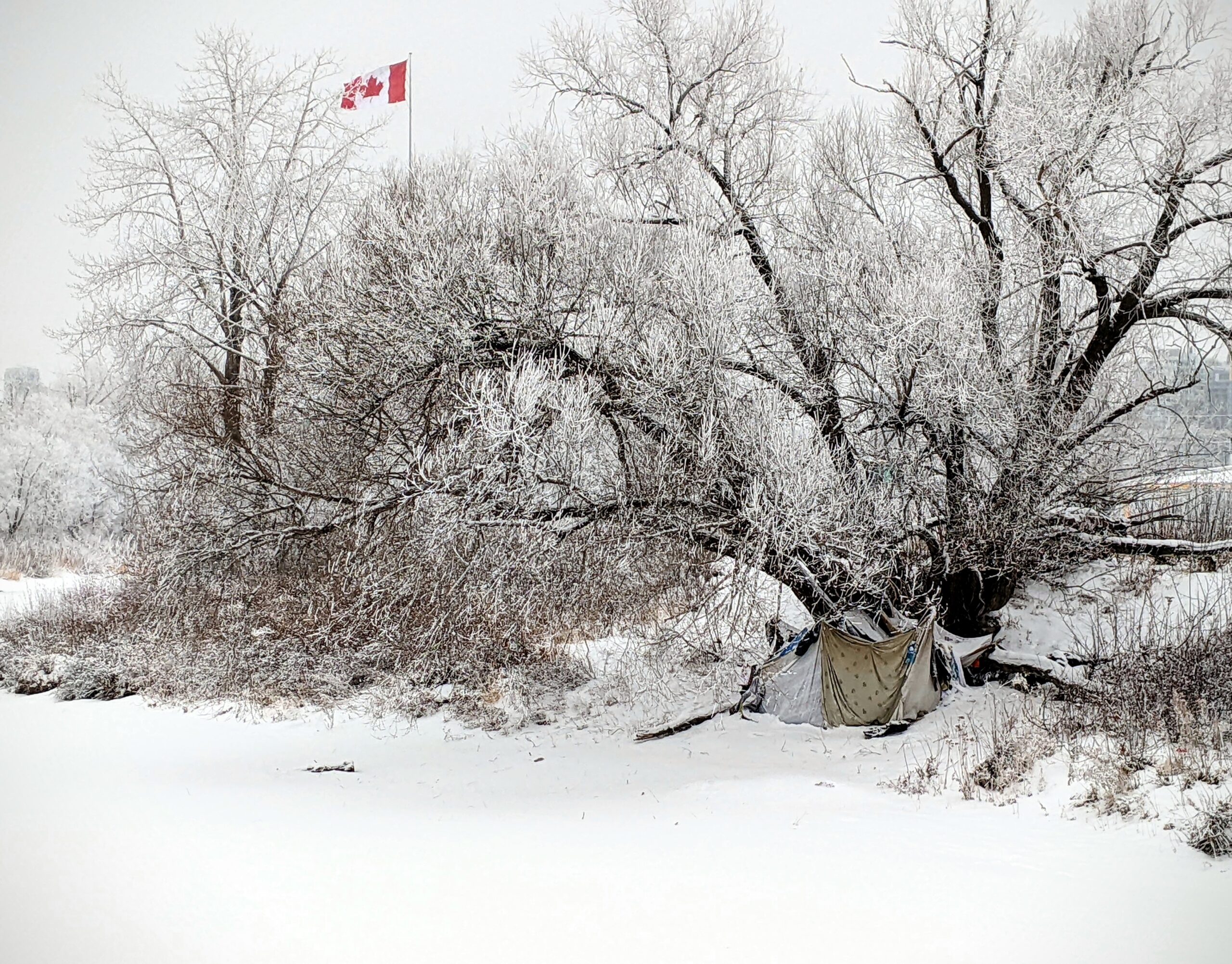
Calgarians filed 6,124 requests to the city about homeless encampments in the first 10 months of 2026, down 19 per cent from 7,560 in the same months of 2025 and 21 per cent below the record pace of 2024, a Canada News Media analysis of the City of Calgary’s 311 records shows. Even after the drop, the number is more than three times what it was before the pandemic, when residents filed 1,786 such requests from January to October 2019.
The city logs the requests under a single service type, “Corporate – Encampment Concerns,” which residents can file by phone, online or through the 311 app. The full-year totals rose every year from 1,944 in 2019 to 2,591 in 2020, 3,441 in 2021, 5,315 in 2022, 7,124 in 2023 and a high of 8,679 in 2024, before easing to 8,459 in 2025. The busiest single month on record was August 2024, with 1,105 requests.
The decline this year is spread across most months. In April 2026 the city received 464 encampment requests, compared with 769 in April 2025 and 818 in April 2024. July had 701 against 1,061 a year earlier, August 857 against 987, and October 753 against 963. February was the exception, with 344 requests this year against 162 last year. From Nov. 1 to Nov. 19, the city logged 374 more.
The concerns are no longer confined to the downtown core. In all of 2019, residents filed at least one encampment request about 166 of the city’s communities. So far in 2026, requests have come from 229 communities. The Beltline remains the community with the most requests, with 550 from January to October, up from 487 in the same period of 2025 but well below 795 in 2024. Bowness, in the city’s northwest along the Bow River, had the second-highest count this year with 266, up 45 per cent from 183 a year earlier. Downtown East Village and Bridgeland-Riverside each had 211, followed by Mission with 185, Montgomery with 157 and Sunalta with 145.
Some communities saw sharp drops. Downtown East Village fell from 396 requests in the first 10 months of 2025 to 211 this year, and Greenview Industrial Park, which had 204 last year, is no longer among the top 12.
The city’s records list two city business units as responsible for the requests, Calgary Community Standards and Emergency Management and Community Safety. Of the 6,498 encampment requests filed in 2026 up to Nov. 19, 261 were still listed as open and the rest as closed. The data show that 2,798 came in through the 311 app.
The 311 records measure how often residents report a concern, not how many people are sleeping outside or how many encampments exist. One encampment can generate many calls, a single caller can report several sites, and a request can be closed once staff have looked at it, whether or not anything changed on the ground. The data do not say what the city did in response to each request, whether people were connected with housing or shelter, or why the number of requests fell this year. Possible explanations include changes in where people are camping, changes in city outreach or enforcement, shelter capacity, weather and how willing residents are to call. The records do not measure any of these, and no person or organization is accused of anything here.
Residents who see someone in immediate danger should call 911. Non-emergency concerns about encampments can be reported to 311, and 211 Alberta can connect people with shelter and other social services.
If you find reporting like this useful, consider supporting Canada News Media, an independently owned Canadian newsroom.
How we checked: We queried the City of Calgary’s 311 Service Requests open dataset on Nov. 21, 2026, when the newest request in the file was dated Nov. 19, 2026. We counted every request with the service name “Corporate – Encampment Concerns” by the month and year it was requested, and by the community named in the record. The service type first appears in the records in April 2018, so full-year comparisons start in 2019. Comparisons between years use January to October so that the partial month of November does not distort them. Counts of communities include any community with at least one request. The file also lists the source of each request, its status and the city business unit responsible. Percentages are rounded. No right of reply was needed because the story reports a pattern in the city’s own records and makes no allegation against any person or organization.
Follow Canada News Media
Get the day's top Canadian stories and our two daily 60-second news videos wherever you scroll.
X Threads Facebook Instagram LinkedIn TikTok YouTube Pinterest Reddit Substack Flipboard Newsletter RSS