


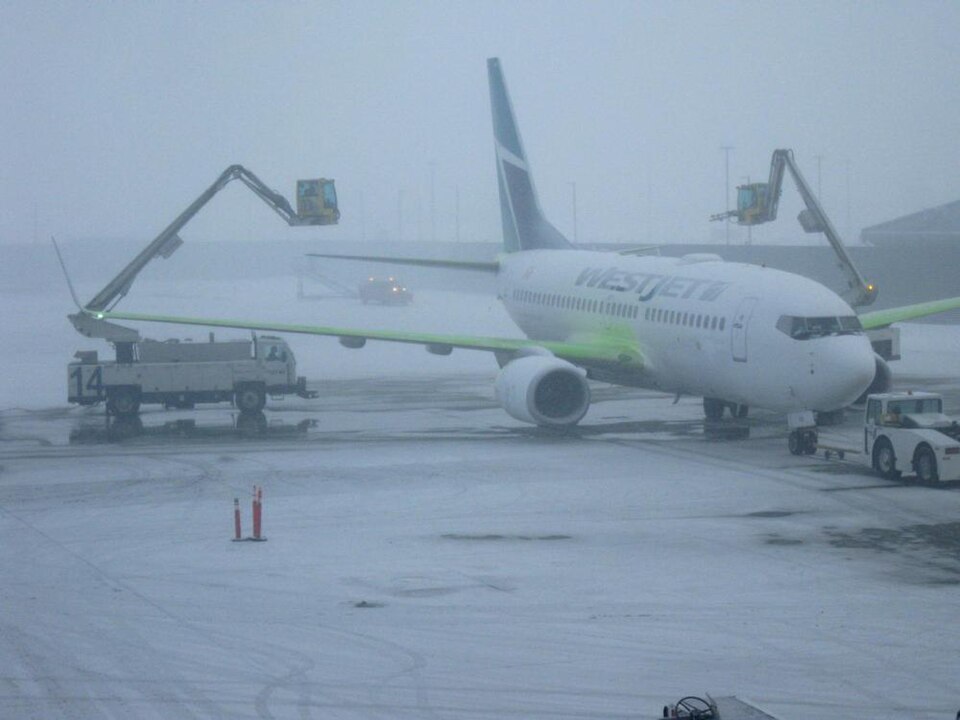
Fluid sprayed on planes to clear snow and ice has become the largest single pollutant reported released onto land in Canada, according to a Canada News Media analysis of the National Pollutant Release Inventory. Airports and de-icing companies reported 16,557 tonnes of ethylene glycol released to land in 2024, the most in at least a decade and up 81 per cent from 9,150 tonnes in 2015.
Ethylene glycol, the main ingredient in many aircraft de-icing fluids and in car antifreeze, made up 72 per cent of all releases to land measured in tonnes in the 2024 inventory, 16,750 of 23,262 tonnes. Almost all of it, 99 per cent, came from airports, de-icing operators and fluid recyclers at airports. The glycol is toxic if swallowed and can use up oxygen in streams as it breaks down, which is why airports collect much of the spent fluid on de-icing pads and send it for recycling or treatment. What reaches the inventory as a release to land is the part facilities estimate was not captured.
The yearly figure tracks flying and winter weather. It fell to 7,677 tonnes in 2020, when the pandemic grounded most flights, and has been between about 13,900 and 16,600 tonnes in each year since 2021. The 2024 total was the highest in the 2015 to 2024 records we examined.
Where the glycol is reported has shifted. Toronto Pearson International Airport reported 9,470 tonnes in 2019 and 1,446 tonnes in 2024. Over the same years, Calgary’s de-icing operator, AeroMag 2000 YYC, became the biggest single source, reporting 1,588 tonnes in 2023 and 5,757 tonnes in 2024; it does not appear in the 2019 records. AeroMag’s Edmonton operation reported 2,603 tonnes in 2024 and Edmonton International Airport itself reported 2,451, while AeroMag’s Vancouver operation reported 1,047 tonnes, up from 308 a year earlier. Inland Technologies’ recovery facilities reported 882 tonnes at Winnipeg, 469 at Ottawa and 391 at Halifax. Smaller airports in Prince George, Kitchener, Regina, Saskatoon and Sault Ste. Marie, Ont., each reported about 100 to 130 tonnes.
Alberta’s airports and their contractors alone reported about 11,000 tonnes in 2024, roughly two-thirds of the national total. The inventory does not say why, but the figures depend on how many flights need de-icing, how cold and snowy a winter is, which company at an airport files the report, which type of fluid is used and how much is recovered, and a change in any of those can move a facility’s number sharply. A drop at one airport can also reflect a move to fluids that are not on the inventory’s substance list or a switch in who reports.
De-icing is a safety requirement: federal aviation rules bar takeoff with frost, ice or snow on critical surfaces. Nothing in the inventory shows that any airport or contractor broke a permit or a law, and none is accused of doing so here. The inventory counts only facilities above its reporting thresholds, so smaller airfields are not included. Total releases to land in the inventory nearly doubled over the decade, from 12,489 tonnes in 2015 to 23,262 in 2024; besides glycol, the other big contributor was an in-situ oil sands site in Alberta that reported 4,161 tonnes of hexane and benzene to land in 2024.
How we checked: We downloaded the National Pollutant Release Inventory’s bulk releases file from Environment and Climate Change Canada’s NPRI data service, kept the 2015 to 2024 reporting years and added up releases to land in tonnes by substance, year and facility. We counted as airport-related every facility classed under air transportation support or airport operations, every facility named as an airport, and the de-icing companies AeroMag and Inland Technologies. Facility names are as reported, and totals are rounded to the nearest tonne.
Follow Canada News Media
Get the day's top Canadian stories and our two daily 60-second news videos wherever you scroll.
X Threads Facebook Instagram LinkedIn TikTok YouTube Pinterest Reddit Substack Flipboard Newsletter RSS