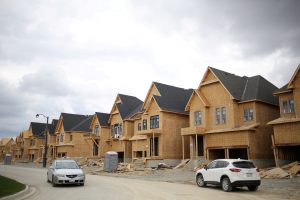



Builders in Canada’s big cities started 25,380 freehold single-detached houses in the first 10 months of 2026, the fewest for that stretch of the year in annual comparisons going back to 1989, according to our analysis of Canada Mortgage and Housing Corporation figures published by Statistics Canada.
CMHC defines a freehold, or homeowner, unit as a residence where the owner owns both the dwelling and the lot outright. The detached count in census metropolitan areas was down 9.1 per cent from 27,908 in January to October 2025 and 10 per cent from 28,187 in the same months of 2019. In 2002 it was 70,852.
Counting every type of freehold home, including semi-detached houses and freehold rows, builders started 42,639 units, the fewest for January to October since 1995, when there were 35,710. That is down 8.1 per cent from 46,414 a year earlier and about half the 86,749 started in the same months of 2002. Freehold homes made up 25.4 per cent of all big-city starts, the smallest January-to-October share since at least 1989. The share was 32.2 per cent in 2019 and 70.9 per cent in 1997.
We reported on Nov. 20 that condo starts had fallen to their lowest level for the period since 2009 while rental starts set a record. Taken together, the two kinds of new homes usually sold to owners, freehold and condo, came to 69,473 starts, the fewest for January to October since 1996. The total was 88,409 in 2025 and 100,015 in 2019, so it has fallen 21.4 per cent in a year and 30.5 per cent since 2019.
Toronto’s metropolitan area started 4,605 freehold homes, its lowest January-to-October count in the data back to 1989. The previous low was last year’s 5,468, and the 2026 figure is 15.8 per cent below it. In the same months of 2002, Toronto started 27,108, so the count is down 83 per cent. Detached freehold starts in the area fell to 1,986 from 2,708 in 2025 and 3,388 in 2019, while freehold rows came to 2,487. CMHC’s fall housing supply report had already said that Toronto’s ground-oriented freehold starts were at record lows after more than two decades of decline, as we reported in September.
The drop is steeper in some neighbouring markets. The Hamilton area started 243 freehold homes, half of last year’s 482 and 84 per cent fewer than the 1,554 it started in 2019. Freehold row starts there went from 893 in 2019 to 60 this year. The Oshawa area started 553, below its previous low for the period of 641 in 2009. Trois-Rivières, Thunder Bay, Sault Ste. Marie and the Quebec side of Ottawa-Gatineau also posted their lowest counts for these months since at least 1989, several of them from small bases.
Not every market is moving the same way. The Ontario side of Ottawa-Gatineau started 3,609 freehold homes, up 36.6 per cent from 2,642. Calgary started 7,891, down 12.9 per cent from 9,058, and Edmonton started 7,769, down 10.8 per cent from 8,711, but both remain well above their 2019 totals of 4,595 and 5,095.
Fewer starts do not by themselves mean there are no new houses to buy. Finished but unsold new single and semi-detached homes reached 7,568 across Canada’s census metropolitan areas in October, in a separate CMHC series that leaves out rows and condos, the most for any October since 1990, and Calgary’s count was a record 1,567. The starts and unsold-home figures measure different things, and neither shows how much unsold stock has affected what builders start.
The starts figures do not say why the counts fell. Possible factors include what buyers can afford and borrow, unsold inventory, construction and land costs, municipal zoning and charges that affect what gets built on a lot, and a wider move toward apartments, including purpose-built rentals. The table does not measure how much any of these contributed, and it does not include prices, so it cannot show whether new freehold houses have become cheaper or more expensive.
For households hoping to buy a new house on its own lot, the figures point to a smaller number of newly started homes of that kind in the big cities, particularly in the Toronto, Hamilton and Oshawa areas, though buyers in some markets may find finished homes still waiting for an owner. Buyers can ask a builder whether a home is freehold or part of a condominium corporation, which affects monthly fees and who is responsible for shared property.
The comparisons have limits. A start is generally counted when the concrete has been poured for the whole footing around a structure, so it is not a finished home. Intended market is the tenure in which a unit is offered, and a freehold home may later be rented out by its owner. Statistics Canada updates the boundaries of metropolitan areas after each census and says the data are therefore not strictly comparable over long periods. The 2026 figures stop at October, and later revisions are possible. The data cover metropolitan areas, which include suburbs and nearby towns, and not rural Canada.
How we checked: We downloaded Statistics Canada table 34-10-0148-01, CMHC housing starts by dwelling type and intended market, on Nov. 25. We added the monthly figures for January to October for every year from 1989 to 2026; the table begins in June 1988, so 1988 was left out. National figures come from the table’s own line for total census metropolitan areas and local figures from each area’s line. “Detached” means the table’s single units in the homeowner market, and the freehold share is homeowner starts divided by starts in all five market types, including co-op and a small other category. The freehold definition and the definition of a start come from CMHC’s survey methodology page. Percentages are our calculations. The unsold-home figures come from our earlier analyses of StatCan table 34-10-0149-01. This story reports official totals and makes no allegation against any person or organization.
Follow Canada News Media
Get the day's top Canadian stories and our two daily 60-second news videos wherever you scroll.
X Threads Facebook Instagram LinkedIn TikTok YouTube Pinterest Reddit Substack Flipboard Newsletter RSS