


Canada’s three big grocers did not follow the same path while food prices climbed. Loblaw’s retail gross margin rose from 29.5 per cent in 2020 to 31.3 per cent in 2025, Empire’s rose from 24.9 per cent in the fiscal year ended May 2020 to 27.1 per cent in fiscal 2026, and Metro’s was 19.9 per cent in fiscal 2020 and 19.4 per cent in fiscal 2026, with the company blaming the most recent dip on a strike. Over the same stretch, Statistics Canada’s price index for food bought in stores rose 28.0 per cent from 2020 to 2025.
Those are the grocers’ own reported numbers, set beside the federal price index. They do not show price gouging, and the companies’ margins cannot be compared with one another, for reasons explained below. They do show that the share of each sales dollar the grocers keep after paying for the goods they sell has changed by very different amounts at each company.
Start with Loblaw. In its year-end news releases, the retail segment’s adjusted gross profit was $15,300 million on $51,859 million of revenue in 2020, a margin of 29.5 per cent. The margin was 30.7 per cent in 2021, 30.9 per cent in 2022, 31.0 per cent in 2023 and 31.3 per cent in both 2024 and 2025. In 2025, a 53-week year, gross profit was $20,032 million on $63,903 million of revenue. Retail adjusted net earnings, a measure that is not part of standard accounting rules, rose from $1,499 million in 2020 to $2,913 million in 2025, an increase of 94 per cent. The margin has been flat for two years, so the most recent gains came from sales growth, not a fatter margin.
Empire, which owns Sobeys, Safeway and FreshCo, shows a steadier climb. Its gross margin was 24.9 per cent in fiscal 2020, 25.5 per cent in 2021, 25.4 per cent in 2022, 25.6 per cent in 2023, 26.3 per cent in 2024, 26.8 per cent in 2025 and 27.1 per cent in fiscal 2026, which ended May 2, 2026. Gross profit grew from $6,633 million to $8,664 million. Empire’s reported net earnings fell to $198 million in fiscal 2026 from $700 million the year before because of large one-time items; adjusted net earnings were $747 million, up from $711 million.
Metro is the exception. Its gross margin was 19.9 per cent in fiscal 2020, 20.0 per cent in 2021 and 2022, 19.7 per cent in 2023 and 2024 and 19.9 per cent in 2025. In fiscal 2026, which ended Sept. 26, 2026, it fell to 19.4 per cent. Metro’s results released Nov. 18 say a labour conflict at its Laval produce distribution centre cut gross profit by an estimated $127 million and operating income by $132 million. Net earnings were $886.1 million, down 13.1 per cent from $1,019.5 million. Between fiscal 2020 and 2025, Metro’s sales rose 22.3 per cent and its adjusted net earnings rose 26.6 per cent while its margin did not move.
The food price index tells the other half. Statistics Canada’s consumer price index for food purchased from stores, with 2002 equal to 100, averaged 151.1 in 2020, 154.4 in 2021, 169.5 in 2022, 182.8 in 2023, 186.9 in 2024 and 193.4 in 2025. Between September 2019 and September 2026 the index rose 34.7 per cent nationally, against 24.8 per cent for all items. By province, the rise ranged from 33.5 per cent in Quebec to 37.4 per cent in Alberta, so the national figure holds across the country.
The margins cannot simply be lined up and compared, because the three companies do not sell the same things. Loblaw sells pharmacy products, clothing and general merchandise as well as food. Empire sells fuel. Metro franchises many of its stores, which changes what counts as its own sales. A rising margin can also reflect a shift to higher-margin private-label products, cost savings, supplier deals or changes in how costs are classified, none of which these filings separate. The numbers cannot say whether any price was too high.
Each company was sent the figures and questions before publication. Loblaw was first asked on Nov. 12 and, at its request, given until Nov. 19 to respond; on Nov. 19, Candace Beres of Loblaw’s media relations team wrote that the company was “not going to be able to accommodate your request in time.” Empire, asked on Nov. 12 through the media address listed in its own results release, did not respond by the Nov. 17 deadline. Metro was sent the figures and questions on Nov. 23, through the media address on its press contact page, and had not responded by the deadline of 5 p.m. ET on Nov. 25.
The questions covered the reasons for the change in each company’s margin, how much of its earnings growth came from higher gross profit rather than lower costs or other factors, whether our figures matched its records, and anything else it wanted readers to know about how it sets prices. The Competition Bureau’s 2023 grocery market study, published June 27, 2023, and the Grocery Code of Conduct, which took full effect Jan. 1, 2026, deal with related questions about competition and supplier terms, but neither sets or reviews grocers’ margins.
How we checked: We read each company’s own year-end news releases and annual reports for Loblaw (2020 to 2025), Empire (fiscal 2020 to 2026) and Metro (fiscal 2020 to 2025, plus its fourth-quarter 2026 report of Nov. 18, 2026) and took gross profit, revenue and net earnings as reported, noting restatements, 53-week years and one-time items. We downloaded Statistics Canada table 18-10-0004-01 and calculated annual averages of the monthly food-purchased-from-stores index, and the September 2019 to September 2026 change for Canada and each province. Margins are each company’s own measure and are not comparable across companies. We sent each company the figures and questions with at least two working days to respond.
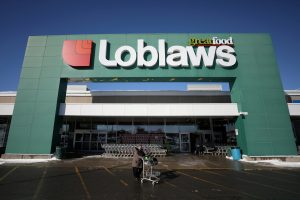
File photo: a shopper leaves a Loblaws grocery store in Ottawa, Feb. 14, 2019. REUTERS/Chris Wattie
Follow Canada News Media
Get the day's top Canadian stories and our two daily 60-second news videos wherever you scroll.
X Threads Facebook Instagram LinkedIn TikTok YouTube Pinterest Reddit Substack Flipboard Newsletter RSS