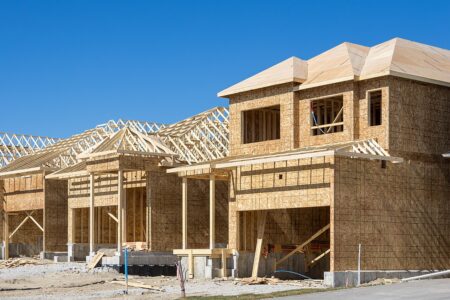






Just 156 condominium units started construction in the City of Toronto during the first six months of 2026. The annual average over the previous decade was about 7,000.
That figure comes from the Canada Mortgage and Housing Corporation’s Fall 2026 Housing Supply Report, released Sept. 10, and it is the sharpest illustration of a shift the federal housing agency says has quietly reshaped what the country builds. Canada’s housing shortfall is no longer spread evenly across the market. It is concentrating in the homes people buy.
CMHC estimates Canada is on pace to build roughly 231,000 homes a year through 2036. Returning affordability to 2019 levels would require between 417,000 and 469,000 starts annually, leaving a gap of 187,000 to 238,000 homes every year for a decade. Global News, reporting on the release Sept. 10, put the requirement plainly: Canada would have to roughly double its current building rate.

What is being built has changed as much as how much. Purpose-built rental apartments now account for two-thirds of all apartment starts across the major markets CMHC examined, while condominium and ground-oriented construction has weakened sharply in Toronto, Vancouver, Ottawa and Montreal. In the Toronto area, rental apartment starts rose 82 per cent in the first half of 2026 compared with the same period in 2025, the only major housing category to grow. Rental apartment starts overtook condominium apartment starts for the first time since 1994.
Toronto shows the divide at its most extreme. Population-adjusted housing starts in the first half of 2026 were the lowest since 1996, setting aside 2025. The inventory of permitted units waiting to break ground has fallen 50 per cent from its 2023 peak. Ground-oriented freehold starts sit at record lows after more than two decades of decline, and condominium launches have largely stalled on weak presales, thin investor demand and heavy resale inventory. CMHC estimates the city needs 21,000 to 26,000 additional starts a year, an increase of at least 50 per cent, to restore 2019 affordability.

The consequence runs further than ownership. Condominiums and ground-oriented homes have historically fed the secondary rental market, the units individual owners lease out. CMHC notes that the rental pipeline now under way has brought Toronto’s rental market closer to balance, but that fewer condo completions in the years ahead will strip out that secondary supply just as the new purpose-built stock is absorbed.
The agency is explicit about where it sees the risk. “As a result, the greater long-term risk may not be excessive rental construction,” the report reads. “Instead, it may be insufficient condominium and ground-oriented housing supply that leaves too few ownership options when demand strengthens again.”
The picture is not uniform. Montreal carries the largest estimated annual supply gap among the major markets CMHC examined, needing 42,000 to 56,000 additional starts a year. Ottawa needs another 22,000 to 27,000, Vancouver 5,000 to 7,000 and Calgary 4,000 to 5,000. Edmonton stands alone with no measurable gap, because construction there has generally kept pace with population growth. That contrast matters: it suggests the shortfall elsewhere is a function of how much gets built relative to demand, not an inevitability of Canadian housing economics.
CMHC says renters in Vancouver, Toronto, Ottawa and Montreal are likely to see affordability relief sooner than would-be owners, precisely because recent construction has skewed toward purpose-built rental. The projected supply gap has narrowed in Toronto and Calgary for different reasons, with Toronto helped by falling home prices and Calgary by a genuine pickup in construction. Vancouver’s gap is roughly unchanged year over year.
The report is reasonably direct about why developers are not launching ownership projects. “Construction costs remain high. Presale financing conditions remain difficult for some projects. Weak condominium market conditions continue to make developers cautious about launching new projects,” CMHC writes. Against that, it credits government financing programs, lower or deferred development charges and zoning reforms with improving project viability, though it notes those measures have landed most heavily on purpose-built rental.
That is the policy problem the report leaves on the table. The tools now working are the ones pointed at rental. The category falling fastest is the one nobody has built an equivalent lever for. CMHC’s closing warning is that recent affordability gains, real as they are, could prove difficult to sustain if construction fails to keep pace when demand strengthens again.
Sources: CMHC Fall 2026 Housing Supply Report; Global News, Sept. 10, 2026; Real Estate Magazine, Sept. 14, 2026.
Follow Canada News Media
Get the day's top Canadian stories and our two daily 60-second news videos wherever you scroll.
X Threads Facebook Instagram LinkedIn TikTok YouTube Pinterest Reddit Substack Flipboard Newsletter RSS