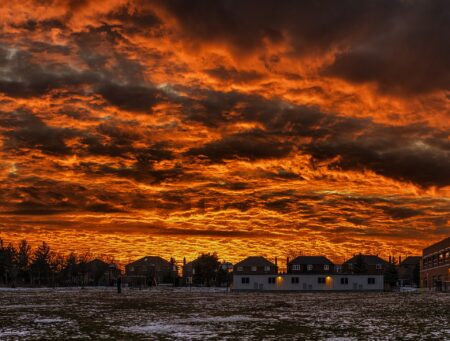



Winter 2026 begins in Canada on Monday, Dec. 21, at 20:50 UTC, the moment of the December solstice. That is 3:50 p.m. in Eastern time, 2:50 p.m. in Central, 1:50 p.m. in Mountain and 12:50 p.m. in Pacific time, and it is also the shortest day of the year.
Updated Nov. 18, 2026.
First day of winter 2026: key facts
| Item | 2026 answer |
|---|---|
| Date of the solstice | Monday, Dec. 21, 2026, in every Canadian time zone |
| Moment of the solstice | 20:50 UTC (3:50 p.m. EST) |
| Atlantic and Newfoundland time | 4:50 p.m. AST and 5:20 p.m. NST |
| Central, Mountain and Pacific time | 2:50 p.m. CST, 1:50 p.m. MST and 12:50 p.m. PST |
| Meteorological winter | Began Dec. 1 and runs to the end of February |
| Spring equinox | March 20, 2027 |
What time does winter start in each Canadian time zone?
The solstice is a single instant for the whole planet, so the clock reading depends on where you live. At 20:50 UTC it is 12:50 p.m. in Vancouver and Victoria, 1:50 p.m. in Edmonton and Calgary, 2:50 p.m. in Regina, Saskatoon and Winnipeg, 3:50 p.m. in Toronto, Ottawa and Montreal, 4:50 p.m. in Halifax and Fredericton, and 5:20 p.m. in St. John’s. Whitehorse, on Yukon’s year-round Mountain time, sees 1:50 p.m., and Iqaluit, on Eastern time, sees 3:50 p.m.
Astronomical winter is not the only definition. Meteorologists treat December, January and February as winter, so the season they track started on Dec. 1. Calendars and almanacs use the solstice.
Why is Dec. 21 the shortest day of the year?
Earth’s axis is tilted about 23.4 degrees. On the December solstice the Northern Hemisphere is tilted as far from the sun as it gets, so the sun rides low in the sky and the daylight hours are at their minimum. The farther north you are, the bigger the effect: Toronto gets about 8 hours 55 minutes of daylight on Dec. 21, Edmonton gets 7 hours 26 minutes, and Iqaluit gets 4 hours 18 minutes.
The shortest day does not bring the earliest sunset or the latest sunrise. In southern Canada the earliest sunsets arrive in early December and the latest sunrises in early January, because the clock and the sun drift apart slightly through the year. Our earliest sunset guide for 2026 lists those dates by city.
How much daylight will my city get on Dec. 21, 2026?
The table shows sunrise, sunset and total daylight on the solstice for 18 cities. The figures are Canada News Media calculations from each city’s coordinates, rounded to the minute and using local standard time; expect differences of a minute or two from other sources, and for your exact address use the National Research Council’s sunrise/sunset calculator. Places north of the Arctic Circle, including parts of Nunavut and the Northwest Territories, get no direct sunrise at all around the solstice.
| City | Sunrise | Sunset | Daylight |
|---|---|---|---|
| Victoria | 8:02 a.m. | 4:20 p.m. | 8 h 17 min |
| Vancouver | 8:05 a.m. | 4:15 p.m. | 8 h 9 min |
| Edmonton | 8:48 a.m. | 4:15 p.m. | 7 h 26 min |
| Calgary | 8:37 a.m. | 4:31 p.m. | 7 h 53 min |
| Regina | 8:56 a.m. | 4:56 p.m. | 7 h 59 min |
| Saskatoon | 9:13 a.m. | 4:56 p.m. | 7 h 42 min |
| Winnipeg | 8:24 a.m. | 4:29 p.m. | 8 h 4 min |
| Toronto | 7:48 a.m. | 4:43 p.m. | 8 h 55 min |
| Ottawa | 7:39 a.m. | 4:22 p.m. | 8 h 42 min |
| Montreal | 7:31 a.m. | 4:13 p.m. | 8 h 41 min |
| Quebec City | 7:27 a.m. | 3:58 p.m. | 8 h 31 min |
| Fredericton | 8:05 a.m. | 4:43 p.m. | 8 h 38 min |
| Halifax | 7:48 a.m. | 4:36 p.m. | 8 h 47 min |
| Charlottetown | 7:52 a.m. | 4:28 p.m. | 8 h 35 min |
| St. John’s | 7:46 a.m. | 4:11 p.m. | 8 h 25 min |
| Whitehorse | 11:10 a.m. | 4:46 p.m. | 5 h 36 min |
| Yellowknife | 10:07 a.m. | 3:03 p.m. | 4 h 56 min |
| Iqaluit | 9:22 a.m. | 1:41 p.m. | 4 h 18 min |
How different is the shortest day from the longest?
Using the same method for June 21, 2026, Edmonton had 17 hours 1 minute of daylight and will have 7 hours 26 minutes on Dec. 21, a drop of 9 hours 35 minutes. Toronto went from 15 hours 25 minutes to 8 hours 55 minutes, a drop of 6 hours 30 minutes. Vancouver fell from 16 hours 14 minutes to 8 hours 9 minutes, and Halifax from 15 hours 33 minutes to 8 hours 47 minutes.
The gap is largest in the Prairies and the North and smallest toward the south and the coasts, which is why a Calgary or Edmonton winter afternoon feels so short compared with Toronto or Halifax.
When do the days start getting longer?
The gain starts on Dec. 22 but is tiny at first. By Dec. 31 Toronto has about three more minutes of daylight than on the solstice and Edmonton about six. By Jan. 21, 2027, Toronto has 9 hours 28 minutes (up 33 minutes), Edmonton 8 hours 19 minutes (up 53 minutes), Vancouver 8 hours 51 minutes (up 42 minutes) and Halifax 9 hours 23 minutes (up 36 minutes). The spring equinox follows on March 20, 2027.
What is happening around the solstice in Canada?
The solstice lands four days before Christmas, so the long nights overlap with school breaks and holiday hours. Check our guides to school winter break dates by province and what’s open on Christmas Day by province.
Short days also change the commute. In Edmonton, Saskatoon and Regina the sun is up for less than eight hours on the solstice, so many people drive to and from work in the dark. Our guide to winter driving rules by province covers tire requirements, chains and fines, and it is worth checking before the first long trip of the holidays.
Frequently asked questions
What time does winter start on Dec. 21, 2026?
The solstice happens at 20:50 UTC on Dec. 21, which is 3:50 p.m. Eastern, 2:50 p.m. Central, 1:50 p.m. Mountain, 12:50 p.m. Pacific, 4:50 p.m. Atlantic and 5:20 p.m. in Newfoundland.
Is Dec. 21 the shortest day of the year in Canada?
Yes. It is the day with the least daylight in every part of Canada, although the earliest sunset comes a little before it and the latest sunrise comes in early January.
Does winter always start on Dec. 21?
No. The solstice falls on Dec. 21 or Dec. 22 depending on the year. In 2026 it falls on Dec. 21 in every Canadian time zone.
Is the first day of winter different for meteorologists?
Yes. Meteorologists count Dec. 1 to the end of February as winter because it makes seasonal statistics easier to compare, so meteorological winter began on Dec. 1.
When do the days start getting longer?
Right after the solstice, but slowly. Edmonton gains about six minutes of daylight by Dec. 31 and about 53 minutes by Jan. 21, based on our calculations.
Sources: the solstice moment is calculated from standard astronomical algorithms and matches a Dec. 21 date in all Canadian time zones; sunrise, sunset and daylight figures are Canada News Media calculations using each city’s coordinates and the NOAA solar equations, and the National Research Council’s sunrise/sunset calculator is the official Canadian tool for exact local times. Time zones follow the legislated zones in each province and territory.
If you find reporting like this useful, consider supporting Canada News Media, an independently owned Canadian newsroom.
Follow Canada News Media
Get the day's top Canadian stories and our two daily 60-second news videos wherever you scroll.
X Threads Facebook Instagram LinkedIn TikTok YouTube Pinterest Reddit Substack Flipboard Newsletter RSS