

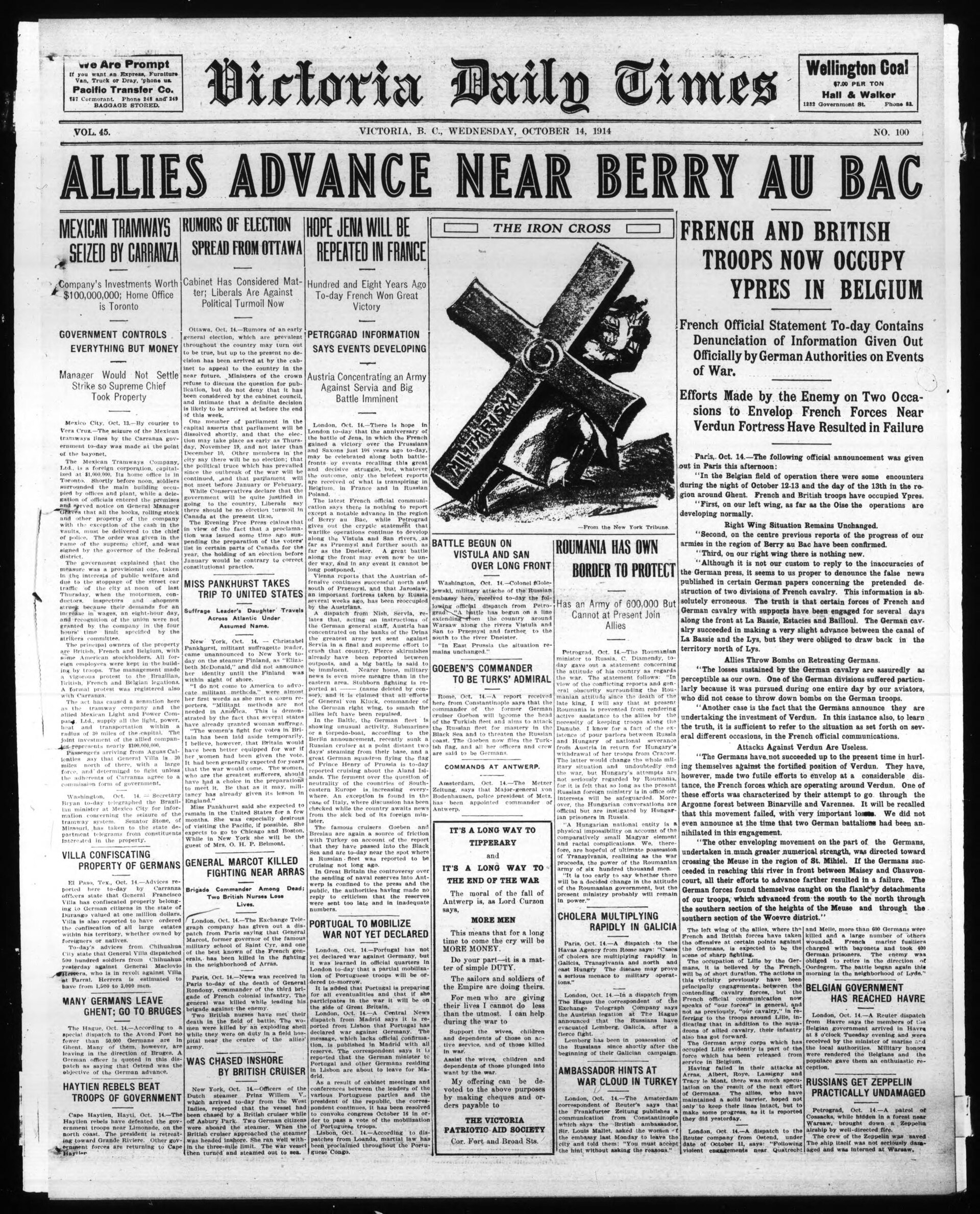
The first large contingent of the Canadian Expeditionary Force reached Plymouth, England, on Oct. 14, 1914, ending a two-week Atlantic crossing by more than 30,000 Canadian volunteers on the way to the First World War.
The Canadian War Museum describes the voyage as an extraordinary achievement for a country that had only gone to war that August. Royal Navy ships escorted a convoy of more than 30 ocean liners, and Lt.-Gen. E.A.H. Alderson led the force.
A timeline published by CMEA-AGMC puts the convoy at 32 ships escorted by 10 British warships, carrying 33,000 men, 7,000 horses and 144 18-pounder field guns, along with engineers, signallers, medical and veterinary units and the Army Service Corps. It calls the convoy the largest armed force to have crossed the Atlantic to that date.
The figures are not identical across sources. The Canadian War Museum speaks of more than 30 ships and more than 30,000 volunteers, and a Times of London report quoted by the University of Victoria’s Canadian Great War Project said that disembarkation at Plymouth had accounted for “over thirty thousand troops.”
The same account said Plymouth had “the distinction yesterday of being the first to welcome the Canadian troops.” The Royal Canadian Dragoons, aboard the Laurentic, arrived a day later, on Oct. 15.
The Times described the crossing as smooth and the health of the men as excellent, and it reported that only 11 horses were lost on the voyage. Several hundred Newfoundlanders sailed with the Canadians and disembarked at Plymouth, the War Museum said. The Canadians travelled by train to Salisbury Plain.
The expedition had been assembled with remarkable speed. Britain’s declaration of war on Aug. 4, 1914, committed Canada automatically, and the federal government under Prime Minister Robert Borden promised an overseas force within days. Volunteers were gathered at a new camp at Valcartier, Que., and shipped out in October.
Conditions on arrival were better than what followed. The Globe reported that the last men reached Salisbury Plain early on a Sunday, with chilly weather that showed “no signs of rain.” Within days that changed. The Royal Canadian Dragoons’ war diary recorded on Oct. 19 that rain was forcing the horse lines to be moved every other day, and the diary called arrangements for the men at Pond Farm excellent but poor for the horses.
The soldiers were spread across camps at West Down South, West Down North, Bustard and Pond Farm. The War Museum said they trained for four months, mostly in mud, during one of England’s wettest winters in decades.
The force crossed to France in early 1915 and fought as the 1st Canadian Division. Its first major test came at the Second Battle of Ypres that April, where Canadian troops held their ground after the first large-scale German use of poison gas on the Western Front.
The crossing also set a pattern. Canada would send far more men overseas than anyone in 1914 expected, and the country’s army, industry and diplomacy would emerge from the war changed. Canada signed the Treaty of Versailles in 1919 as a separate signatory.
Sources for this article include the Canadian War Museum, the CMEA-AGMC timeline, and the University of Victoria’s Canadian Great War Project, which draws on contemporary reports from The Times and The Globe and on the Royal Canadian Dragoons’ war diary.
If you find reporting like this useful, consider supporting Canada News Media, an independent Canadian newsroom with no corporate parent.
Follow Canada News Media
Get the day's top Canadian stories and our two daily 60-second news videos wherever you scroll.
X Threads Facebook Instagram LinkedIn TikTok YouTube Pinterest Reddit Substack Flipboard Newsletter RSS