

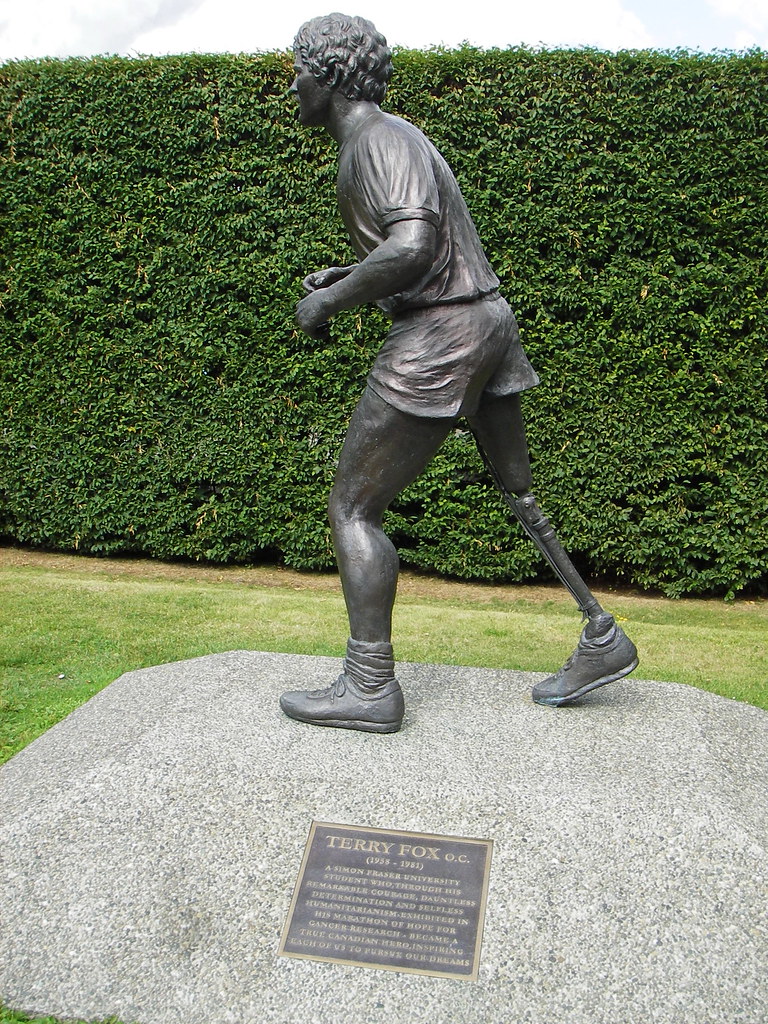
On September 1, 1980, Terry Fox stopped running. Outside Thunder Bay, Ontario — 143 days and 5,373 kilometres after dipping his artificial leg into the Atlantic Ocean at St. John’s, Newfoundland — the 22-year-old was forced to end his cross-Canada Marathon of Hope after doctors discovered that the cancer which had taken his right leg three years earlier had spread to his lungs, according to the Canadian Encyclopedia and CBC News.
Fox had begun the run on April 12, 1980, setting out to average a marathon a day — about 42 kilometres — across the country to raise money for cancer research. He had lost his leg above the knee to osteosarcoma at age 18, endured 14 months of chemotherapy, and decided, from his hospital bed, to run across Canada. His goal was simple and audacious: raise one dollar from every Canadian.
Through the spring and summer of 1980, Fox ran through Atlantic Canada, Quebec, and Ontario, drawing larger crowds and more national attention with every province he crossed. But near Thunder Bay, a persistent cough and chest pain he had been pushing through for weeks turned out to be tumours in his lungs. On September 1, he called a press conference and told the country he could not continue. He died in New Westminster, British Columbia, on June 28, 1981 — a month before his 23rd birthday, according to the Canadian Encyclopedia’s timeline of his life.
The Marathon of Hope did not end when Fox stopped running. Within a day of the news, Isadore Sharp, founder of Four Seasons Hotels, contacted the Fox family with a commitment to organize an annual fundraising run in Terry’s name — a pledge made on September 2, 1980, according to CBC News. By February 1981, the Marathon of Hope fund had reached $24.17 million, meeting Fox’s original per-capita goal for a Canadian population of roughly 24 million at the time. The annual Terry Fox Run, now held in communities across Canada and dozens of other countries every September, has raised hundreds of millions of dollars for cancer research since 1980 — reported by CBC as approaching $800 million and, in more recent Terry Fox Foundation figures, as exceeding $850 million, reflecting the run’s continued growth between those counts.
What makes September 1, 1980 worth marking is not simply that a young man stopped running. It is that the stopping point became, almost immediately, a starting point for something larger and more durable than the roughly 8,000-kilometre coast-to-coast goal Fox never got to finish. Thunder Bay itself absorbed that moment into its civic memory: a monument now marks the spot on the Trans-Canada Highway where the run ended, and the city has marked milestone Terry Fox Run anniversaries in the decades since, as local outlet TBnewswatch.com has reported.
Four decades on, the September 1 anniversary tends to be overshadowed by the mid-September Terry Fox Run itself and by the April 12 anniversary of the run’s start. But the day Fox was forced to stop is arguably the hinge point of the whole story — the moment a personal athletic feat became, involuntarily, a national institution that persists today. It is a reminder that some of Canada’s most durable civic traditions began as unfinished business.
Follow Canada News Media
Get the day's top Canadian stories and our two daily 60-second news videos wherever you scroll.