


VICTORIA — The New Democrats have been forced to defend their Clean B.C. climate plan because of the discovery that the government’s own modelling says it will hurt the economy.
The province’s economic output would take a $28.1 billion hit according to the model, which was keyed to the Clean B.C. Roadmap for 2030, released earlier this year.
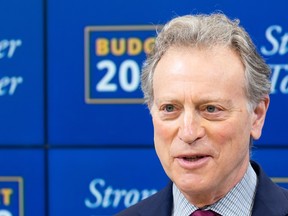
Leading the NDP effort to discredit the report is George Heyman, the cabinet minister for the environment and climate change.
Heyman dismissed the report as misleading, unhelpful and just plain wrong. When the Opposition cited the findings during question period, Heyman accused the other side of practising denialism on climate change.
He also suggested that if the province were to abandon the emission reduction target for 2030, it would consign B.C. to a future of record-breaking floods and wildfires.
The environment minister fired off a letter to the B.C. Business Council disputing the findings on a point-by-point basis.
The council responded this week with a six-page letter from chief economist Ken Peacock, co-author of the earlier analysis, and policy vice-president David Williams.
They began by dismissing the insinuation that the business council was fronting an exercise in climate change denial.
Rather, they were alarmed by the target of a 40 per cent reduction by 2030.
“The time frame is too short to allow for asset turnover, transition technologies, and enough electrification,” they wrote.
“As the government’s modelling shows, the main mechanism to achieve quick reductions in greenhouse gas (GHG) emissions by 2030 is to substantially downsize the B.C. economy, especially its export and industrial base.”
Note the emphasis on “the government’s modelling.”
Heyman, in his letter, suggested the council “had asserted” that Clean B.C. would have a $28.1 billion affect on the economy.
The council asserted nothing of the kind, wrote Peacock and Williams. “We are reporting that result from the government’s own economic modelling.”
Granted it was only a model. The impact could be lower. Or — ahem — higher.
The modelled impact “is large enough — roughly the equivalent of the province’s annual health care budget — that we are concerned.”
“We cannot afford to miss the economic opportunities in clean energy and clean technology, none of which was factored into the statistics that the business council offered British Columbians,” he argued during question period.
The business council duo pointed the environment minister back to the published contents of his own economic modelling report.
“Nowhere does the report suggest that uncertainty about the future energy economy should be taken to mean there are large, unambiguously positive economic gains for B.C. that are missing from the modelling and can be assumed to negate its findings,” they wrote.
“We find it hard to believe there is at least $28.1 billion of GDP in 2030 to be gained from ‘economic opportunities’ that are missing from the model and sufficient to overcome the GDP losses that are predicted by the model.”
Heyman invited the critics to consider the alternative: “You do not factor the considerable costs to the province and to industry in remediating climate change induced damages at multiple levels.”
That is because: “B.C.’s emissions are 0.19 per cent of global GHG emissions. This is not to say that we should not manage our emissions, but rather recognizing the reality that 99.81 per cent of global GHG emissions currently occur outside B.C.”
The government’s own model recognizes the limitations of what can be accomplished realistically here in B.C.: “Nowhere in the report do the modelers suggest CleanBC will independently alter the pace of change in the global climate — leading to cost savings for the provincial budget and industry that are missing from the modelling.
“We do not believe it is credible to suggest that implementing CleanBC would allow B.C. to avoid budgeting for the costs of extreme weather events or of making infrastructure more resilient.”
Instead they say the province “must budget to improve infrastructure resiliency and repair damage from extreme weather events, regardless of CleanBC. Indeed, it would be reckless not to do so.”

Follow Canada News Media
Get the day's top Canadian stories and our two daily 60-second news videos wherever you scroll.
X Threads Facebook Instagram LinkedIn TikTok YouTube Pinterest Reddit Substack Flipboard Newsletter RSS