



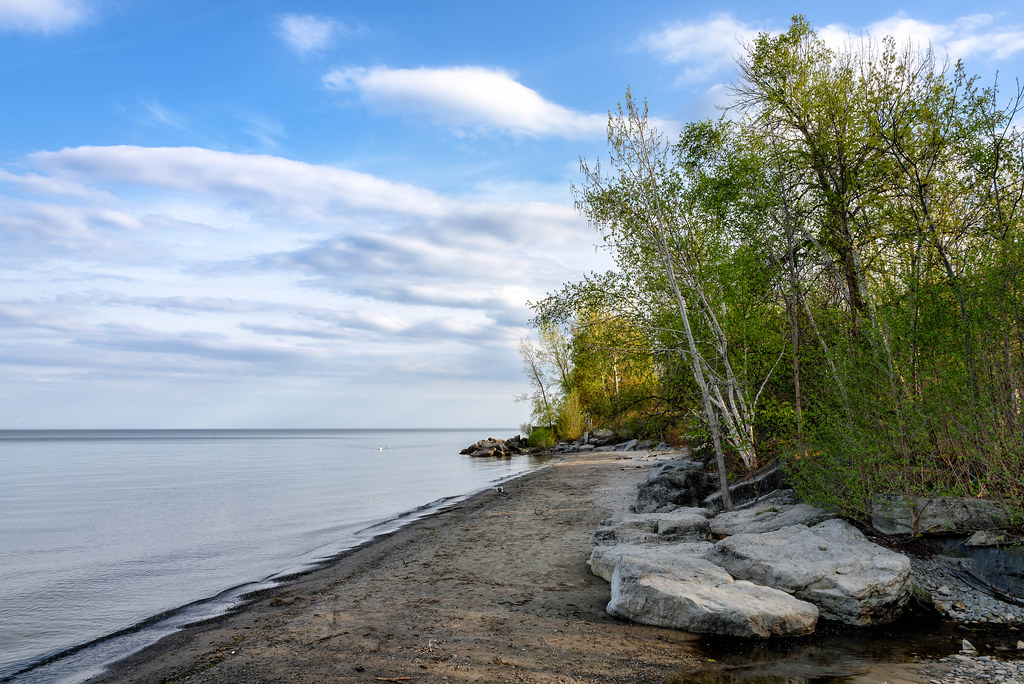
When President Trump signed an executive order last week directing the U.S. government to rename Lake Ontario “Lake America,” and Ontario Premier Doug Ford answered over the weekend with a two-storey-tall sign on the Canadian shoreline reading “Lake Ontario — Now and Always,” most coverage focused on the political theatre: the billboard, Trump’s remarks blaming Canada for tough trade talks, and Google’s decision to display the new name to U.S. users. What’s had far less attention is what an executive order can and cannot actually do to a lake that people were naming a millennium before either country existed — and what an almost identical fight over the Gulf of Mexico last year already revealed about how these renamings actually play out.
A Name Older Than Either Country
“Ontario” isn’t a settler invention up for a presidential edit. It descends from the Wyandot (Huron) word Ontarí:io, generally translated as “great lake” or “beautiful lake” — a root meaning “lake” combined with a suffix meaning “great” or “large.” The name was first recorded in writing in 1641, more than two centuries before Confederation and well over three centuries before Trump’s order. Samuel de Champlain, for what it’s worth, called it Lac Saint-Louis; the Kanien’kéha (Mohawk) name for the area around present-day Kingston was Katarokwi. Only “Ontario” stuck, adopted by European settlers directly from the Indigenous nations who lived on its shores. That history doesn’t settle the political dispute, but it complicates the idea that there is a single “American” or “Canadian” name in play to begin with — the name already belonged to neither government when this fight started.
How the Rename Actually Works — And Where It’s Been Tried Before
Trump’s order doesn’t rename the lake by itself. It instructs Interior Secretary Doug Burgum and the U.S. Board on Geographic Names to formally update the Geographic Names Information System within 30 days — the same federal database process used for the Gulf of Mexico order in January 2025. Google didn’t wait for that window to close: in an Aug. 29 blog post, the company said it was already applying its “long-standing policy for bodies of water with names that vary from country to country,” meaning Google Maps now shows “Lake America” to users in the U.S., “Lake Ontario” to users in Canada, and both names to everyone else. That is the exact three-way split Google applied to the Gulf of Mexico rename, which shows “Gulf of America” in the U.S., “Gulf of Mexico” in Mexico, and “Gulf of Mexico (Gulf of America)” elsewhere. It’s also worth noting how that precedent ended up in court: Mexico disputed the change and sued Google over it, a fight that dragged on for months. Canada hasn’t signaled a lawsuit — so far the response has stayed political, from Ford’s sign to Prime Minister Mark Carney’s statement that Canadians “know that naming reality means calling it Lake Ontario – then, now and always.”
What the Order Can’t Touch
Whatever the U.S. federal database eventually says, Lake Ontario remains a boundary water under the Boundary Waters Treaty of 1909, the 117-year-old bilateral agreement that gives the International Joint Commission authority over the lake’s water levels, water quality, diversions and navigation. An executive order renaming a geographic feature for U.S. federal purposes doesn’t amend that treaty, doesn’t alter the IJC’s jurisdiction, and has no legal standing in Canada, where the name carries forward unchanged in law, provincial jurisdiction and everyday use. Even inside the U.S., the rename hasn’t landed cleanly: New York Governor Kathy Hochul — whose state is the only one bordering the lake — said she won’t be using the new name, calling the whole exercise a distraction from “the real needs of Americans.”
The renaming didn’t happen in isolation — it followed the collapse of U.S.-Canada trade talks on Aug. 21 and Trump’s announcement of 50% tariffs on a broad range of Canadian goods, with Ottawa’s dollar-for-dollar retaliation set to take effect Sept. 8. Measured against that fight, a map label is symbolic rather than substantive. But the split-screen outcome — one name in an app depending on which side of the border you’re standing on — is likely to outlast this particular news cycle regardless of how the tariff dispute resolves.
via NPR (npr.org)