

Toronto Pearson International Airport is running four biometric boarding gates with Air Canada under a federal privacy law that was written in 2000, years before facial verification reached any Canadian departure gate.
The pilot puts one gate in Pearson’s domestic area and three in its United States transborder zone, according to the trade publication ID Tech, which reported the deployment on Sept. 11. A camera captures a live image of a traveller’s face and compares it against an approved traveller record, replacing the final passport and boarding pass check. Domestic passengers enrol through the Air Canada mobile app before reaching the gate. Transborder passengers can rely on the identity record already created during U.S. preclearance, so they need no separate sign-up. Dormakaba supplied the physical gates, SITA and Airsphere the middleware, and Air Canada the enrolment software and the identity gallery used for matching. Participation is voluntary, and travellers can still use the ordinary document check.
Pearson is not the only Canadian airport doing this. Air Canada’s digital identification option, which CBC News and CTV News reported on when it expanded to domestic departures at Vancouver International Airport, uses the same app-based enrolment and the same face-matching step at the gate. The technology is spreading across the country’s two busiest airports at once.
Almost all of the coverage has framed this as a capacity story, and the airport has encouraged that reading. Pearson handles about 47 million passengers a year and expects 65 million by the early 2030s. “We can’t keep thinking solely about adding physical infrastructure as the only way to expand capacity,” Mark Manickaraj, the airport’s executive director of digital products, data and AI, told BetaKit in a Sept. 10 article that was published as sponsored content presented by the Greater Toronto Airports Authority. Manickaraj said privacy is built into the program from the outset, and that the long-term goal is a traveller who never has to pull out a document.
What none of that coverage sets out is the legal floor underneath it. Canada has no dedicated federal statute governing facial biometrics. Private-sector collection falls under the Personal Information Protection and Electronic Documents Act, passed in 2000, which does not mention the technology. The most recent federal attempt to replace it, Bill C-27, died on the order paper when Parliament was prorogued in January 2025. Its successor, Bill C-36, received first reading on June 15 and would replace Part 1 of PIPEDA, recognize privacy as a fundamental right and create a new regulator with stronger enforcement powers, according to analyses published by the law firms Osler and DLA Piper. Three months later it is still at first reading, and still not law.
In the meantime, what governs the Pearson gates is guidance. The Office of the Privacy Commissioner issued its final guidance for processing biometrics in the private sector on Aug. 11, 2025, its first update since 2011. The law firm BLG, in its analysis of the document, noted that the guidance is not legally binding, that express consent is the general rule, and that organizations must ensure both technical accuracy and fairness, including minimizing performance differences across socio-demographic groups. That last requirement matters, because facial matching systems have repeatedly been shown to perform unevenly across skin tones and, in Canada, no public filing would tell a traveller how a given system performs. Federally, BLG noted, there is no requirement to conduct a privacy impact assessment before deployment and no requirement to notify the regulator at all.
Quebec is the exception, and the contrast is sharp. Under the province’s IT Act, an organization must declare a biometric system to the Commission d’acces a l’information at least 60 days before using a database of biometric characteristics, and a privacy impact assessment is mandatory. The same Air Canada gate, moved from Toronto to Montreal, would carry filing obligations that it does not carry in Ontario.
There is a reason that gap is not academic. On Sept. 11, 2025, almost exactly a year before the Pearson pilot surfaced, Italy’s data protection authority suspended the Faceboarding system at Milan’s Linate airport. Reuters and Biometric Update reported that the regulator found the operator, SEA, had stored biometric templates in its own centralized system despite saying they stayed on travellers’ phones, and had not encrypted them. The authority said there is no general ban on facial recognition at airports, only that this implementation was incompatible with EU law. The point is not that Pearson has done anything similar. The point is that Italy had a mechanism that surfaced the discrepancy and stopped the system while it was examined, and Canada does not have an equivalent one.
Manickaraj himself identified the missing piece. Canada, he said, has no national identity gallery that airports and airlines can draw on, which is why Pearson is working with Air Canada and the Canada Border Services Agency to build a foundation. The airlines, he added, want biometrics at every gate and lounge, not just at boarding. That infrastructure is being designed now. The law meant to govern it is sitting at first reading.
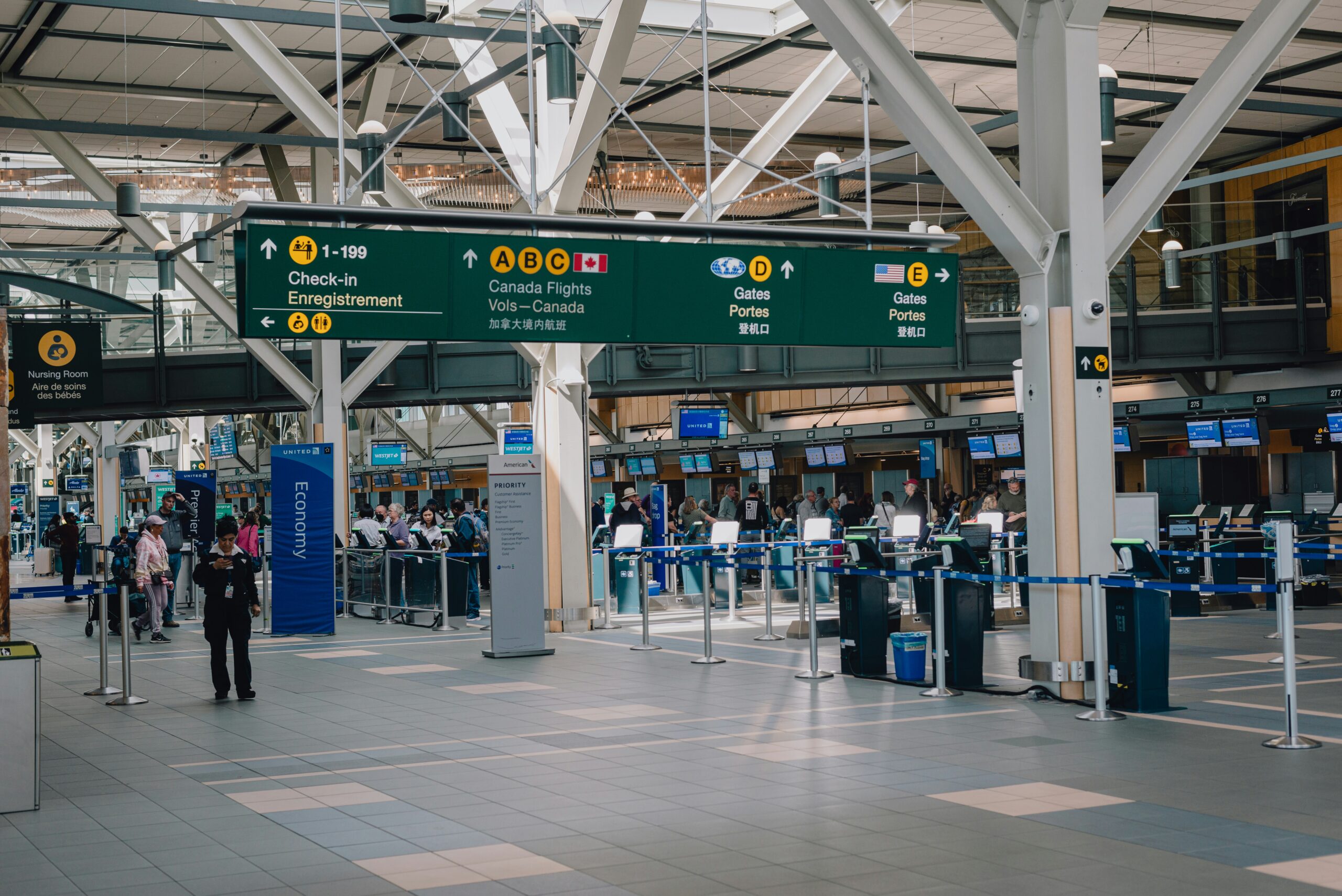
Reporting on the Pearson deployment via ID Tech. Featured photo shows the check-in hall at Vancouver International Airport, not Toronto Pearson, and is illustrative. Photo by Albert Stoynov via Unsplash.