Press release. The following was issued by Bau-Xi Gallery and is published as received. Canada News Media did not write or edit it.
Kyle Scheurmann | All That We Can Take
Bau-Xi Gallery | Dufferin
November 5 – 30, 2026
1384 Dufferin Street, Toronto
Opening reception: Thursday, November 5 | 5:30 – 7:30 PM | Artist in attendance
Artist talk: Saturday, November 28 | 1 PM
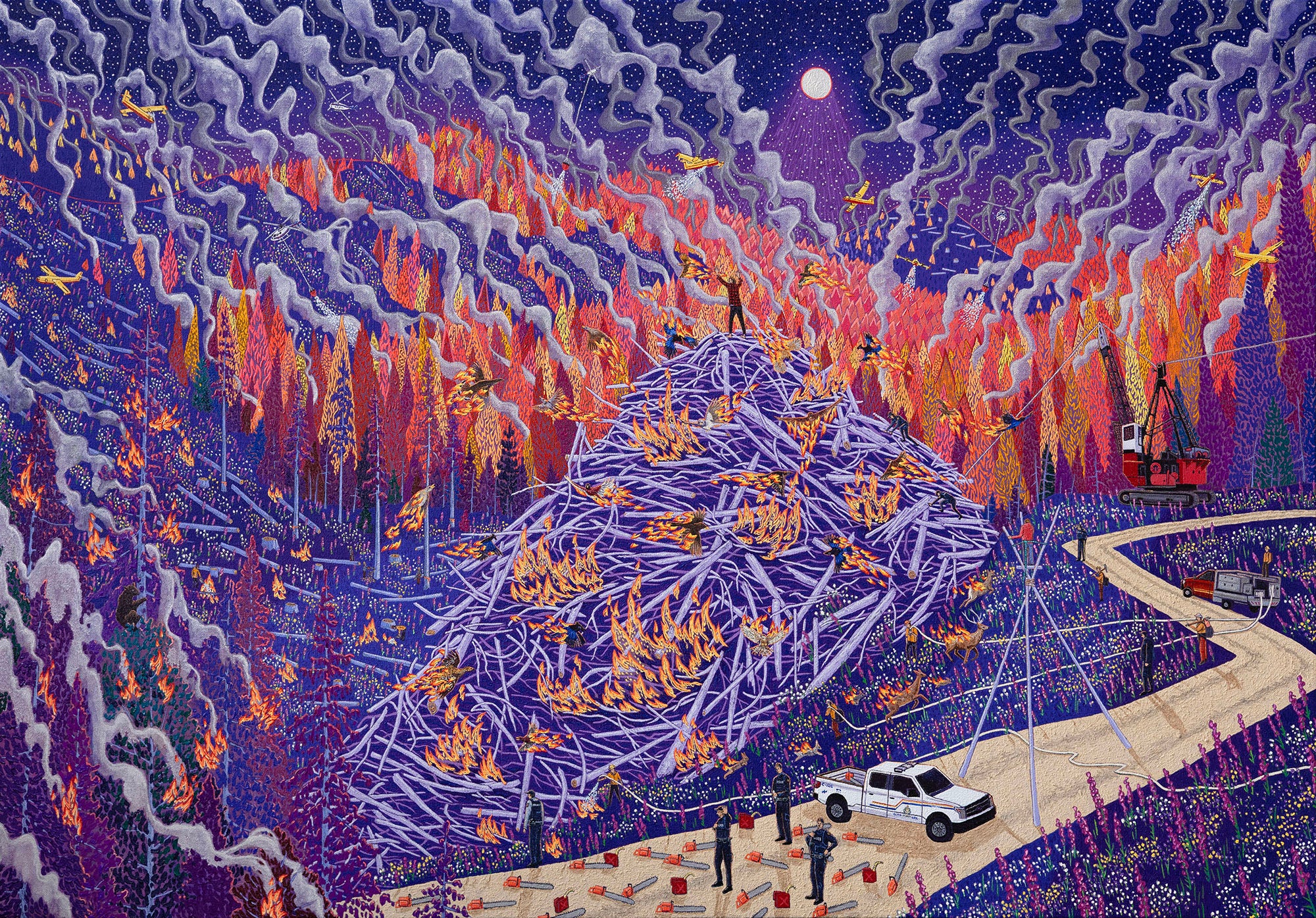
In his newest exhibition, All That We Can Take, artist and activist Kyle Scheurmann combines painting and environmental activism to confront the consequences of resource extraction and the urgent need to protect Canada’s remaining ancient forests.
The exhibition was inspired by Scheurmann’s return to Tree Farm Licence (TFL) 46 on Vancouver Island in April, where he discovered that an ancient forest he had worked to protect through landback blockades and legislative efforts had been logged for industrial resource extraction. This discovery became the starting point for a body of work shaped by grief, uncertainty, and a renewed sense of urgency.
Building on the Canadian landscape painting tradition, All That We Can Take challenges idealized representations of nature and asks what landscape painting can communicate in the face of today’s ecological crisis. The exhibition offers a deeply personal response to the destruction of endangered ecosystems while examining the complex relationships between land, industry, government, and environmental protection.
Scheurmann uses the landscape not only as a subject but also as a material, incorporating sawdust collected from TFL 46, cedar ash, fireweed flowers, sand, and charred animal remains into his meticulously rendered oil and mixed-media paintings. These materials serve as physical remnants of the landscapes and events depicted, establishing a direct material connection between the works and the environmental loss they contemplate.
Scheurmann’s commitment to conservation extends beyond the studio. Through his Art Auction for Old Growth, he has raised nearly $150,000 in support of the Nature-Based Solutions Foundation and its work to advance Indigenous-led protection plans and Indigenous Protected and Conserved Areas.
The opening reception will take place at Bau-Xi Gallery | Dufferin on Thursday, November 5, from 5:30 to 7:30 p.m., with the artist in attendance. An artist talk, hosted by Katie Marks of the ArtBeat Podcast, will follow on Saturday, November 28, at 1 p.m.
Artist statement
Some of the ancient forests that I’ve worked to save while living at blockades have now been cut. The enthusiasm, community building and tactical planning don’t always equate to lasting protection. But this spring, I visited an active old-growth cutblock at the site of a forest I’d been trying to save the legal way, using colonial system processes to initiate a permanent, government-approved protection. But the loggers still won.
It was a forest deep in Tree Farm Licence (TFL) #46 on southern Vancouver Island. It’s not that the strategizing, budgeting or planning were flawed. Everything was in place to establish a new Indigenous Protected and Conserved Area (IPCA), just as the federal government now recognizes as the most effective way towards protecting endangered ecosystems. We just simply didn’t get the money in time.
So, in late April, as fire season sparked early on the mountain, I hiked about a kilometre past the newly built cadmium red gate and into the detritus. What I saw there didn’t look much different than any of the other cutblocks I’ve scaled:
Dense pyres of tree parts rose out of the excavator-tracked earth.
Mechanical teeth waited along the blast-rock road for their operators to return in the morning.
Tall trees held scared Jays in their canopies, branded with neon tape looped around their torsos.
But what I felt there was new.
I thought I’d learned the hard lesson that a blockade at its best can only save a forest for a few hours or days – or maybe if you’re really lucky, a whole summer. I naively believed that working directly with the nation in a thoughtfully budgeted way would result in some patience on the other side of the negotiation. But in the end, the bid from the logging company was too lucrative for our charity-backed proposal and in a few short afternoons, thousands of years of continuous growth were cut, stacked, sorted and sold.
This exhibition is a painted attempt at navigating the new feeling I had while standing in that cutblock. What should I do now if the negotiated, nuanced, money-first method can come up short too?
I had originally imagined these new paintings to be narrative-rich visual essays of the wildfire-chasing, 3-month research trip I’d completed in anticipation of this new show. But then just as I started painting, I made a short, pointed trip back out west to see a cutblock I’d heard a rumour about…
Although flames still dot these images, the pictorial language has altered from urgent invitations of action into fearful acquiescence.
I can see it in the painted faces atop pensive painted postures, measuring a stump or priming a saw.
I can smell it in the ancient sawdust and ashy cedar char as I mix them into my iridescent palette.
I can hear it in the voices of my apprehensive friends as videos from my travels loop on the screen in the background while I work.
As hungry extractive industry tests the boundaries of All That We Can Take, what’s left of the forest shudders, silvers and eventually sparks.
Kyle Scheurmann, 2026
About Kyle Scheurmann
Born in Winnipeg, Manitoba in 1988, Kyle Scheurmann completed his Bachelor of Fine Arts at the Ontario College of Art and Design, Toronto in 2013. In 2018, Scheurmann completed his Master of Fine Arts at Emily Carr University of Art and Design, Vancouver, where he was given the honour of Valedictorian.
From 2019 to 2025, Scheurmann kept studios in remote, wooded locations to document the incremental approach of climate change while simultaneously working on conservation and activism efforts. In 2021, the artist was invited to participate in the Eden Grove AiR, a residency at the Fairy Creek Blockades on unceded Pacheedaht territory. During his four-month stay at the blockade camps, Scheurmann served not only as a resident artist but also as a journalist and legal witness in the face of the injustices carried out by law enforcement against Forest Protectors who were fighting to save some of the last remaining highly productive ancient forests in Canada.
Since this experience, Scheurmann has been working towards systemic and legislative approaches for permanent environmental protection, including aligning himself with the conservationist group, the Nature-Based Solutions Foundation (NBSF), as the founder and chief organizer of the Art Auction for Old-Growth. In 2024, two significant Kyle Scheurmann paintings were acquired by Global Affairs Canada for its permanent collection.
Notable artist residences include Island Mountain Arts Centre, Wells BC (2025), Harvest Moon Learning Centre, Clearwater, BC (2021 and 2022), Georgian Bay Land Trust, Georgian Bay ON (2020), Falcon Trails AiR, Falcon Lake MB (2018) and Kunstort ELEVEN Artspace in Starzach, Germany on the edge of the Black Forest (2018).
Works in the exhibition include “All That We Can Take,” 50 x 68 inches, oil, acrylic, sand, ashes, and fireweed flowers on canvas, 2026; “Sawdust Stardust (For EC),” 60 x 36 inches, oil, sand, and sawdust on linen, 2026; “Scorned from The Sky (For EC),” 60 x 36 inches, oil, acrylic, sand, and sawdust on canvas, 2026; and “Ghosts Across the Water,” 68 x 50 inches, oil, acrylic, sand, ashes, bones, and fireweed flowers on canvas, 2026.
Media contact
Bau-Xi Gallery | Toronto
416-977-0600
[email protected]
bau-xi.com
High-resolution (300 dpi) digital images are available upon request. For radio media: Bau-Xi is pronounced bow-she.
Follow Canada News Media
Get the day's top Canadian stories and our two daily 60-second news videos wherever you scroll.
X Threads Facebook Instagram LinkedIn TikTok YouTube Pinterest Reddit Substack Flipboard Newsletter RSS