

A small company of Black volunteers helped British forces win the Battle of Queenston Heights on Oct. 13, 1812, and the African-born veteran who first proposed it was not allowed to lead it, according to the Canadian Encyclopedia.
Richard Pierpoint, then roughly 68, pressed the Upper Canada government to raise a corps of men of colour on the Niagara frontier. The Dictionary of Canadian Biography records that his offer was refused at first.
The government reconsidered after American forces occupied Sandwich, now part of Windsor, Ont., on July 12, 1812, the Canadian Encyclopedia said. By late August a core company had formed in Niagara as part of the 1st Lincoln Militia. Command went to a white captain, Robert Runchey, not to Pierpoint, who enlisted as a private from Sept. 1, 1812.
Pierpoint was born around 1744 in Bondu, in present-day Senegal, the Dictionary of Canadian Biography said. Around 1760 he was taken prisoner and sold into slavery, and he was shipped to the American colonies and became the slave of a British officer. In the biography he is quoted describing himself as having been “made a Prisoner and Sold as a Slave.”
He won his freedom by serving with British forces in the American Revolution. By 1780 he was with Butler’s Rangers in the Niagara region, and his name appeared on a July 20, 1784, list of disbanded rangers who meant to settle there. About 1788 he received 200 acres on Twelve Mile Creek in what became Grantham Township. He sold the lots in 1806.
He had already asked for something more collective. On June 29, 1794, Pierpoint was one of 19 signatories to a petition from “Free Negroes” to Lt.-Gov. John Graves Simcoe. The petitioners asked for “a Tract of Country to settle on, separate from the white settlers.” An Executive Council committee rejected it on July 8, the biography said.
The Canadian Encyclopedia said the company grew to about 40 men after 14 Black soldiers were transferred from the 3rd York Militia in early October 1812. The Dictionary of Canadian Biography gives a smaller figure, 27 to 30 men not counting sergeants and officers. The sources do not agree on the exact strength, and it likely changed over time.
At Queenston Heights, the company marched with Maj.-Gen. Roger Sheaffe’s reinforcements, fired from the heights alongside Capt. John Norton’s Six Nations warriors, and then joined Sheaffe’s battle line, the Canadian Encyclopedia said. Along with the 41st and 49th Foot, it helped force the American surrender. Runchey was absent that morning and later resigned, and Lt. James Cooper of the 2nd Lincoln Militia temporarily commanded the company.
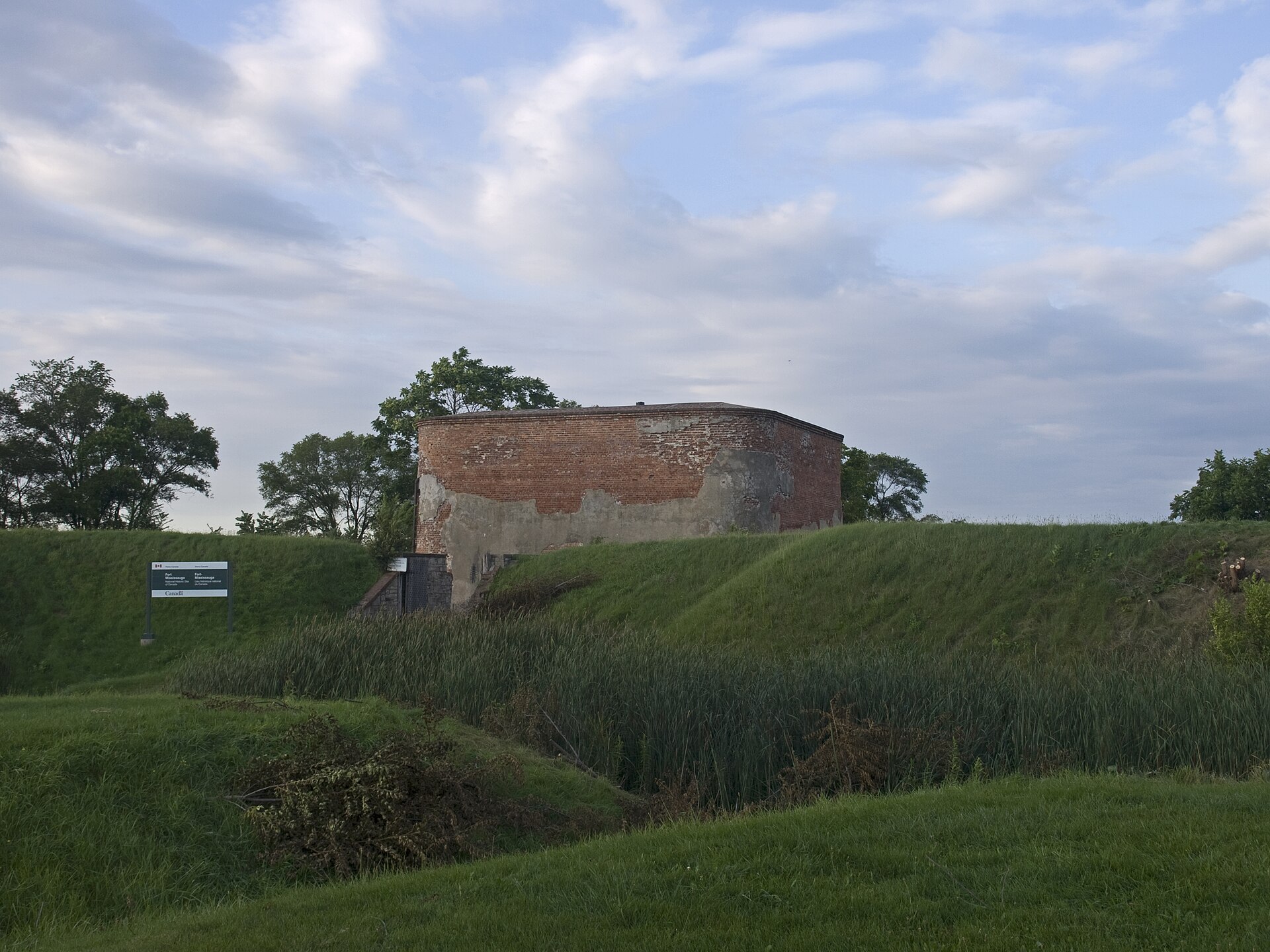
The unit, by then called the Coloured Corps, fought again at Fort George on May 27, 1813. It lost four men wounded or captured before naval gunfire forced it back, then withdrew with Brig.-Gen. John Vincent’s troops to Burlington Heights. After the British captured Fort Niagara on Dec. 19, 1813, it was attached to the Royal Engineers. In spring 1814 the men began building Fort Mississauga, the Canadian Encyclopedia said, and an engineer praised them as expert axemen in February 1815.
The company was disbanded on March 24, 1815. Pierpoint, in his 70s, asked to be sent to Africa in place of a land grant, and the request was denied, the Canadian Encyclopedia said. In a petition dated July 21, 1821, he told Lt.-Gov. Sir Peregrine Maitland it was “difficult to obtain a livelihood by his labor” and that he was “above all things desirous to return to his native country,” the Dictionary of Canadian Biography said.
He instead received a location ticket for 100 acres in Garafraxa Township, near present-day Fergus. The Canadian Encyclopedia said veterans of the corps received half the acreage given to white comrades, and that much of the land was poor. Pierpoint was the only one of three corps members in the area to take up his land, and in May 1825 he finished the settlement duties by clearing and fencing five acres and building a house.
He wrote his will on Jan. 28, 1828, describing himself as having “no heirs nor relations,” and left his farm to Lemuel Brown of Halton County. The will was proved on Sept. 27, 1838, and the biography said he died in 1838 or late 1837.
The service of Black Canadians did not end with the war. The Canadian Encyclopedia said another Coloured Corps was raised in Niagara during the Rebellions of 1837-38. The same pattern of exclusion followed Black volunteers into the next century, as Black volunteers were turned away until 1916. Other Black people arrived through the war itself, as nearly 2,000 Black refugees reached Nova Scotia after 1814, and the earlier fight over slavery in Upper Canada is told in the story of Chloe Cooley’s 1793 ordeal.
If you find reporting like this useful, consider supporting Canada News Media, an independent Canadian newsroom with no corporate parent.
Follow Canada News Media
Get the day's top Canadian stories and our two daily 60-second news videos wherever you scroll.
X Threads Facebook Instagram LinkedIn TikTok YouTube Pinterest Reddit Substack Flipboard Newsletter RSS