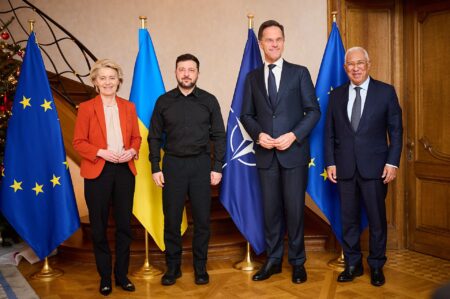



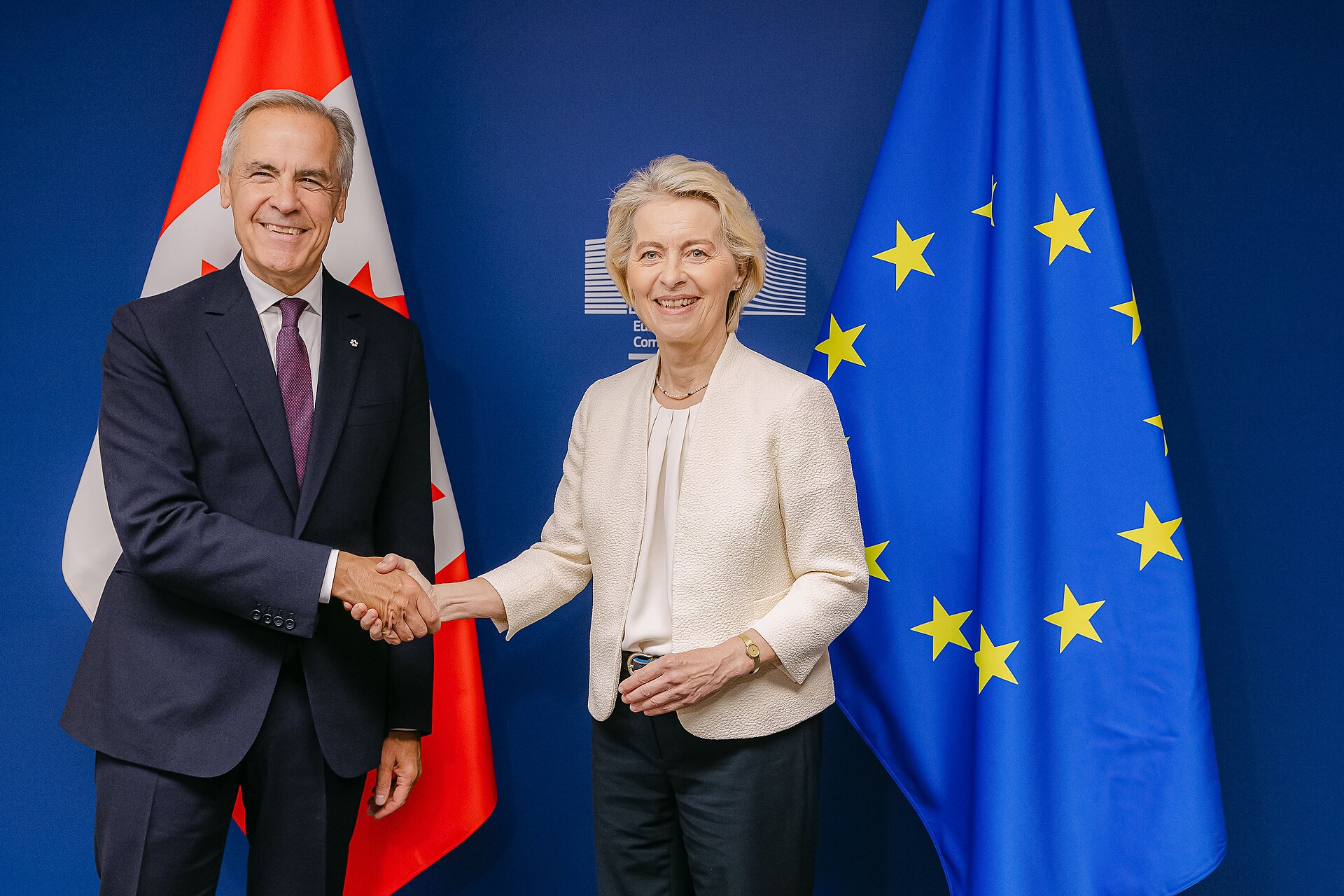
Canada and the European Union are expected to launch a new partnership at a summit in Montreal on Oct. 29 and 30, with draft deals on critical minerals, digital trade and the joint purchase of 50 De Havilland water bombers.
The summit follows European Commission President Ursula von der Leyen’s September invitation for Canada to become the EU’s first “associate member,” a status with no precedent in the bloc’s treaties. The United States takes close to 70 per cent of Canadian exports, down from 76 per cent a year earlier, The Hub reported, and Prime Minister Mark Carney has said he wants to double non-U.S. exports within a decade.
A draft joint statement seen by AFP, and reported by Canadian Affairs on Sept. 30, lists several agreements. They include a digital trade deal to allow “faster, lower cost secure digital trade and transactions,” a pact between competition authorities, and an arrangement that would let the European Investment Bank fund Canadian critical minerals projects.
The same draft says the two sides would jointly buy 50 water bombers from De Havilland, for wildfire duty by 2030, and that Canada would start negotiations to join the Erasmus student-exchange program. It also calls for a feasibility study on exporting liquefied natural gas from Canada to Europe.
A separate draft reported by The Hub, citing the Globe and Mail, describes the cooperation as an “alliance for the future.” It would give Canadian firms access to EU cloud and AI tenders, give Canada a role in the Galileo satellite system and ease European investment in Canadian critical minerals. Both drafts are subject to change.
What “associate member” would mean in practice remains unwritten. Carney told the European Parliament in Strasbourg on Sept. 17 that Canada welcomed the offer but is not seeking full EU membership. “The nomenclature, the precise nomenclature, is a question for Europe,” he said, according to Euronews, adding that the partnership is not a reaction to another country. He said any final structure would go to a vote in the Canadian Parliament.
U.S. President Donald Trump threatened “very serious tariffs” if the plan went ahead, calling it a hostile act, Euronews reported. The European Commission replied that the partnership “is not against anyone else, but for our common strength.” Canada’s Conservative opposition has criticized the idea as a possible transfer of sovereignty without a parliamentary mandate, the same report said.
Tobias Cremer, a German socialist member of the European Parliament and its standing rapporteur on Canada, said Oct. 23 that warm words are not enough. He told Euronews the relationship must be more than a “trade deal ‘plus’” and should offer “the closest possible partnership that the EU can offer to a non-European country.” He called Canada “probably the most European of non-European countries.”
Cremer proposed sectoral agreements covering trade, defence, digital cooperation, the Arctic and students, held together by a common institutional framework. He suggested Canada could sit as an observer in the Council of the EU and proposed a parliamentary partnership assembly modelled on the EU-U.K. body, which brings together 35 members from each side twice a year.
The Canada-EU trade agreement known as CETA has been provisionally applied since 2017, and any deeper arrangement would raise the same questions about national approvals. Canada News Media has examined why the associate-member idea has no basis in the EU treaties, and earlier reported the summit dates.
An Abacus Data poll cited by Euronews found 49 per cent of Canadians support Canada becoming an EU member, 30 per cent oppose and 21 per cent are unsure.
The Ukraine war will also hang over the Montreal meeting. Brussels is pushing for a seat at the next round of peace talks, as Canada News Media reported in its latest Ukraine talks story. A Politico report cited by ua.news said the partnership could also include support for Ukraine.
The summit opens Oct. 29. Whether it produces signed texts or only a declaration of intent will be the first test of how far the EU is willing to go.
If you find reporting like this useful, consider supporting Canada News Media, an independent Canadian newsroom with no corporate parent.
Via Euronews, Canadian Affairs and The Hub.
Follow Canada News Media
Get the day's top Canadian stories and our two daily 60-second news videos wherever you scroll.
X Threads Facebook Instagram LinkedIn TikTok YouTube Pinterest Reddit Substack Flipboard Newsletter RSS