

Article content
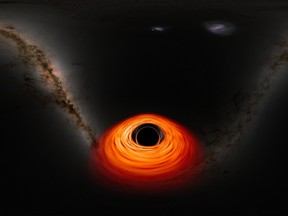
What would it be like to fall into a black hole, the densest object in the universe? A NASA astrophysicist and his trusty supercomputer have provided a stunning answer and even a way to experience it – minus the crushing gravitational forces and certain death that would accompany such a trip.
The videos, which have been uploaded to YouTube in both a flat-screen and 360-degree virtual reality versions, let viewers experience the mind bending (and light bending) visions of either flying around a black hole or, for the more adventurous, plunging directly into one. It is, in a word, trippy.
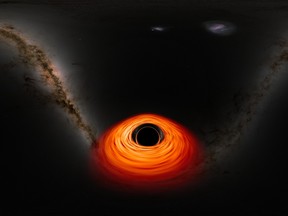
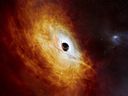
In the first version, the camera approaches what looks to be a jet-black orb, surrounded by a glowing orange ring. As it gets close, the ring seems to stretch and then flip itself inside out, before looping up like a fiery skipping rope suspended in space. In the second, the rope gets thinner and stretches out until it disappears into utter blackness.
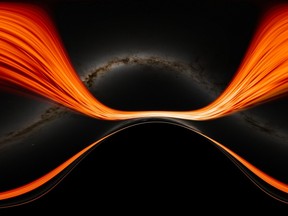
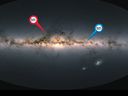
In both cases, the object is a supermassive black hole with 4.3 million times the mass of the sun. There’s one just like it at the centre of the Milky Way galaxy. It’s called Sagittarius A* (pronounced “A star”) and is more than 25,000 light years away, or 235 quadrillion kms. Far out.

NP Posted
Although there are short versions of the video that let you just watch the camera orbit or enter the black hole, slightly longer clips include more information about exactly what is happening.
The thin inner circle of light is called the photon ring, they explain, and is produced by light that has orbited the black hole before escaping again. It’s a region outside the so-called event horizon, which is the point beyond which nothing, not even light, can escape the black hole’s massive gravity.
-
 Universe’s brightest object was hiding in plain site, discoverers say
-
 Scientists have found both the oldest and nearest black holes
To create the visualizations, Schnittman and fellow NASA scientist Brian Powell used the Discover supercomputer at the agency’s Center for Climate Simulation. The 10 terabytes of data created would have taken more than a decade to process using a standard laptop, but the supercomputer was able to generate the video in just five days, using only a fraction of its computing power.
The simulations also show off the time dilation effects of being near a black hole, with Schnittman pointing out that, in the orbital simulation, a six-hour trip around the black hole would end with the astronaut returning having aged 36 minutes less than her less adventurous colleagues.
“This situation can be even more extreme,” he added. “If the black hole were rapidly rotating, like the one shown in the 2014 movie Interstellar, she would return many years younger than her shipmates.” Good to know that filmmaker Christopher Nolan got his science right on that one.

Follow Canada News Media
Get the day's top Canadian stories and our two daily 60-second news videos wherever you scroll.