
The company that owns the Port of Churchill says expanding the northern Manitoba port and upgrading the railway that feeds it would cost $2 billion to $3 billion, a small fraction of the $70 billion to $80 billion price Premier Wab Kinew has put on his own vision for the site, CBC News reported.
Arctic Gateway Group chief executive Chris Avery told CBC News the lower figure would cover new facilities at the port, upgrades to the 1,300-kilometre Hudson Bay Railway so it can carry heavier loads, and rebuilt rail service facilities at The Pas. Avery said that package works out to less than four per cent of the premier’s estimate.
The gap between the two numbers is not a dispute about the port. It is the liquefied natural gas project. Kinew has described a Churchill expansion built around a floating, offshore LNG platform in Hudson Bay, and that platform, rather than the docks or the track, is what carries the weight of his estimate. Avery said Arctic Gateway is not the proponent of an LNG pipeline to Churchill or of an LNG terminal on Hudson Bay, and that the provincial government is the party behind that effort.
Arctic Gateway’s stated role is narrower. Avery said the company’s focus is the range of commodities that could move through the port, naming critical minerals, potash, agricultural products and energy products, and said the company facilitates those shipments rather than sponsoring them.
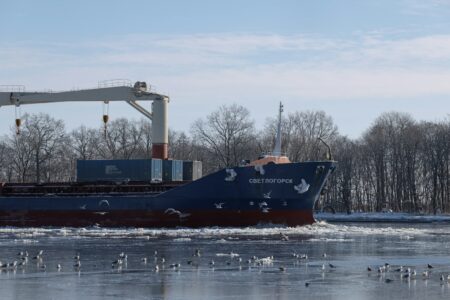
The distinction matters because of what Hudson Bay will and will not allow. Studies carried out as part of the expansion work found that freighters built to handle ice can safely move through the bay outside the existing four-month shipping season, the finding that underpins the case for something closer to year-round operation. The same work found that fully laden natural gas tankers cannot manoeuvre through the shallow, narrow entrance to the existing port. That constraint is why the LNG concept requires an offshore platform rather than a dockside terminal, and why its cost sits in a different order of magnitude from rail ties, grain handling and yard upgrades.
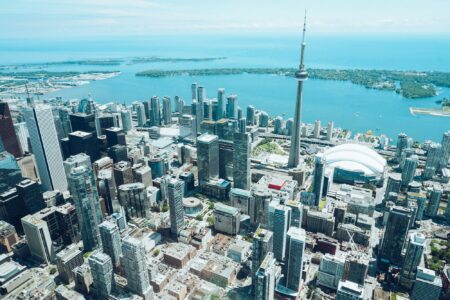
The two estimates surfaced as Kinew was pitching the project to international investors at the Canada Investment Summit in Toronto this week, the gathering Prime Minister Mark Carney’s government has built around roughly $1 trillion in prospective capital. Manitoba said ahead of the summit that it will waive its seven per cent provincial sales tax on major investments at the Port of Churchill, a measure aimed at improving the return on whichever version of the project attracts money.
Churchill is Canada’s only deepwater port on Hudson Bay and its sole deepwater port on the Arctic watershed, a position that has made it a recurring candidate for federal and provincial trade-corridor spending. Grain shipments through the port resumed this year, according to Arctic Gateway, and its near-term business remains the commodities Avery listed rather than gas.
For investors reading the two figures side by side, the practical question is which project is actually on offer. A $2-billion to $3-billion package of track, terminal and rail-yard work is a conventional infrastructure investment with a defined scope and an owner willing to put a number on it. An $80-billion offshore LNG platform is a different proposition, dependent on a proponent that has not been named, on regulatory approvals that have not been sought, and on ice conditions the studies treat as improving rather than settled.
Neither Kinew’s office nor Arctic Gateway has described the two plans as competing, and the rail and port work Avery costed would be needed under either scenario.
Follow Canada News Media
Get the day's top Canadian stories and our two daily 60-second news videos wherever you scroll.