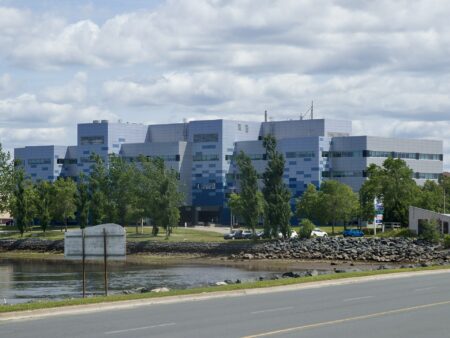




A paperboard and pulp complex that has operated for nearly a century in Temiscaming, Que., will shut down Sept. 15, putting 425 people out of work in a town of 2,500, and the company’s own public filings show it has been trying to sell part of the site since 2023.
RYAM, the Jacksonville, Fla.-based forest products company Rayonier Advanced Materials, announced the shutdown Aug. 27 and blamed United States tariffs. “Despite all the efforts we have made to adapt to this new reality, the magnitude of the tariffs no longer allows us to operate the site under sustainable conditions,” a company spokesperson said in an email reported by the North Bay Nugget. Spokesperson Alexandre Boucher said the duration of the shutdown “remains undetermined,” and that everything on the site will stop except the wastewater treatment plant and Boiler No. 4. RYAM acquired the mill from Tembec in 2017.
The tariff explanation is real. U.S. President Donald Trump signed proclamations in July imposing additional duties of up to 50 per cent on roughly $27.6 billion in Canadian goods effective Aug. 22, and wood and paper products including pulp were on the list, according to analyses published by the law firms Blakes and McMillan. Canada answered with counter-tariffs of 15, 25 and 50 per cent on an equivalent $27.6 billion in American imports, effective Sept. 8, and Ottawa announced $7.5 billion in support for affected workers and businesses.
What the coverage of this closure has not said is that the Temiscaming assets were already on the market. RYAM announced in October 2023 that it had engaged Houlihan Lokey to explore a sale of the paperboard and high-yield pulp assets at the site, describing the move as a way to optimize its portfolio and provide flexibility to “pay down debt and reduce leverage.” The company said afterward that it was running a process involving multiple suitors and remained committed to completing a near-term sale. No sale was ever announced.
The other half of the complex stopped earlier. RYAM suspended operations at its Temiscaming high-purity cellulose plant effective July 2, 2024, for what it then described as an indefinite period, citing market conditions, the plant’s high capital and fixed costs and its ongoing operating losses. The trade publication PaperAge described that plant in August as having been idled since July 2024. CTV News reported that 275 workers lost their jobs at that time.
That history matters for the question workers are actually asking, which is whether an undetermined shutdown becomes a permanent one. Unifor Quebec director Daniel Cloutier told CTV News there is no agreement that the mill reopens even if the tariff dispute is settled. “We do not even have an agreement that if the tariff solution would be fixed, then they will reopen. They said they could revisit the decision,” he said, adding that he expects to lose skilled workers from the region in the meantime. Ian Dunn, chief executive of the Ontario Forest Industries Association, told the same outlet the sector has seen consolidation “really across North America.”
The second thing the coverage has largely missed is where the workers live. About half of the 425 affected employees are Ontario residents and half are from Quebec, according to CTV News, which means a Quebec plant closure lands directly on households in northeastern Ontario. The complex sits about 45 minutes east of North Bay, Ont. It produces 150,000 tonnes a year of high-purity cellulose, high-yield pulp and coated paperboard, and Unifor says Canada accounts for about 20 per cent of the market for those products, with most of the rest shipped to the United States.
Dave Plourde, president of the Federation of Northern Ontario Municipalities, said chips from Ontario sawmills and wood-processing mills flow into the Temiscaming plant. “It just goes to show you that pain that they’re feeling in Quebec is affecting northern Ontario,” he said. Plourde called on FedNor and the Northern Ontario Heritage Fund Corporation to help suppliers and communities on the Ontario side, and said existing programs “must be coordinated, accessible and delivered quickly.”
Mayor Alain Gauthier, who worked at the plant for more than 20 years and ran it as general manager a decade ago when it employed 900 people, called the tariffs a “nuclear bomb” for industries that sell into the American market. His own figure is a measure of the decade: the site is shedding 425 jobs now, having already come down from 900. Gauthier said the town needs “a bridge to get across that river.” What he did not say, and what the company’s filings raise, is who would be waiting on the other side to buy it.
Reporting on the closure via CTV News. Corporate history drawn from RYAM’s own announcements and securities filings.
Follow Canada News Media
Get the day's top Canadian stories and our two daily 60-second news videos wherever you scroll.
X Threads Facebook Instagram LinkedIn TikTok YouTube Pinterest Reddit Substack Flipboard Newsletter RSS