

Canadian Space Agency astronaut Joshua Kutryk, born in Fort Saskatchewan, Alta., launched to the International Space Station on Thursday, Oct. 1, 2026, beginning a six-month mission that makes him the first Canadian on a long-duration station stay in nearly eight years. A SpaceX Falcon 9 rocket carrying the Crew-13 Dragon capsule lifted off at 11:10 a.m. EDT from Cape Canaveral Space Force Station in Florida, NASA said.
Kutryk, 44, a Royal Canadian Air Force test pilot and former CF-18 fighter pilot, is flying as a mission specialist alongside NASA commander Jessica Watkins, NASA pilot Luke Delaney and Roscosmos cosmonaut Sergey Teteryatnikov. NASA said the capsule was expected to dock autonomously with the forward port of the station’s Harmony module at about 7 p.m. EDT, which would be the fastest launch-to-docking by a U.S. spacecraft in the station’s history, at roughly seven hours and 50 minutes.
The flight is a milestone measured in years of waiting. Kutryk was selected by the Canadian Space Agency in July 2017, after an unsuccessful attempt in the 2009 recruitment, according to SpaceQ. He was first assigned to a 2024 flight on Boeing’s Starliner capsule, but that assignment was delayed indefinitely by the spacecraft’s technical problems, and he was moved to SpaceX. That makes him the first CSA astronaut, and the second Canadian after private astronaut Mark Pathy in 2022, to ride a Crew Dragon.
He is only the fourth Canadian to live aboard the station for a long-duration mission, following Robert Thirsk in 2009, Chris Hadfield in 2012-13 and David Saint-Jacques, who returned in June 2019 after launching in December 2018. Canada’s access to those seats is tied to its contributions to the station, most famously the Canadarm2 robotic arm, which means long gaps between missions are built into the arrangement.
For readers in the Edmonton region, the launch has a local thread. Kutryk was born in Fort Saskatchewan, northeast of Edmonton, and grew up near Beauvallon, northwest of Lloydminster. In remarks before the flight reported by Global News, he said he had “dreamt of going to space my whole life” and felt “a lot of Canadian pride” in the mission. He told SpaceQ he hoped younger Canadians would see space as part of a future where “countries are working together, not fighting.”
The science on board touches everyday health questions. NASA said the Crew-13 astronauts will grow human stem cell-derived tissues for personalized medicine and drug testing, test autonomous plant-growth systems for crop production, study blood-flow abnormalities in microgravity and try out new diagnostic devices for monitoring astronaut health. Kutryk is also carrying out Canadian research projects on how the human body responds to long stays in space, according to The Canadian Press. Industry Minister Mélanie Joly attended the launch, the news agency reported.
The bigger question for Canada is what comes after the station. Under its original Artemis agreement with the United States, Canada’s contribution of Canadarm3 to the planned Lunar Gateway outpost was expected to earn Canadian astronauts two opportunities to fly to the Moon, SpaceQ noted. NASA has since pivoted away from that Gateway architecture, and discussions about how Canada’s role in Artemis will evolve are continuing, the outlet reported. Fellow CSA astronaut Jenni Gibbons is set to serve as capsule communicator for Artemis III in 2027.
That uncertainty matters because the station itself has a limited future. NASA and its partners plan to retire the ISS around the end of the decade, and Canada has not yet publicly confirmed where its next long-duration flight opportunity will come from. Kutryk’s six months in orbit may be one of the last chances for a Canadian to live and work on the station before that transition.
Canadians can follow the mission through the Canadian Space Agency’s website and social channels, where the agency posts updates on Canadian experiments throughout the expedition.
If you find reporting like this useful, consider supporting Canada News Media, an independent Canadian newsroom with no corporate parent.
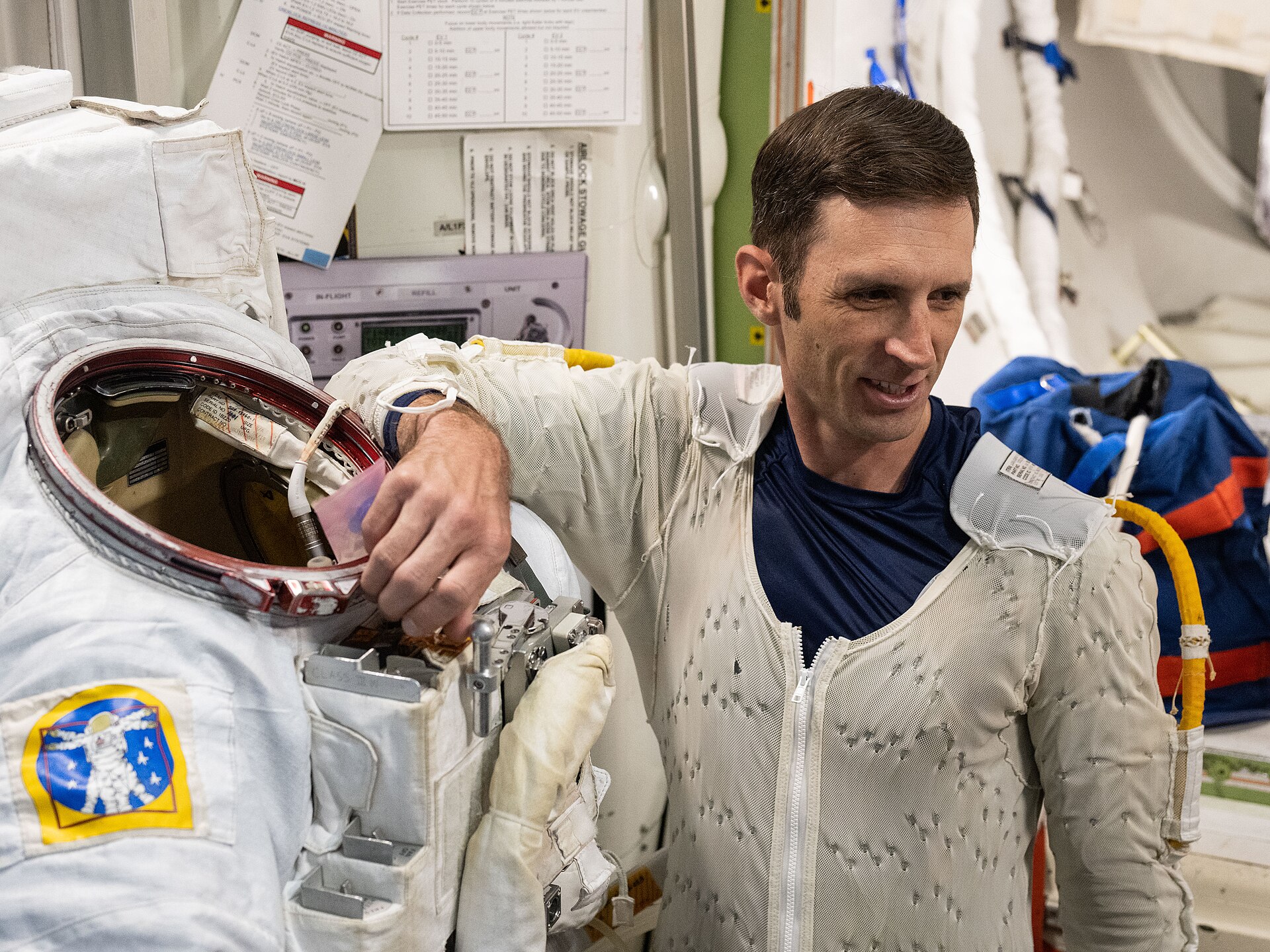
Sources: via NASA and SpaceQ; The Canadian Press via Narcity; Global News. Photo: Kutryk during spacesuit training at NASA’s Johnson Space Center (NASA/Josh Valcarcel, public domain, via Wikimedia Commons).