


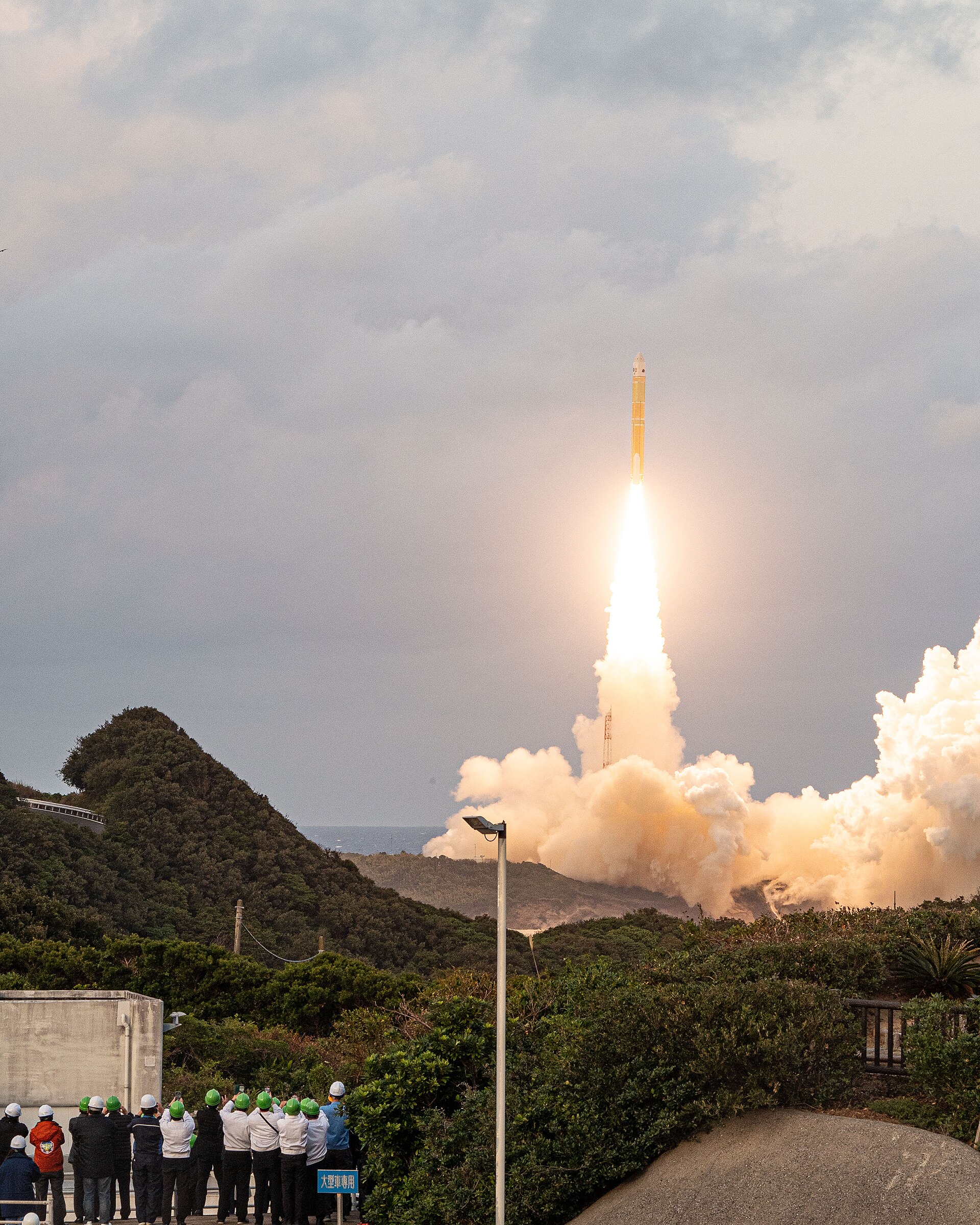
Japan launched a spacecraft on an H3 rocket from Tanegashima Space Center at 4:41 a.m. Oct. 20 Japan time (3:41 p.m. EDT Oct. 19) to collect samples from Phobos, a moon of Mars, and return them to Earth in 2031.
The mission, called Martian Moons eXploration, or MMX, is aimed at bringing back at least 10 grams of Phobos material. CBS News reported that it would be the first spacecraft to return to Earth from the Mars system.
The probe separated from the rocket’s upper stage one hour and 11 minutes after liftoff, following two firings of the upper-stage engine, CBS News reported. Interesting Engineering reported that the Japan Aerospace Exploration Agency (JAXA) confirmed the separation.
Outlets differ on the timetable after launch. CBS News reported the spacecraft will brake into orbit around Mars in September 2027, while Space Policy Online reported an August 2027 arrival. Space Policy Online said the probe will descend to Phobos no earlier than December 2028. CBS News reported a touchdown around 2030, once and possibly twice. JAXA’s mission page, which was last published before the launch, described only a planned launch in fiscal 2026.
The sample capsule is expected to land in Australia in 2031, according to CBS News and Space Policy Online. The European Space Agency’s mission factsheet also gives 2031 as the return year and says at least 10 grams will come back in the capsule.
JAXA leads the mission with NASA, the French space agency CNES, the German Aerospace Center (DLR) and the European Space Agency, the ESA factsheet said. CNES and DLR jointly developed a 25-kilogram, four-wheeled rover named Idefix that is to be deployed on Phobos, according to ESA and Space Policy Online. Space Policy Online said NASA supplied two instruments, MEGANE and the P-Sampler.
Thomas Statler, who helped oversee development of the two NASA instruments, said the launch is significant. “MMX will be the first spacecraft ever to return to Earth from the Mars system. That says a lot,” Statler said, as quoted by CBS News.
The science question is where Phobos came from. Statler said the samples should help show whether the moon’s material is more consistent with an asteroid composition, CBS News reported. Mars has two small moons, Phobos and Deimos, and scientists have long debated whether they are captured asteroids or debris from an ancient impact on Mars.
Sources disagreed on the mission’s cost and on the spacecraft’s launch mass, so those figures are not given here. Neither JAXA’s nor ESA’s pages name Canada as a partner, and none of the reports reviewed mentioned Canadian involvement.
The launch follows other recent flights of Japan’s flagship rocket. Canada News Media reported on the February 2025 H3 launch of a navigation satellite and on the June 2024 launch of an Earth observation satellite.
The next milestone is Mars orbit insertion in 2027, followed by the first Phobos landing attempt no earlier than late 2028, according to the reports above.
If you find reporting like this useful, consider supporting Canada News Media, an independent Canadian newsroom with no corporate parent.
Via CBS News, Space Policy Online and Interesting Engineering, with details from the European Space Agency’s MMX factsheet.
Follow Canada News Media
Get the day's top Canadian stories and our two daily 60-second news videos wherever you scroll.
X Threads Facebook Instagram LinkedIn TikTok YouTube Pinterest Reddit Substack Flipboard Newsletter RSS