


A winter car emergency kit is a box of supplies you keep in your trunk from roughly October to April, and Transport Canada says every vehicle should have one. At minimum it holds a first aid kit, a shovel, traction material, booster cables, windshield washer fluid, an ice scraper, a flashlight, warm layers and blankets, non-perishable food and water, and something to make you visible to other drivers.
September is the right month to build it, not December. Roadside supplies get picked over once the first storm warning goes out, and the point of a kit is that it is already in the car the day you need it. Most Canadians do not get stranded in a blizzard on a highway. They get stranded in a grocery store parking lot with a dead battery at minus 20, or in a snowbank at the end of a rural side road while waiting an hour and a half for a tow. The kit is what makes that wait uncomfortable instead of dangerous.
The other thing worth understanding before you start is that a car kit is not the same as a home emergency kit. Everything in it has to survive months of freezing and thawing in an unheated trunk, has to be reachable when the trunk lid is frozen shut or buried, and has to be useful to someone wearing gloves in the dark. That shapes what goes in it. Below is how to assemble one, using the item lists published by Transport Canada and the Canadian Automobile Association.
How to build a winter car emergency kit, step by step
1. Choose a container that actually fits your trunk
Use a soft-sided duffel bag or a plastic bin with a latching lid. A duffel is easier to wedge around a spare tire and stroller; a rigid bin protects fragile contents better. Whichever you choose, leave room to still close the trunk with groceries in it, because a kit that gets taken out for a weekend trip and left in the garage is not a kit. Label it clearly so anyone who borrows the car knows what it is.
2. Pack the traction and digging gear first
These are the bulkiest items and the ones most often used. CAA recommends a small shovel with a long handle, traction aids, and a bag of abrasive material such as sand or cat litter. CAA specifically advises avoiding road salt as your abrasive, because it can cause your vehicle to rust. Transport Canada lists kitty litter, traction mats and a shovel together as the “in case you get stuck in the snow” group. A folding shovel is fine and takes far less space than a full-size one.
3. Add the gear that makes you visible
Being seen matters as much as getting unstuck, especially if you are stopped on a shoulder in blowing snow. Transport Canada recommends a flashlight so you can see, plus road flares and a reflective vest so others can see you. CAA suggests reflective safety triangles or flares, and specifically recommends a crank-type flashlight, because batteries do not last long in extreme cold. If you buy only one light, buy the hand-crank one.
4. Pack for warmth before you pack anything else soft
If your engine is off, your car is a metal box that cools to the outside temperature. Transport Canada recommends extra clothing and a blanket, noting that a lightweight, heat-reflective blanket is best. CAA adds a warm blanket, extra socks, boots and gloves, plus hand and foot warmers. Pack a full set of layers sized for the largest adult who drives the car, and remember that the clothing you commute in is often not the clothing you would want to be stuck in for two hours.
5. Add water and food that survive freezing
Transport Canada recommends an emergency food pack with water and non-perishables such as canned fruit and granola bars, plus a can opener and utensils if you pack canned goods. CAA lists bottles of water and granola bars. Use plastic bottles rather than glass, since glass can break when the contents freeze, and rotate the food out once a season so you are not eating something from three winters ago.
6. Include the fluids and small tools that keep the car itself going
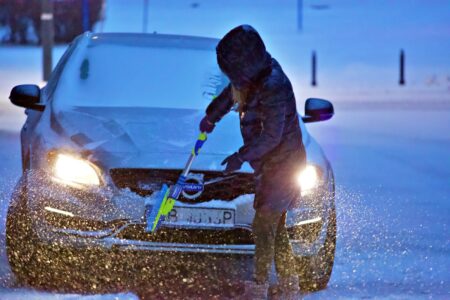
Transport Canada’s list includes windshield wiper fluid, an ice scraper and fuel line antifreeze, plus booster cables. CAA expands this with plenty of windshield washer fluid, a snow brush and scraper, gas-line antifreeze, lock de-icer, paper towels, a small tool kit with a screwdriver and pliers, and extra fuses for the vehicle’s electrical system. One important detail from CAA: in extreme cold, keep the lock de-icer with you rather than in the vehicle, since a de-icer locked inside a frozen car helps nobody.
7. Add a first aid kit and any personal medications
Both Transport Canada and CAA put a first aid kit at the top of the list. Buy a prepared one rather than assembling your own, then add anything specific to the people who ride in your car, such as spare inhalers, an epinephrine auto-injector, or a few days of a prescription for longer trips. Check the expiry dates on the contents when you check the food.
8. Plan for power and communication
Transport Canada notes that having a charged cell phone in the car for emergencies is a good idea, with the obvious caveat not to pick it up while driving. A cold battery drains fast, so add a car charging cable and, if you can, a small power bank kept in the glovebox rather than the trunk so it stays closer to cabin temperature. If you regularly drive rural routes with poor coverage, know before you leave where the dead zones are.
9. Keep a small second bag inside the cabin
A trunk can freeze shut or end up buried. Keep the flashlight, a pair of gloves, a hat, a blanket and some food in the cabin itself, under a seat or behind the driver’s seat, so you can reach them without opening a door into a snowbank. This is not on the official checklists, but it follows directly from the advice to stay with your vehicle.
10. Know what to do if you actually get stranded
The Canadian Red Cross advises staying with your vehicle for safety and warmth, and calling for help. Your car is far easier for searchers to spot than you are on foot, and it is shelter. The critical safety point is carbon monoxide: if snow is piled around the vehicle, clear the exhaust pipe before you run the engine, run it only occasionally rather than continuously, and crack a window slightly on the side away from the wind. Carbon monoxide is colourless and odourless, and people have been poisoned in snowed-in vehicles. If you carry the survival candle Transport Canada recommends for warming your hands without draining the battery or fuel tank, use it in a deep metal can and only with ventilation.
Build the kit once, put it in the trunk, and then set a reminder to open it twice a year, once in the fall and once in the spring. Replace the food and water, test the flashlight, check that the washer fluid is rated for winter temperatures, and top up anything you used. It takes about ten minutes and it is the difference between a kit and a bag of expired granola bars.
Sources
- Transport Canada, “Winter Driving Emergency Kit”
- Canadian Automobile Association, “Emergency Kit”
- Canadian Red Cross, “Safe Winter Driving”
- Public Safety Canada, Get Prepared, “Winter storms”
Follow Canada News Media
Get the day's top Canadian stories and our two daily 60-second news videos wherever you scroll.
X Threads Facebook Instagram LinkedIn TikTok YouTube Pinterest Reddit Substack Flipboard Newsletter RSS