


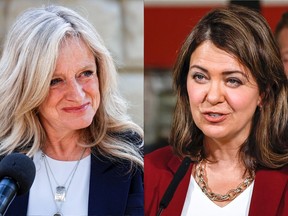
A year ago, it looked like Rachel Notley’s race to lose. Danielle Smith has caught up in high-drama, low-issue battle
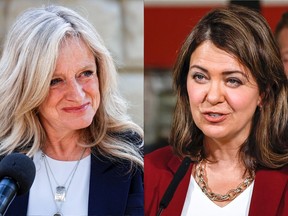
But this time, with the two parties neck-and-neck as voting day approaches, the election is not about jobs or pipelines or even party platforms.
It’s about Rachel Notley, leader of the NDP, and Danielle Smith, leader of the United Conservative Party.
Issues have surfaced, none of them campaign-defining. The NDP has hammered away on health care. They’ve promised a recruitment strategy for doctors and nurses, and repeatedly raised the spectre of private medicine, which is actually part of the UCP’s handbook. It’s an issue the NDP poll better on than the UCP.
And the UCP have talked extensively about the economy. Former prime minister Stephen Harper even put out a video early in the campaign warning about the economic damage he believes the NDP would do if they were re-elected. The UCP polls well on the economy.
Albertans seem to put Smith and Notley in a dead heat in terms of who they like more: 39 per cent have a positive view of Notley, 38 per cent have a positive view of Smith. The numbers are equally tight for those who dislike Notley (46 per cent) and Smith (47 per cent), per recent Abacus Data polling.
Six months, a year ago, it looked like Notley’s race to lose. The NDP had good polling numbers, and Notley was well-liked. The party out-fundraised their opponents and was flush with cash.
After Jason Kenney quit the UCP, a leadership campaign last summer saw the party’s right edge emerge victorious, with Smith taking the helm in a narrow victory. By the time the UCP held its convention last fall, the party was united to defeat Notley’s NDP.
The latest polling — the bulk of it from Mainstreet Research — shows the United Conservatives with a modest lead. On May 25, the pollster reported 46 per cent of Albertans planned to cast a ballot for the UCP, and 42 per cent for the NDP, with seven per cent still undecided, and the remainder scattered between small parties.
“The fact that the NDP are even close is already an indictment of the Danielle Smith era of the UCP,” said Boessenkool. “There’s no way that any party should be close to a united conservative tent.”
At least part of the reason has been the “bozo eruptions.” In a country where an impropriety or an inelegant comment has been enough to end a political career — and scuppered Smith’s last crack at becoming premier in 2012 — the UCP has largely kept its candidates while dealing with a steady drip of controversy.
“I think these things will affect turnout: they’ll hurt UCP turnout and they’ll boost NDP turnout,” said Boessenkool.
Jennifer Johnson, a nurse and farmer who lives near the central Alberta town of Bentley, was the UCP candidate for Lacombe-Ponoka, at least until audio of her comparing transgender children in the classroom to feces in cookie dough leaked out. She’s still technically on the ballot — it was too late to remove her — but Smith said she won’t sit in caucus.
“(They’re) focusing on the UCP’s record on the economy, and really sowing equal doubt in the minds of voters about ‘do you want to go back to to a Rachel Notley-led government,’” Myatt said.
For most of her career in media and politics, Smith has operated on something of the political fringe; the libertarian wing of Alberta politics. As recently as June 2021, Smith argued in a position paper that out-of-pocket payments would be necessary to sustain the health-care system, and in October 2021, suggested selling off several Alberta hospitals. Those positions have been repeated ad nauseam by her NDP opponents, and Smith has had to swear, repeatedly, she doesn’t stand by her previous comments.
Additionally, she promoted hydroxychloroquine, an anti-malarial drug, as a “100 per cent” effective treatment for COVID-19, and herself took Ivermectin — an anti-parasitic drug — when she came down with COVID-19, picking up the drug on the same day the College of Physicians and Surgeons of Alberta said it should never be prescribed to treat the viral infection.
Trussler compared Smith’s actions to those of Prime Minister Justin Trudeau during the SNC-Lavalin affair. “In the whole scheme of things, it is a threat to democracy to interfere with the administration of justice,” Trussler wrote.
Again, the report didn’t seem to move voters. At least part of the explanation, said Menzies, is that everyone knew the report was coming and anticipated it wouldn’t exonerate Smith. It was already baked in with voters, Menzies said.

The UCP mentions in its campaign advertising that Notley once said Alberta risked being Canada’s “embarrassing cousin” if it didn’t get its environmental record under control. And that Sarah Hoffman, former NDP deputy premier, once called Wildrose supporters “sewer rats.” Campaign literature in Edmonton details “anti-police” NDP candidates, too, but none of it seems to have broken into the popular discourse.
“I think voters kind of look past the noise now,” said Menzies.
On May 18, Rachel Notley and Danielle Smith faced off in a one-on-one leaders debate. It was just hours after Trussler had released her report. The UCP had crowed victory, as Trussler also said that she could find no evidence that Smith had contacted Crown prosecutors directly regarding COVID prosecutions, a central allegation the CBC had been reporting that the NDP had seized on.
“Ms. Notley, the NDP and the CBC lied for months saying I was calling Crown prosecutors and my staff were calling Crown prosecutors and it wasn’t true, and that is what the ethics commissioner found,” Smith responded.
For Smith, the debate was a strong showing. Perhaps her best day on the campaign.
“The NDP has had a full campaign of draws and the UCP has had a full campaign of losses, with one draw,” said Boessenkool.
Anecdotal evidence from those working the doors around the province for the NDP suggests voters do care about some of the scandals.
There have been some high-profile defections from conservative camps, who aren’t voting blue this time.
There’s no way that any party should be close to a united conservative tent
Doug Griffiths, who served as a cabinet minister under former Progressive Conservative premier Ed Stelmach, said he’d be giving his vote to the New Democrat in Fort Saskatchewan-Vegreville, a suburban and rural riding east of Edmonton.
“I don’t believe the UCP party is conservative anymore,” Griffiths said in a video. “They are conspiratorial, they are feeding anger. They are anti-science, anti-truth, anti-fact.”
“I’m a lifelong conservative both federally and provincially, and this is a big change for me to abandon my party, but I simply cannot any longer tolerate this,” Foster told the Calgary Herald.
“The vast majority of conservatives who are nervous about Danielle are ultimately going to wind up supporting her,” Myatt predicted.
The tight popular vote polling doesn’t break down cleanly in terms of seat count, which are weighted towards Calgary and small-town Alberta — conservative heartlands. There are 87 seats in the Alberta legislature, 20 of them in Edmonton, 26 in Calgary and 41 in the rest of the province.
On Monday, it may come down to who can get people out the door and to the polling stations.
“The only thing left to do is to motivate and mobilize your supporters to get to the polls,” said Leah Ward, Notley’s former communications director, now with Wellington Advocacy. “There’s very little persuading left to do.”
• Email: [email protected] | Twitter: