

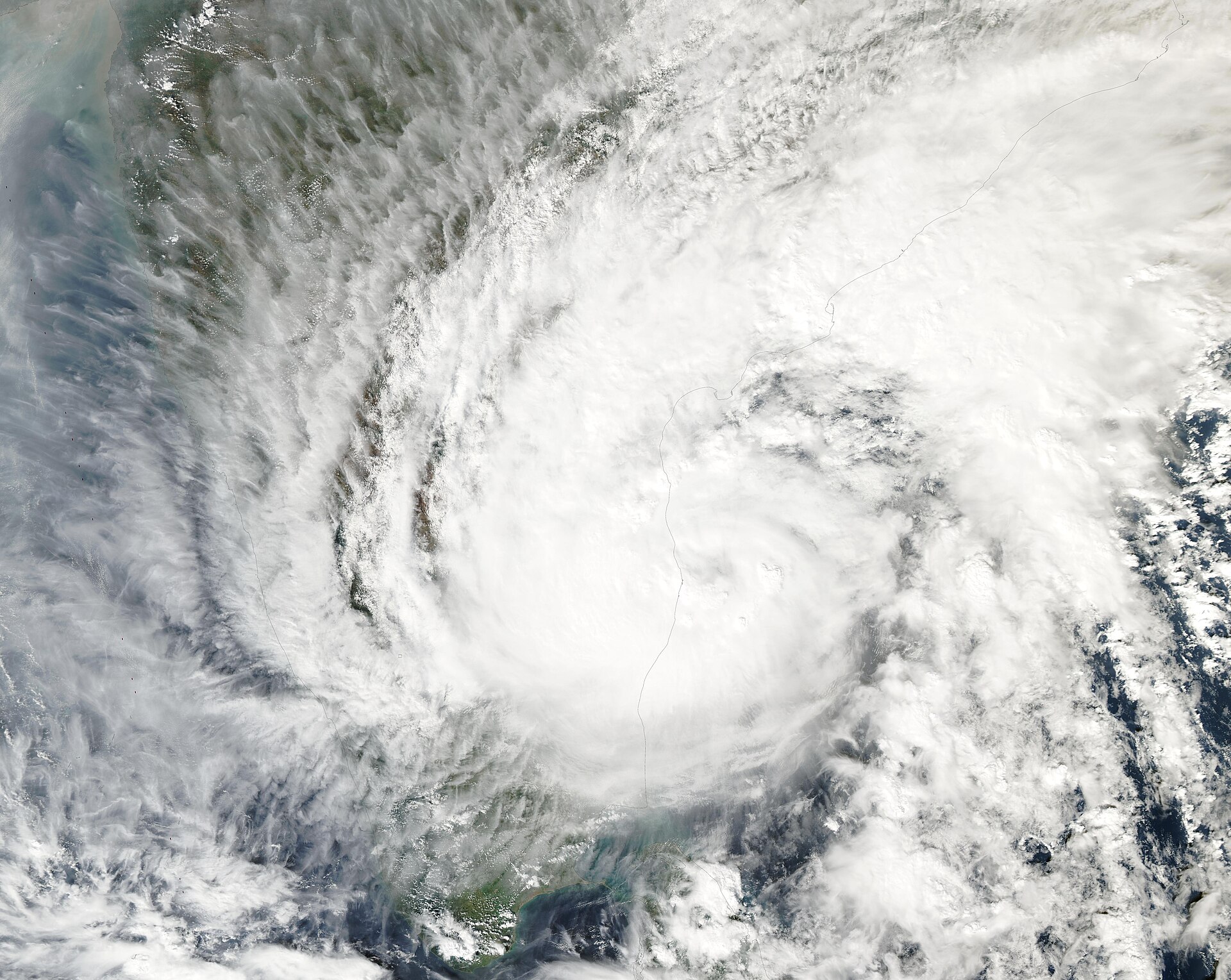
Cyclone Arnab crossed India’s southeast coast in Andhra Pradesh early Wednesday, Oct. 28, with winds of up to 135 kilometres per hour, bringing storm surge, flooding and tens of thousands of evacuations, authorities and news agencies reported.
The India Meteorological Department (IMD) said the system struck as a very severe cyclonic storm, the third-highest category on its scale, before weakening to a severe cyclonic storm over land. Al Jazeera, citing AFP and Reuters, reported that at least 180,000 people were moved out of Andhra Pradesh and Odisha a day earlier, and that more than 12 million people live in the storm’s expected path.
Indian outlets gave lower figures for Andhra Pradesh alone. Down To Earth reported that the state disaster management authority counted about 58,000 people in roughly 1,000 relief camps across 764 villages by Wednesday afternoon. Open, citing the Press Trust of India and a senior National Disaster Response Force (NDRF) officer, put the number at 57,000. The Quint, citing the Indian Express, reported more than 84,000 in shelters.
The death toll was not settled. Open reported that NDRF Inspector General Narendra Singh Bundela said three people had died and 31 houses were damaged. Al Jazeera reported no casualties, and Down To Earth said there had been no major loss of life, noting an unconfirmed report that a 65-year-old man died in Visakhapatnam after touching snapped live wires.
Andhra Pradesh Chief Minister N. Chandrababu Naidu said in a letter to Union Home Minister Amit Shah that no loss of life had been reported, according to Down To Earth. Naidu’s preliminary assessment, which officials were still verifying, put damaged houses at about 180 and fallen trees on state roads at more than 220.
The same assessment estimated about 70,900 hectares of crops, mainly paddy, were inundated or damaged, along with about 10,450 hectares of horticulture. The state recalled about 30,000 fishing boats and banned fishing until Thursday.
Landfall was slow. Sagili Karunasagar, an IMD scientist at the Amaravati centre, told Down To Earth the system “remained practically stationary for four hours,” so landfall expected between 2 a.m. and 4 a.m. was not complete until about 8 a.m. He said the storm would likely weaken into a deep depression by Wednesday evening and could move toward Chhattisgarh, Telangana or Jharkhand.
Reports differ on the storm’s strength. Down To Earth, citing the IMD, gave sustained winds of 110 to 120 km/h gusting to 135. Open and The Quint reported sustained winds of 125 to 135 km/h with gusts to 150. The IMD forecast a storm surge of up to 1.5 metres above the tide level, which it said was likely to flood low-lying areas.
Trees fell across highways, power was cut in parts of the coastal districts, and schools in affected districts were closed. Down To Earth reported that flights were suspended at the Visakhapatnam, Vijayawada and Rajahmundry airports since Tuesday and that railways cancelled 64 services. Kakinada, Konaseema and West Godavari were among the worst-hit districts, The Quint reported.
The IMD expects heavy rain to continue in 18 coastal and neighbouring districts of Andhra Pradesh through Thursday, Oct. 29, and has warned of heavy to very heavy rain in parts of Odisha. In the Himalayas, Reuters reported that Nepal suspended trekking permits for three days over fears of downpours, snowstorms and avalanches, and Sri Lanka closed schools over flash flood and landslide warnings, according to Al Jazeera.
For Canadians, the storm matters mainly to people with family or travel plans in coastal Andhra Pradesh, Odisha and neighbouring states. Travellers can check Global Affairs Canada’s advice for India at travel.gc.ca, and airlines have cancelled some flights at the region’s airports.
It is the latest in a run of severe weather and disaster stories across the region this month, after the earthquake in Tibet and the long haze in Singapore. India’s economy, meanwhile, was in the news this week when IMF data showed Bangladesh edging India on per capita GDP.
This is a developing story and figures may change as officials complete damage surveys.
If you find reporting like this useful, consider supporting Canada News Media, an independent Canadian newsroom with no corporate parent.
Via Al Jazeera, Down To Earth, Open The Magazine and The Quint.
Follow Canada News Media
Get the day's top Canadian stories and our two daily 60-second news videos wherever you scroll.
X Threads Facebook Instagram LinkedIn TikTok YouTube Pinterest Reddit Substack Flipboard Newsletter RSS