
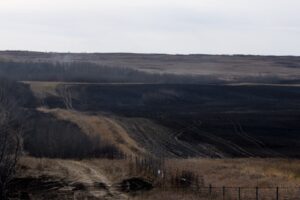

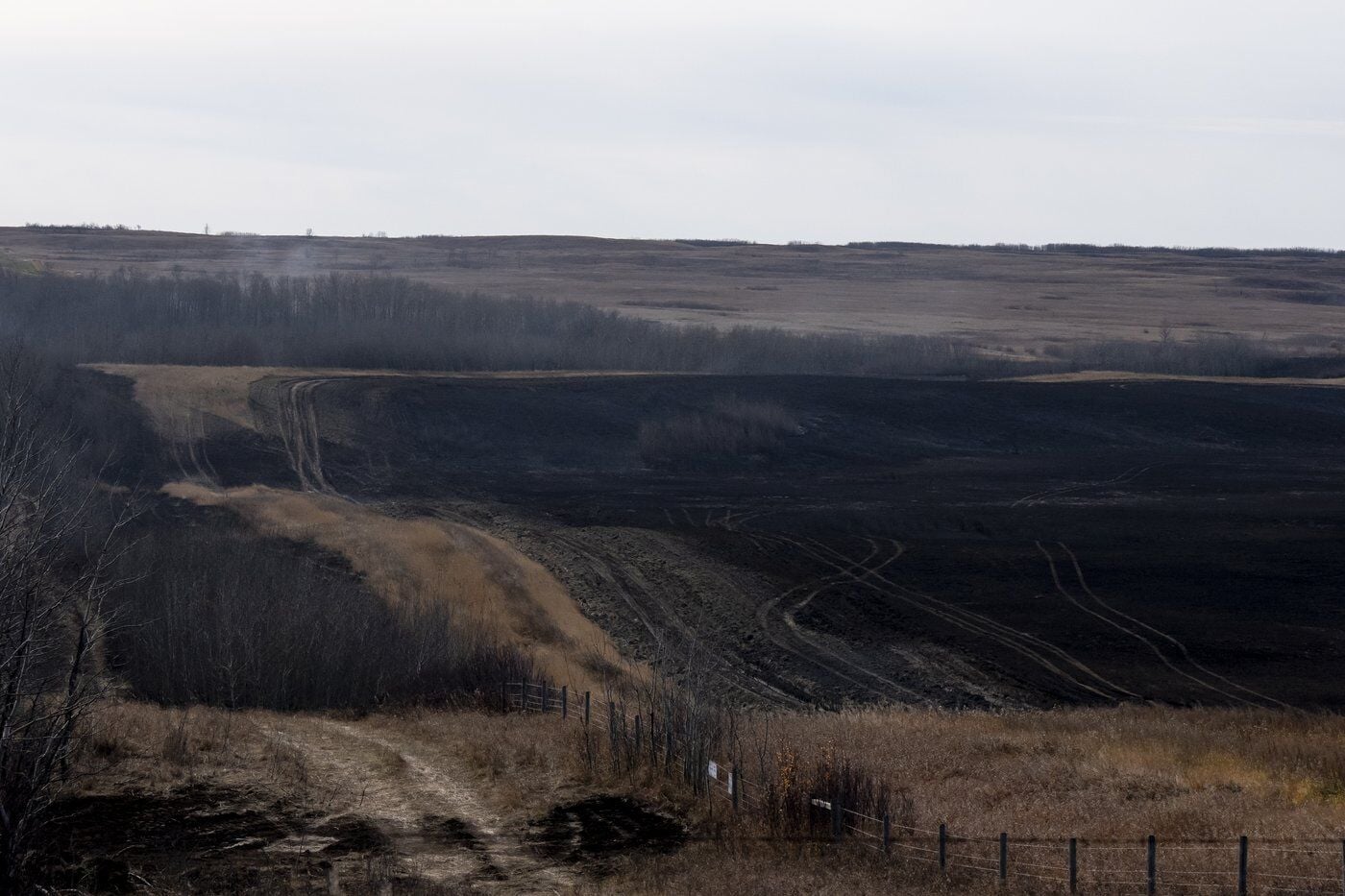
A Global News analysis of satellite images and weather records suggests the deadly fire at CFB Wainwright in Alberta was burning for hours before it overran soldiers on Oct. 17, challenging the military’s description of a sudden event.
The Canadian Armed Forces has described a common grass fire that erupted in “uncommonly strong winds,” with flames devouring a kilometre in 30 to 60 seconds. Maj.-Gen. Wade Rutland has called the event “entirely anomalous.” Four soldiers were killed and 39 were injured, 19 of them critically.
Global News, which had seven wildfire experts review its findings, reported Saturday that a Landsat 8 image captured at 12:17 p.m. MDT already showed active fire roughly two kilometres long. Jen Beverly, an associate professor of wildland fire at the University of Alberta, estimated from NASA hotspot data that about 48 hectares had burned by then. “A one hectare fire is getting to be problematic, so imagine 50 of those,” she told Global News.
The military’s timeline has shifted since the fire. Officials first put ignition at around 4 p.m. Rutland later said it started “several hours earlier” and that officials believed it was contained. The military has not said precisely when it began. It has said the blaze was inside a restricted area used for live ammunition, which limited firefighters’ ability to attack it directly.
Environment Canada had forecast strong winds a day ahead, with a shift from southwest to west expected that afternoon. A yellow wind warning with gusts up to 100 km/h was extended to Wainwright at 2:14 p.m., about two hours before the military says soldiers were overrun. Environment Canada records show sustained winds at the base airfield doubled from 15 to 30 km/h between 1 p.m. and 2 p.m. At 2:49 p.m., a NOAA-20 satellite pass detected heat beyond the earlier fire locations, and Beverly estimated the fire had nearly tripled to about 140 hectares.
Mike Flannigan, a wildfire researcher at Thompson Rivers University, said the fire was already running by 2 p.m. He described the day as “a classic setup” and said, “You don’t want to be out in the field on a day like Saturday.”
A GOES-18 satellite recorded about 76 megawatts of fire radiative power at 3:10 p.m. By roughly 3:30 p.m. the reading had risen almost sixteenfold to 1,215 megawatts, as a cold front reached the training grounds. Environment Canada recorded an 82 km/h gust at the airfield at 3:16 p.m. Flannigan said that was about 30 minutes before the military says the fire reached the soldiers. Beverly called it a well-known pattern in which a cold front passing over an established blaze turns a long flank into a fast-moving front.
Experts also questioned the reported speed. Marty Alexander, a fire behaviour researcher, said a grass fire spreading faster than 60 km/h is “very highly improbable.” Cordy Tymstra said the fastest documented Canadian grass fire he knew of, near Granum, Alta., in 1997, averaged 14.7 to 16.8 km/h. Three experts said wind-blown embers could have driven rapid spread. Rutland acknowledged the fire may have advanced unseen through terrain, and said the investigation would seek to establish that.
Global News reported that no Environment Canada meteorologist was stationed at Wainwright that day. The base received remote forecasting support from CFB Gagetown in New Brunswick. Rutland declined to say whether the base had a meteorologist or wildfire-behaviour expert, citing the investigation. Base standing orders list August through October as a high-risk fire period and advise scheduling live-fire training for early morning, though Rutland called them a “guideline.” The military also declined to say whether procedures for halting training and reporting changes in fire behaviour were followed.
The Department of National Defence told Global News it has made no changes to safety measures since the fire and expects to convene a Board of Inquiry “in the near future.” The military has said the inquiry could take more than a year.
“Where they find our procedures, our training, our equipment, or our policies must change, they will change,” Rutland said.
Earlier coverage: Wainwright fire started on grenade range, military says; Fire’s speed main factor in Wainwright deaths: Carignan; Military names four soldiers killed in CFB Wainwright fire.
If you find reporting like this useful, consider supporting Canada News Media, an independent Canadian newsroom with no corporate parent.
Via Global News: New evidence challenges military’s account of deadly Wainwright fire, by Ashleigh Stewart.
Follow Canada News Media
Get the day's top Canadian stories and our two daily 60-second news videos wherever you scroll.
X Threads Facebook Instagram LinkedIn TikTok YouTube Pinterest Reddit Substack Flipboard Newsletter RSS